At the end of His public ministry, on the day following the Feast of Tabernacles, the Lord Jesus Christ said as He conversed with the Jews: When ye have lifted up the Son of man, then shall ye know that I am he (Jn. 8:28). Those unbelieving Jews would then come to understand the divine power and authority of the God-man Jesus; they would see that He is truly an extraordinary Messenger from heaven, the true Son of God (John 8:16, 18, 23, 25), when, through their hardened malice and unbelief, the Son of man would be nailed to the shameful Cross as though He were the worst of criminals.
And indeed, the wondrous hand of God—besides the extraordinary darkness over all the land from the sixth to the ninth hour (Matt. 27:45; Mark 15:33), from the time of the crucifixion until the very death of Jesus Christ—through a series of miraculous signs at His death on Golgotha, revealed the greatness and power of Him who was crucified, and at the same time the greatness and power of those blessings granted to mankind through His death on the Cross.
When Jesus Christ, the Prince of life (Acts 3:15), gave up His spirit on the Cross, the following astonishing signs took place, as the Evangelist Matthew recounts (Matt. 27:51–53):
First of all, the inner veil of the Temple in Jerusalem, which separated the Holy Place from the Holy of Holies (Exod. 26:31–33)—the dwelling place of God on earth, into which only the high priest could enter once a year, on the Day of Atonement, to sprinkle it with sacrificial blood (Lev. 16:11–17)—was torn in two from top to bottom. By the rending of this veil it was mystically revealed that through the death of the Son of God—who with his own blood… entered in once into the holy place… now to appear in the presence of God for us (Heb. 9:12–24)—heaven was once again opened to mankind, and access to God, formerly closed by sin, was restored (Heb. 7:19).
Then, at the moment of Christ’s death, the earth shook so violently that the rocks were split. This fearful phenomenon had such a powerful effect even upon the hardened hearts of the Roman centurion and the soldiers guarding the Crucified One that they involuntarily cried out: Truly this was the Son of God (Matt. 27:54). This extraordinary earthquake was a sign that, after the death of Jesus Christ, a great upheaval would take place in humanity (cf. Hag. 2:6–7)—a profound moral transformation and renewal of mankind through the spread and establishment of the Gospel.
Furthermore, as a result of this violent shaking within the rocky mountains—particularly those in which tombs had been hewn (cf. Isa. 22:16)—the burial caves were opened by fissures in their walls and vaults, and the heavy stones that sealed their entrances were dislodged. The opening of the tombs initiated an even more astonishing miracle: Many bodies of the saints which slept arose, and came out of the graves after his resurrection, and went into the holy city, and appeared unto many (Matt. 27:52–53).
Thus, at the very moment of His death, the glory of the God-man is revealed! Among these signs, the extraordinary event of the resurrection and subsequent appearance of many saints—mentioned so briefly by the Evangelist—appears as a truly mysterious phenomenon and naturally raises many perplexing questions in the inquiring mind, the resolution of which cannot but interest every Christian.
First of all: in what way is the resurrection of many bodies of departed saints connected with the death and resurrection of Jesus Christ?
As is evident from the Gospel narrative, the resurrection of a multitude of saints took place at the very moment when Jesus Christ committed His spirit on the Cross to God the Father; therefore, this wondrous event has a direct and inner connection with the death of the All-holy God-man. According to the apt comparison by Archbishop Innocent of Kherson, “The death of the Lord appears as it were a great thunderclap that resounded throughout the whole world, shook the entire earth, shattered the strongholds of hell, and awakened the bodies of the saints that rested in the heart of the earth.” And thus, by the almighty breath of the Life-giving Spirit, these dead were loosed from the bonds of death.
This miraculous sign, therefore, served as an expression of the power and majesty of the death of Jesus Christ. It showed that by His death, the God-man Jesus trampled down death, deprived “him that had the power of death, that is, the devil” (Heb. 2:14) of power, that “He who was nailed to the Cross is Lord of things on earth and in the underworld” (St. Isidore of Pelusium), and that the power of His redeeming death extends even to the realm beyond the grave, where He delivered those who were held under the dominion of the devil. However, the fullness of renewed life was granted to the bodies of many departed saints not before, but after the Resurrection of Jesus Christ; and He Himself appeared as the first among the risen, or, in the words of the Apostle, the firstborn from the dead, that in all things he might have the preeminence (Col. 1:18). Those saints who had been awakened from the sleep of death by the death of the Crucified One “received so much life-giving power from the risen Lord that they not only came forth in soul from Hades, but also drew out their very bodies from the tombs.”
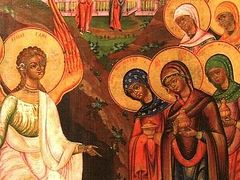
 James Tissot. The Dead Appear in Jerusalem. Photo: wikimedia.org According to the Evangelist Matthew, having risen from their graves after the glorious Resurrection of Christ, many departed saints went into the holy city, and appeared unto many. But who were these saints who rose together with the Lord Jesus, and to whom did they appear? The Evangelist, whose principal aim was to show the great power and significance of the death and Resurrection of Christ, does not name them, and their names are unknown in Church Tradition. It would seem most natural that those who had long awaited the coming of the promised Messiah should be the first to rise with Christ—such as the patriarch Abraham and King David, His kin according to the flesh, or the holy prophets who most clearly foretold His Resurrection, such as David, Isaiah, Hosea, Ezekiel, and Daniel.
Yet the saints who rose with Jesus Christ were appointed to appear to many inhabitants of Jerusalem, who would most readily recognize them. In view of this, it is more probable that not all the righteous who had awaited salvation in the Messiah were raised, but only those who could be recognized in Jerusalem —either as well known in life or as having died not long before. Therefore, it is more likely that among the many risen saints were the recently departed Simeon the God-receiver, and according to tradition, his two sons; Anna the prophetess; the priest Zechariah and his wife Elizabeth; Joseph, the betrothed of the Lord; John the Baptist; and other righteous persons of their time.
Those many saints who rose at the death of Jesus Christ remained hidden until His Resurrection; but afterward they appeared to many in Jerusalem, so that, as St. John Chrysostom remarks, “this reality might not be taken for a mere imagination.” The appearances of the saints who rose with the Lord Jesus were for His followers the strongest testimony to His Resurrection and divine dignity. When one who had risen might say, “I have risen by the power of Jesus who was crucified and is risen; believe in Him as surely as you see me,” then all doubts vanish and all objections fall away of themselves.
If it be supposed that these risen saints, by their appearances in Jerusalem, were in some sense to take the place of the appearances of the risen Savior, then it must be concluded that they did not appear to the apostles, who were vouchsafed to see the Lord Jesus Himself several times after His Resurrection. For other believers—among whom the Risen One Himself appeared, at one time to more than five hundred brethren (1 Cor. 15:6)—the appearance of the risen saints could serve not only as a further confirmation of the truth and power of the Resurrection of the crucified Jesus Christ, but also as a kind of testimony of gratitude to Him who raised them, for His glorification.
Moreover, the appearance of the risen saints to those who had witnessed the sufferings and death of the God-man, besides exposing the unbelief of the Sadducees, who said “that there is no resurrection” (Acts 23:8), was meant to bring comfort and encouragement to the little flock of believers (Luke 12:32), who remained in a world hostile to the Gospel (John 15:19–20; 16:20). And for those who did not believe in the Lord Jesus—who had not recognized the time of their visitation (Luke 19:44) and had rejected the God-sent Messiah—the appearance of the saints who rose with Him was to serve as a special mercy from beyond the grave, and as the most convincing preaching of repentance, to awaken in their souls a disposition toward faith in the glorified Messiah, Jesus.
What was the fate of the saints who rose together with the Lord?
Examples of the resurrection of individual dead persons occurred occasionally in the Old Testament (the raising by the prophet Elijah of the widow of Zarephath’s son; by the prophet Elisha of the Shunammite woman’s son; and the revival of a dead man upon touching the bones of the prophet Elisha), as well as during the earthly life of the Savior (the raising of Jairus’ daughter, the son of the widow of Nain, and Lazarus). But these were cases of a temporary return to life. Those raised by the prophets and by Christ Himself died again after some time, since they were restored to their former, ordinary bodies, suited to the present conditions of earthly existence.
By contrast, according to the ancient patristic understanding, the righteous who rose together with the Lord Jesus were raised in a transfigured, renewed body, free from every kind of heaviness and infirmity—in incorrupt bodies, akin to what all the saints will possess after the general resurrection. Such a body is not suited to remain on earth or to undergo death again, with corruption in the grave; its proper dwelling is in another world—the heavenly realm.
Therefore, the ancient Fathers of the Church held that the saints who rose with Christ, after serving Him by appearing to many inhabitants of Jerusalem, did not die again. Rather, at the Ascension of the Risen Lord, they accompanied Him—unseen by the apostles—in the company of the angels of God; and, having been taken up with Him into heaven, they dwell in blessedness in the mansions of the Heavenly Father.
The resurrection of this company of saints serves as a sure and consoling pledge of the universal future resurrection of those who have died in Christ—or, more precisely, of the glorification of the righteous. People continue to die even after Jesus Christ, Who has overthrown the kingdom of death by His death. Observing how, once the soul has departed, the body is given over to corruption and returns to dust, those who rely only on human reasoning are often inclined to doubt the possibility of resurrection, or of being clothed again with flesh for life, as proclaimed by Divine Revelation.
But by beholding the glory of our Head, the Lord Jesus Christ, in His Resurrection, believers already possess a firm hope of their own resurrection. According to the teaching of Gregory the Great, lest anyone should even slightly doubt in his thoughts or suppose that Christ rose only because He was both God and man (as God, He conquered death, which He assumed as man), while we, being ordinary men, cannot be freed from the condemnation of death—for this reason, at the time of His Resurrection, He raised the bodies of many saints. Thus, in His own Resurrection He showed the pattern, and by the resurrection of others like us He confirmed the hope of our own resurrection. Therefore, if anyone does not hope to receive what the God-man revealed in Himself, he should at least be convinced that the same will assuredly happen to him as occurred with others who were, without a doubt, human just like us.
From this it follows that the company of the many risen saints instructs us by their resurrection: First, that the one Source of life for mortals subject to corruption is our Lord Jesus Christ; and second, that if the faithful are true members of our Redeemer, they may expect for themselves what was accomplished in the Head (1 Thess. 4:14), what He revealed in His flesh by His Resurrection; and they have grounds to expect the same that was accomplished in others who were members before us.
We firmly believe that one day the Lord Himself, with the voice of the archangel, and with the trump of God (1 Thess. 4:16), will call all people forth from their graves, so that on the day of the dread Judgment of God every one may receive the things done in his body, according to that he hath done, whether it be good or bad (2 Cor. 5:10).
Having conquered death, Jesus Christ by His power raised many bodies of the departed saints. He will also raise all the faithful: For as in Adam all die, even so in Christ shall all be made alive (1 Cor. 15:22). And those who have kept His commandments, united with Him in spirit and body in the mystery of the Holy Eucharist, shall one day enter into the Heavenly Jerusalem and be made worthy of blessed life eternal.
From: I.V. Bazhenov. The Mystery of the Resurrection of Many Saints at the Moment of Christ’s Death (Matt. 27:52–53) // Kostroma Diocesan Gazette (Supplement to the Unofficial Section). 1910. No. 7. pp. 203–207.