Many parishioners of the canonical Ukrainian Orthodox Church have today gone into a kind of “inner exile.” On the one hand, we are citizens of Ukraine and are expected to obey its laws. On the other hand, we have no desire to take part in fratricidal bloodshed or to die for the alien ideas of leaders totally dependent on outside forces, and of fierce nationalists who are uprooting our faith and culture. That is why many Orthodox men have set aside a place in their homes for prayer, where we withdraw in solitude and ask the Lord to bring wisdom to our country’s leaders, to move them toward compromise, and to bring the war to an end.
The hypocritical authorities have raised up man-hunting “oprichniki”1
We all continue to live in fear, and our resistance often amounts to running as fast as we can from the officers of the TTsK (Territorial Recruitment Centers, formerly military enlistment offices). They have become modern-day “oprichniki,” “man-hunters,” “attack dogs,” ready to send their neighbors to death for the sake of their own survival. Many of them are reportedly given a choice: Hunt down draft dodgers in the populace, or go to the real war at the front, where your chances of survival are very slim.
I know there are men who still value their honor. For them, death at the front is preferable to disgrace in the rear. But many choose the TTsK because they want to live. One can understand that choice, though it is hard to accept. All the more so because some of their actions are truly brutal. TTsK officers are already being compared to the auxiliary police who served the Nazis in occupied territories2 during World War II.
Freedom of religion in Ukraine is now little more than a line in the Constitution, which the authorities have long disregarded
Freedom of religion is now little more than a line in the Constitution—one the authorities have long since ceased to notice. What is striking is that among members of the Verkhovna Rada [Parliament], government officials, and people in the Presidential Office, there are quite a few who still attend churches of the Ukrainian Orthodox Church, have their children baptized in it, and whose relatives still go to services. Some of those in power even maintain good relations with canonical priests. But in public they are nationalists and supporters of the non-canonical Orthodox Church of Ukraine, backing repressive laws against the canonical Church. I would remind you that even our non-Christian president’s children were baptized in a church under the canonical UOC.
Hypocrisy is everywhere. In private conversations—and even at work—state officials and deputies speak Russian, yet ordinary people are forbidden to do so. A poor schoolteacher from Odessa3 was hounded simply because she wrote in Russian in a parents’ chat group. What have we come to?
Aggression is flooding all shores. Ukrainians are completely forgetting the root causes of the misfortunes that have befallen them. Many want to live in Europe, yet still want a well-connected “godfather” to solve their problems. Bribery and corruption are rampant. What kind of European Union is that? Europe needs us only for the sake of inflicting a “strategic defeat” on Russia or “weakening” it, as many Western politicians openly desire. For them, Ukrainians are expendable material, which they are willing to pay for.
“Busification”: How Priests of the Ukrainian Orthodox Church Are Being Taken to the Trenches
 Archpriest Alexander Itsenko The mass mobilization of clergy from the Ukrainian Orthodox Church is taking place on a broad scale. In society, the word “busification” has taken root (from the word “bus”—the military minibus used by the TTsK). Not only are draft evaders being seized, but also priests of the UOC. Meanwhile, their “colleagues” from the Orthodox Church of Ukraine (the new religious body created by the Ecumenical Patriarchate of Constantinople) have not been touched by this “busification.”
Hundreds of UOC priests are faced daily with a choice between two paths. The first is mobilization. The TTsK captures you—often with serious abuses—and sends you to the front as an ordinary soldier. The canons of the Orthodox Church forbid a priest to take up weapons and shed blood. But the law completely disregards these rules. The second path is to transfer to the OCU, obtain the “necessary stamp” in one’s documents, and instantly gain exemption from mobilization.
The second path is to transfer to the OCU, obtain the “necessary stamp” in one’s documents, and instantly gain exemption from mobilization.
“If a clergyman of the UOC transfers to another confession favored by the authorities, he immediately receives a deferment from mobilization. Otherwise, he is sent to war as an ordinary soldier.” These words of Metropolitan Theodosius, spoken at a session of the United Nations Human Rights Council, have spread around the world.
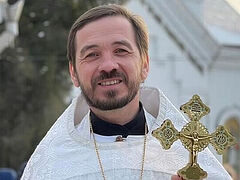
In in Kiev, on January 2026, Archpriest Alexander Itsenko was on his way to the All-Night Vigil. He had with him all the documents confirming his priestly rank. TTsK officers approached him, demanded that he “update his records,” and forced him into a bus.
In Lutsk, Archimandrite Nikolai was seized at the gates of a monastery.
The most widely discussed case is that of Archpriest John Chirik in Volyn Province. He was abducted right outside the entrance to the rented apartment where his family was living. A few days later, he appeared in photographs wearing a military uniform.
Why is this happening? Priests of the Ukrainian Orthodox Church, unlike military chaplains of other confessions, are in practice largely denied the right to exemption from mobilization. The state does not recognize a status for them that would allow them to remain outside the army. They are being sent to the front lines.
Mobilized UOC priests continue, whenever possible, to carry out pastoral duties in the military. “They hear confessions, baptize people—though without chrismation,” reports Fr. Sergiy Kholodkov. They do this in secret.
The leadership of the UOC describes the state’s repressive policy as nothing less than a “deliberate desecration of holy orders.” Metropolitan Anthony (Pakanich) speaks plainly:
“It is a blatant sacrilege to send to the front a priest who, by Church law, is forbidden to shed blood.”
“We have been declared enemies.” Politics at the doors of the church
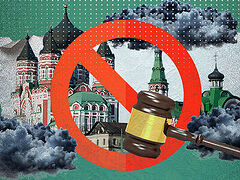
The state’s attitude toward the UOC today is tough and systematic. In August 2024, the Verkhovna Rada passed Law No. 8371, effectively banning the activities of organizations affiliated with the Russian Orthodox Church. The authorities act under the logic of “national security,” and on paper it is supposedly a purge of the “Russian world,” but in reality it has resulted in a wave of property seizures and forced transfer of clergy’s ecclesiastical subordination.
According to the State Service for Ethnopolitics, nearly 1,400 communities have left the canonical UOC over three years, yet around 10,000 religious organizations remain. Pressure on them is increasing. The Kiev Province Council has recommended that local administrations “assist” communities in changing their confessional affiliation. In essence, this is a soft form of state coercion.
“We, as believing Orthodox Christians, are constantly forced to defend ourselves from attacks on our church,” says an appeal from one parish community to the international community. “The Ukrainian Orthodox Church today is being subjected to oppression, mockery, barbarism, and persecution.”
These words sound like a cry for help—one many prefer not to hear.
“Taken by force.” A chronicle of church seizures
 In the village of Kuzmin, unknown individuals broke the locks of the Church of the Nativity of the Most Holy Theotokos. While the world watches the front lines, a quieter drama is unfolding in Ukraine. On one side stands a law said to defend the constitutional order by requiring the severing of ties with Moscow. On the other stand millions of believers, for whom their church is home, and their priest is not a politician but a spiritual father. In recent times, the pattern of church seizures has become cynically simple.
In the village of Kuzmin, Ukrainian Orthodox Church sources say unknown individuals broke the locks of the Church of the Nativity of the Most Holy Theotokos and pushed out the people who had prayed there their entire lives. According to Archpriest Nikita Chekman, it was a classic raid. First, a “meeting of the territorial community” was held without the presence of any real parishioners. Then the registration documents were changed. After that, unknown persons broke the locks.
“There is not a single court decision authorizing the seizure of the church or the eviction of the community,” the priest emphasized.
In Chernivtsi Oblast, events unfolded even more dramatically. In the village of Komariv, parishioners of the UOC were promised: “Hand over the keys to the large church, and you may continue praying in the old one.” They agreed, wishing to avoid conflict. But the next morning they were met by buses full of special police forces and ten police vehicles. They were also forbidden to enter the old church. Now the faithful are forced to travel to a neighboring village for services.
“We do not renounce our faith.” The pain and hope of the faithful
Behind the dry statistics of transfers and church seizures stand living people. Among them are elderly women driven out of the church where they were baptized and married, and sincerely believing men who refuse to take up a rifle because their weapon is the Cross and prayer.
Parishioners left without churches gather for secret services in private homes and apartments.
Parishioners left without churches gather for secret services in private homes and apartments. They are afraid to speak openly, because any word may be interpreted as “pro-Russian propaganda.” Members of the Ukrainian Orthodox Church live in fear, yet with deep faith in their souls. God has sent them trials, and many are enduring them with honor and dignity.
Officials within the Orthodox Church of Ukraine acknowledge a “personnel shortage”—priests are forced to serve as many as five parishes over a single weekend. But that brings no comfort to those whose churches have been taken away. They feel betrayed.
A deep, bleeding wound has appeared in the body of Ukrainian society, where parishioners of one Church are turned into “enemies” simply because they do not wish to renounce their faith. One mobilized priest, who wished to remain anonymous, wrote in a private message:
“I do not want to kill anyone. I want to pray for those who kill and for those who die. But they have placed me before a choice: You will either shoot, or be imprisoned.”
This whisper from the trench is more horrifying than any public declaration.