Photo: wikimedia.org In the name of the Father, the Son, and the Holy Spirit!
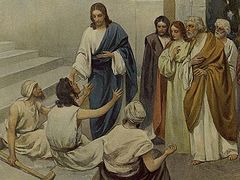
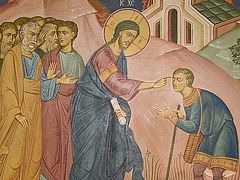
Today the Holy Orthodox Church recalls, through the appointed reading from the Holy Gospel, the greatest of miracles—the healing of the man born blind performed by our Lord Jesus Christ. Since nearly everyone knew this man had been blind from birth, news of his receiving sight quickly spread through the testimony of the witnesses to the miracle, and the people, astonished by this unprecedented healing, were stirred with amazement and excitement.
The Pharisees, alarmed by this commotion, hastened to assemble in order to investigate the event and discuss what action they should take. At first, after questioning the man who had been healed, the Pharisees themselves became confused, and disputes and divisions arose among them. But then, seeing no way out of their difficulty, they decided to accuse the healed man—who testified that he had been born blind—of deception.
Against Christ they had only one accusation: that He had healed the suffering man on the Sabbath. Yet they themselves keenly felt how inadequate such a charge was in the face of the overwhelming greatness of the miracle that had occurred. Their only remaining hope was that the parents of the man who had received sight would be afraid to confirm their son’s testimony, fearing excommunication from the synagogue. But when the parents were summoned for questioning, although they avoided speaking about how the healing had taken place, they nevertheless testified that the man who had received sight was indeed their son and that he had been born blind.
Then the Pharisees again entered into dispute with the healed man, and, unable to find any evidence to refute the miracle, finally resorted to their usual deceitfulness. They demanded that he give glory for the healing to God alone and not glorify Jesus Christ, whom they claimed to know as a great sinner. This hypocritical and unjust judgment deeply outraged the joyful man who had been healed, and he began to expose the inconsistency of the teachers and interpreters of the Law sitting before him. Whether he be a sinner or no, I know not: one thing I know, that, whereas I was blind, now I see (John 9:25). And when they declared to him: We know that God spake unto Moses: as for this fellow, we know not from whence he is (John 9:29), the man answered: Why herein is a marvellous thing, that ye know not from whence he is, and yet he hath opened mine eyes. Now we know that God heareth not sinners: but if any man be a worshipper of God, and doeth his will, him he heareth. Since the world began was it not heard that any man opened the eyes of one that was born blind. If this man were not of God, he could do nothing (John 9:30–33). Enraged, the Pharisees fell upon the healed man and, declaring that he had been altogether born in sins, cast him out (John 9:16–34).
Rejected by these teachers—and perhaps also by many of their followers, even among his own relatives and acquaintances—the man departed. Yet no one could take away his joy. He saw the light; he beheld God’s world; he understood that he had been reborn. Only the Lord did not forget him.
When Christ heard of the Pharisees’ judgment, He sought out the healed man, desiring that he openly confess his faith before all, so that through this confession others might be strengthened and guided onto the path of truth, while he himself might attain salvation unto eternal life. Dost thou believe on the Son of God? (John 9:35), asked Jesus Christ. The healed man answered with words so profound that they were preserved forever in the Holy Gospel and became known throughout the whole world. By them he testified that he had received sight not only with his bodily eyes, but also with his heart. Understanding and believing inwardly that Jesus Christ—who had healed him—was greater than a prophet, since none of the prophets had ever performed such miracles, he simply could not yet comprehend that Jesus Himself was the Son of God. Therefore he replied: Who is he, Lord, that I might believe on him? (John 9:36)
Then Christ said to him: Thou hast both seen him, and it is he that talketh with thee (John 9:37). Lord, I believe, cried the man who had received sight, and he fell down in worship at the feet of the Son of God (John 9:35–38).
Many other things truly did Jesus,” says the holy Apostle John the Apostle, “the which, if they should be written every one, I suppose that even the world itself could not contain the books that should be written (John 21:25). Yet the people remained hardened, and the Pharisees only became more entrenched in their malice. They demanded signs from heaven as proof of the divine authority of the Teacher. They all stubbornly insisted on this demand. Studying the Scriptures, the Jews knew that God’s appearance to Moses had been accompanied by signs from heaven—thunder, lightning, and earthquakes—and that God had miraculously fed the people of Israel in the wilderness with manna descending from heaven. Neither the feeding of the multitudes with a few loaves, nor the healing of the blind, the paralytics, and the sick, nor the casting out of demons, nor even the raising of the dead produced upon their hardened hearts the same impression and awe as did natural phenomena—thunder, lightning, earthquakes, subterranean rumblings, and threatening storm clouds in the sky.
Thus, after the feeding of the four thousand with seven loaves, the Pharisees and Sadducees approached Jesus Christ and began asking Him to show them a sign from heaven. The Son of God answered them: When it is evening, ye say, It will be fair weather: for the sky is red… O ye hypocrites, ye can discern the face of the sky; but can ye not discern the signs of the times? A wicked and adulterous generation seeketh after a sign; and there shall no sign be given unto it, but the sign of the prophet Jonas (Matt. 16:2–4). And, leaving them, He departed.
But the Holy Gospel adds that the Pharisees asked this of Christ “tempting him.” Indeed, this is true. One cannot doubt the deceitfulness of the Pharisees, if only because they acted contrary to their own learning. It may perhaps be admitted that the common people, in their spiritual immaturity, were inclined to demand signs from heaven, although many Jews knew the Holy Scriptures well and had some understanding of the miracles performed by magicians and of the power of fallen spirits in the aerial realm. But such ignorance cannot be attributed to the Pharisees. They encouraged the people’s misconceptions and asked Christ for signs from heaven not because only natural phenomena convinced them, nor because “God spake unto Moses,” while they did not know whence Jesus came, but because they wished to use these popular expectations as grounds for their unbelief and to justify their refusal to recognize Christ as the Messiah by pointing to the absence of heavenly signs.
Given their learning, they could not fail to know that a sign from heaven is not always a sign from God. True, they did not yet understand that what is visible belongs to the atmosphere, that thunder, lightning, and rain arise from the workings of the earthly air, and that the sun, moon, and stars also appear within this visible expanse rather than in heaven itself. Yet they knew enough about spiritual wickedness in high places (Eph. 6:12). They knew how satan had called down fire—that is, lightning—from heaven and destroyed the sheep and shepherds of righteous Job. They knew how magicians such as Simon, by demonic power, worked wonders and rose into the air, while people mistakenly took the works of fallen spirits for the works of God.
The Pharisees themselves repeatedly accused Jesus Christ of acting by the power of Beelzebub, although from their vigilant observation they could not have failed to notice, for example, His calming of the storm upon the sea. They constantly questioned the people and the witnesses of His miracles and were therefore well informed concerning the signs wrought by Christ. No, their demand for signs, made only to tempt Him, was the most malicious mockery, ridicule, and scorn directed against the Lord. Each of them, according to his carnal reasoning, invented ever new cunning devices. Standing before the Cross of the crucified Son of God, they no longer demanded a sign from heaven, but insisted that He come down from the Cross, promising that then they would believe in Him.
Signs from heaven did indeed appear as soon as Christ gave up His spirit—yet these were truly signs from God: an extraordinary darkness fell, the veil of the Temple was torn in two, the earth quaked, rocks split apart, graves were opened, and many bodies of the departed saints arose. But on Golgotha, as the Holy Gospel says, only one centurion, terrified by the earthquake and by all that had taken place, cried out: Truly this was the Son of God (Matt. 27:54).
But the Pharisees did not believe even these divine signs. To warn His followers, our Lord Jesus Christ revealed to the Apostles that before His Second Coming, false christs and false prophets would arise and perform great signs and wonders—especially the Antichrist. Therefore, what existed then and exists now will only increase in the future. Without a doubt, the Antichrist will call down fire from heaven and perform before men precisely those signs which the Pharisees demanded from Christ as proof of His divinity. Many will be deceived, and even the learned will fall into delusion. In every age, people crave signs from heaven—not merely because of ignorance, but often in spite of education and scientific knowledge. Like the Pharisees, they will do so because of unbelief, spiritual immaturity, self-will, and carnal reasoning, which gives birth to false judgment and superstition. The Jews were not satisfied with the sign of the prophet Jonas; they did not recognize the signs of the times—the birth, death, and resurrection of the Messiah—yet they will glorify the Antichrist for his false signs from heaven.
Why is this so? The Lord Himself explained the reason to His disciples: because that Jewish generation was wicked and adulterous (Matt. 16:4), having betrayed God and become rejected by the Heavenly Father. Therefore, it is not surprising that in our own times the same delusions and aspirations are repeated. With the modern decline of faith, superstition may spread with great force. Both life itself and science have long shown that the weaker faith becomes in people, the more strongly superstition—false belief—takes possession of their minds and hearts. Humanity cannot live without any religion at all, in complete unbelief. Rejecting one faith, people create another for themselves.
In our time, this decline of religion and true knowledge is especially encouraged by certain trends in philosophy and the natural sciences, which lead to the denial of the truths of the Gospel and of everything miraculous. By “miracles” they mean only miracles from God, not signs from heaven. Preaching the power of matter and claiming that Holy Scripture, with all its spiritual and supernatural dimension, is merely an invention, they nevertheless attribute mystery and power to certain forces of nature still little understood by science. Thus they awaken in their followers another thirst for wonders—wonders of a different kind, communication with unknown powers—and compel them mistakenly to accept fallen spirits as the souls of deceased relatives, friends, famous statesmen, or celebrated scientists appearing to them.
Every sort of spiritual influence they call magnetism or hypnotism, and communication with the world beyond the grave they call spiritualism. Undoubtedly, many people are involved in sorcery of one form or another. Thus, through false enlightenment, people replace truth, faith, and religion with falsehood, vain speculation, and superstition.
Beloved! Was it not of our own times that the holy Apostle Paul the Apostle wrote to Timothy: Now the Spirit speaketh expressly, that in the latter times some shall depart from the faith, giving heed to seducing spirits, and doctrines of devils; speaking lies in hypocrisy; having their conscience seared with a hot iron (1 Tim. 4:1–2).
How many have already fallen away from the Christian faith, from the Orthodox Church! How many young lives perish through the hypocrisy of false teachers! Are not the same mockeries, ridicule, and blasphemies now repeated against the miracles of Christ as were heard in the days of the Jews?
The modern Pharisees are even more terrible. After enlightenment, sanctification, and spiritual rebirth in the Mysteries of Christ’s Church, they have come not only to deny everything, but even to blaspheme the Holy Spirit—a sin which, according to the Word of God, shall never be forgiven them. The Pharisees of the Old Testament taught in synagogues and corrupted their people within their homes, but they did not possess the powerful means now available for spreading blasphemy, deception, and mockery of all that is holy through the press, newspapers, and literature.
Whose generation, then, is more wicked, adulterous, and criminal? The modern Pharisees believe in nothing—not even in the Creator. To explain everything they produce their absurdly “scientific” arguments, and in refutation of their own delusions they boldly demand signs from heaven, summoning even God the Father Himself to judgment. But no sign shall be given them except the sign of the resurrection of the Son of God, the God-Man.
They deny even the possibility of divine miracles. Yet were there not countless witnesses to them? Jesus Christ performed His miracles openly, before multitudes of people, in a manner definite, tangible, and undeniable. The enemies of Christ themselves stood present and saw everything. The same occurs even now.
The ancient Pharisees never denied Christ’s miracles, as modern unbelievers do, for they were unable to refute them. Instead, they sought only to counteract their influence upon the people through blasphemy, slander, and cunning deceit.
Modern unbelievers imitate the Jews and demand signs from heaven as proof of God’s existence. Yet the Jews never blasphemed in such a manner or doubted in God the Provider; they merely desired that Jesus prove His divinity through such signs. Can the modern Pharisees truly fail to understand that Christ had no need of signs from heaven? He acted through the goodness, mercy, and loving-kindness of the Heavenly Father, pursuing higher, holy, and benevolent purposes. He performed signs within man himself—within the human soul—renewing man unto eternal life and granting salvation.
Christ came not to display His authority over nature, but His authority over sin, fallen spirits, and human souls. He acted through His word, directly influencing the human heart and mind, and the miracles of the Son of God were the greatest benefactions. Signs from heaven are far less wondrous, for they are perceived only by the bodily senses and cannot truly be called benefactions, since their influence upon human beings is brief and passing.
They also reject the miracles performed by the Apostles and their successors! But is it possible to refute the history of Christianity—the history of the world’s rebirth through Christianity—the lives of the holy Apostles, martyrs, holy fathers, and monastics, who left us their writings, their disciples, and their followers, all of whom testified to these things not only by their honor, but by their very lives, imitating the spiritual labors of the holy Fathers of the Church?
The entire history of Russia is interwoven with wondrous events obtained through the prayers of the faithful people to the Mother of God, blessed by self-sacrificing hierarchs, and proclaimed in the prophetic spirit by holy monastics filled with grace! “There are no miracles in our time,” they say. But how could miracles cease to exist while God exists, when every act of God is itself a miracle? Among believers, miracles are continual—daily and hourly. Some see them, understand them with the mind, and perceive them with the heart; others do not. Nicodemus saw the miracles of Jesus Christ, while the other Pharisees did not. Therefore, for believers there are miracles of God, but for unbelievers there are none. Thus the Lord Himself said: If thou canst believe, all things are possible to him that believeth (Mark 9:23).
Amen.