Photo: wikipedia.org
Today we celebrate the memory of a man who was wealthy, yet entered the Kingdom of Heaven. The Lord said: Verily I say unto you, That a rich man shall hardly enter into the kingdom of heaven (Matt. 19:23). But the Lord did not say that it is impossible for a rich man to enter the Kingdom of Heaven. Had He said so, then many wealthy heirs, through no fault of their own, would have been deprived of the Kingdom. King Stefan Nemanja, who possessed “seven towers full of silver and ducats,” would also have been excluded from it. All those who were considered rich in this world would have been shut out as well—yet we read their names in the Church calendar.
No, my brethren, the good Lord deprives no one of His Kingdom, nor does He close its gates before anyone seeking eternal life, whatever his rank or station may be. In His ineffable love for mankind, God desires that all should be saved, and no one can prevent another from attaining salvation unless a man hinders himself.
A rich man finds it difficult to enter the Kingdom not because he is rich, but because few wealthy people are able to overcome the temptations that come with riches. Rare is the rich man who can refrain from abusing wealth. Few in this world have not used their riches to purchase hell instead of paradise, eternal torment instead of eternal life. Few are those whose hearts did not cling to wealth and thereby fall away from the Creator. Few indeed—but such people did exist.
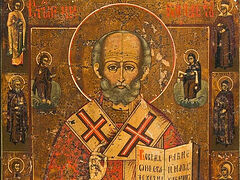
It is difficult for a rich man to enter the Kingdom of Heaven, yet some have entered. St. Nicholas of Myra entered; King Stefan Nemanja entered; others entered as well. Wealth did not hinder them—in fact, it even helped them enter the Kingdom and the calendar of saints, because they used it for the glory of God and for the salvation of their neighbors.
Though they possessed riches, inwardly they remained free from them. Everything they owned they regarded as God’s property, while they considered themselves servants of God and stewards of another’s treasure, distributing and administering it according to the commandments of the Gospel. Thus they saved their own souls and helped others to be saved. These were courageous souls who did not allow wealth to conquer them, but themselves became victors over wealth.
Besides earthly treasure, St. Nicholas possessed three other treasures, far surpassing all earthly riches in value: the treasure of faith, the treasure of righteousness, and the treasure of mercy. Giving away his wealth to the poor out of love for Christ, he himself became poor. Yet those three treasures continued to increase within him until the end of his earthly life. The more faith he gave to others, the richer he became; the more zealously he strove for the righteousness of God, the fuller his soul became; the more mercy he poured out upon people, the gentler his heart grew.
Faith, righteousness, and mercy—these are the heavenly treasures that multiply when they are given away. Faith, righteousness, and mercy—these are the three of St. Nicholas’ treasures that he left as an inheritance to the Church; and they remain undiminished. The saint of God left this threefold treasure as an inheritance to you as well, who today remember and glorify him. Know this, you who glorify St. Nicholas, for it gives him greater joy to give to you than to receive from you.
The faith of Nicholas of Myra was pure as crystal and firm as a diamond. He proved this at the First Council of Nicaea, when, risking his own life, he defended Orthodoxy against the heretic [Arius].
The righteousness of God within St. Nicholas shone brightly as the sun. He revealed this when he prevented the executioner from putting to death three innocent men who had been unjustly condemned. The saint ran forward and, once again placing his own life in danger, personally seized the sword from the executioner’s hand.
And the saint’s mercy toward the poor and destitute was like the mercy of Christ Himself. He distributed all his possessions as alms, usually doing so in secret, consigning himself to hunger and poverty.
Yet this great servant of God feared neither heretics, nor executioners, nor hunger. He knew with certainty that the Most High watches over His faithful servants. And so it was—the Most High protected him until the end of his life and glorified him after death among angels and men as He has glorified only a few.
But besides the three great spiritual treasures—faith, righteousness, and mercy—St. Nicholas possessed an inexhaustible treasury of spiritual gifts. Within it were the treasures of meekness, self-restraint, fasting, prayer, and humility. This treasury, overflowing with spiritual and moral riches, the wondrous hierarch of Christ left as an inheritance to you, Orthodox Christians.
Today this treasury stands wide open, and its riches are offered to you. The favorite of God will receive from you candles, prayers, and the slava bread not as gifts, but as thanksgiving. For today it is he himself who offers gifts to you. If you accept them, then he too will accept your gratitude; but if you reject his gifts, then he will reject yours. Take care, then, lest you despise the gifts that this rich man of Christ offers to you.
And remember this as well, and rejoice: St. Nicholas of Myra wrote no books, nor did he shed his blood as a martyr for Christ, and yet he is venerated more than many saints who either wrote wise theological works or suffered martyrdom for Christ. This mystery is great and wondrous. It is the work of Divine Providence. By this the good Lord wished to show that He admits into His Kingdom not only wise theologians and martyrs, but also the countless multitude of good souls who preserved the true faith and fulfilled the commandments of God. And such people among the faithful have always been, and still are, numerous—those who did not merely speak, but acted; who wrote no books, yet breathed by the Spirit of God. True, wise theologians and martyrs are numerous, yet they remain few compared to that great multitude of the latter, glorified not as theologians or martyrs, but as silent and faithful servants of Christ, as the holy people of God.
St. Nicholas is the people’s saint, the perfect image of those who, hearing the word of God, hastened to fulfill it and by their example taught others to do the same. This is the reason why God’s beloved, St. Nicholas, is honored more than many holy teachers and martyrs. This is also why the Church has dedicated to him not only this feast day which we celebrate today, but every Thursday of every week throughout the year, alongside the holy Apostles—to him, Nicholas the Wonderworker of Myra.
To our God be glory; to St. Nicholas be honor and praise; and to all of you, peace and health and joy and blessing unto the ages. Amen.
From: St. Nikolai Velimirović, Do Works of Righteousness: Sermons, Russian version translated from the Serbian by S. A. Luganskaya (Moscow: Sibirskaya Blagozvonnitsa, 2010).