In the name of the Father, and of the Son, and of the Holy Spirit!
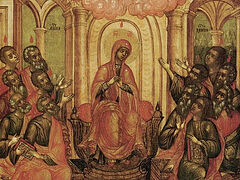
Dear brothers and sisters, greetings to all of you on the feast of the Holy Trinity, the Descent of the Grace of the Holy Spirit upon the Apostles, or Pentecost. Now the week is beginning, which is popularly and theologically referred to as Green Week. There is no fast throughout this week, and as on Pascha, we celebrate this great Day of the Holy Trinity all week long.
Scientists claim that the history of mankind from its beginning to the present day spans millions or even billions of years. But the Church speaks of just over 7,500 years—5,500 years before the coming of Christ and 2000 years after the coming of Christ, in the period we live in. Therefore, the entire history of mankind is nothing other than the history of salvation, which is divided into three periods.
The first period was the preparation of the world for the coming of the Messiah from the time of the fall of Adam and Eve in Paradise to the day of the Annunciation, when humanity in the person of the Most Holy Theotokos accepted its Savior and Lord. During that period, Divine Providence, continually conforming to the free will of people, arranged ways for salvation, preparing them for the coming of the Savior. The second period was from the Annunciation to Pentecost, when the Lord Jesus Christ accomplished the work of saving the world, preparing the way for humanity to God through His labor of redemption, His life, Passion, death on the Cross, and Resurrection. And the third period, which continues to this day, lasts from Pentecost to the Second Coming of Christ, when mankind is given the opportunity to attain salvation from corrupting sins, and deification (theosis), which our Lord Jesus Christ gave to the world once and for all.
The dogma of the Most Holy Trinity is incomprehensible at the level of reason. It is no coincidence that Priest Pavel Florensky (1882–1937) called the dogma of the Holy Trinity “a cross for human thought.” It is impossible to fathom the mystery of the Holy Trinity with the mind. And St. Symeon the New Theologian says: “No one can clearly and fully comprehend the dogma of the Most Holy Trinity with his mind and express it in words, no matter how much you read the Divine Scriptures.” And he adds: “Thy beauty has amazed and stunned me, O Trinity, my God!” “The concept of God as Love is explicable only through the concept of God as the Holy Trinity,” says St. Nikolai (Velimirovich) of Zica. If you want to understand what the love of God is, then you cannot do without the Trinity. And the mystery of the Holy Trinity is comprehended—only partially—in the experience of spiritual life with ascetic labors. Therefore, the Lord gradually revealed the mystery of the Holy Trinity.
We remember that at the beginning of the creation of the world, the Lord said: Let us make man in Our image, after Our likeness (Gen. 1:26). That is, we read about One God, but not about one Person. Even then it was obvious that God was not one Person, but the concept was still rather unclear. Through the prophets, He revealed the mystery of the Holy Trinity. If we look at the Psalter, it is permeated with allusions to the Father, the Son (the Messiah) and the Holy Spirit. That is why, while arguing with the Pharisees, Christ repeatedly pointed to the prophets and the holy Psalmist David, referring to what was said about Him there.
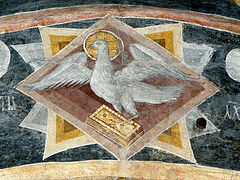
And the Trinity is fully revealed in the New Testament—in the Theophany, in the waters of the Jordan River when the Father spoke from heaven, the Holy Spirit descended in the form of a dove, and the Savior Himself stood in the Jordan. It is also revealed on Mount Tabor in the Transfiguration of the Savior, and in the Upper Room of Mt. Zion in Jerusalem. On the fiftieth day after the Resurrection of Christ, when 120 believers gathered in the Upper Room of Mt. Zion (where the Savior had earlier instituted the Last Supper), the Holy Spirit descended in the form of tongues of fire and the first Church came into being—the Church of the Holy Spirit.
 Hieromonk Seraphim (Panich)
So, man cannot fulfill God’s commandments. When the Lord gave us His commandments, He understood that they can be fulfilled only by the grace of the Holy Spirit. The Trinity is a great mystery. When Christ was ascending ten days ago, He said, I am with you always, even unto the end of the world (Mt. 28:20). How is He with us if He is not physically here? The mystery of the Holy Trinity lifts this veil for us. By the grace of the Holy Spirit, the Lord is present and helps in the salvation of every human being.
And when Fr. Pavel Florensky admired the Holy Trinity, he said: “If there is this icon by St. Andrei Rublev, then God really is the Trinity!” The Stoglav (“one hundred chapters”) Local Council of the Russian Orthodox Church, which was held from February to May 1551 in Moscow and presided over by St. Macarius of Moscow with the participation of Tsar Ivan IV, recognized this icon as the original, the canonical image of the Trinity. And every icon-painter knows that he is limited in his methods. He cannot arbitrarily use a certain light, shape, or movement. Everything should be done according to the canons and rules.
St. Andrei Rublev’s icon partly unveils the mystery of Love to us—this is the Pre-Eternal Council of the Holy Trinity before the beginning of the creation of the world. The Trinity before its creation of man is depicted as three angels. We will tell you one of the versions of this interpretation, which was published in the Journal of the Moscow Patriarchate. If we look at it, it is depicted at the top, as you can see, with God the Father in the center of the icon. He wears red vestments. Why red? Because our God is a consuming fire (Heb. 12:29). And He is enclosed by heaven—He is beyond the heavens and unknowable to us. Behind Him is a tree—the tree of life—because Every good gift and every perfect gift is from above (Jas. 1:17). On His right is an angel in a blue robe and a cloak. That is, Christ came down from heaven and clothed Himself in human flesh. And when light shines through this bodily cloak, it means that His Heavenly origin shines through, which not everyone can fathom. A church is depicted behind Him. Christ said: I will build My church; and the gates of hell shall not prevail against it (Mt. 16:18). St. Andrei Rublev depicted columns there with the Russian sign “И.Н.”, which means “Jesus the Nazarene”, as if indicating that this is the Savior. On the left there is an angel in a green cloak and with blue surroundings—the Holy Spirit that descends from the heavens, the Life–Giving Spirit of green color. And behind Him is a mountain—because, “Let us lift up our hearts”, as the priest exclaims during the Anaphora at the Divine Liturgy (compare: “gora”—the Russian for “mountain”, and “gore”—the Russian for “high up”). A Eucharistic Chalice is in the middle.
Let’s dwell on the interesting concept that before creating the world, the Father blesses, and the Holy Spirit moves and looks at the Son: “We are beginning to create the world, and we realize that man may misuse his free will if he follows the path of disobedience, and then he will not be able to return to the path of repentance either physically or spiritually—he will simply be incapable. Are You ready to go, become a Man, and endure sufferings for the salvation of humanity?” And Christ says, “Yes.” And after that, the creation of the world begins. In other words, creation was based on the Eucharistic Sacrifice.
And think about this simple thing: When Christ became incarnate and united with our nature (there are two natures in Christ: Divine and human, in one Person) without confusion, without change, without separation, and without division, as the Orthodox Church teaches. Human nature (which each one of us has) became a part of Christ. Then He ascended and sat on the right hand of the Father. And now, looking at the icon of the Holy Trinity, we understand that human nature is present there in the Person of our Lord Jesus Christ. It’s a fearful thought, but it is really so. This is the honor the Lord has prepared for every person.
Look—they sit at a square table in the icon. A square table in iconography represents the earth. Three sides are occupied, and the fourth is vacant. And the Holy Trinity says: “We have done everything for you, man. We have created you, We have granted you gifts, and we have helped you in order to atone for your original sin. We have given you grace. And we will be happy if you are with us—the place for you is prepared. Do you want to be with us? It depends in some way on you, on your use of free will.” The Apostle Paul says: The love of God is shed abroad in our hearts by the Holy Ghost (Rom. 5:5). And the Holy Fathers remind us that the Trinity is the key to the knowledge of love. It is impossible to know the love of God without the Trinity, because there is no love without sacrifice.
By the way, in June 23, 2024, the icon of the Holy Trinity by St. Andrei Rublev was returned to where it was supposed to be—the iconostasis of the Trinity Cathedral in the Holy Trinity-St. Sergius Lavra.1
I will conclude with a fragment from a speech by His Holiness Patriarch Kirill of Moscow and All Russia on the occasion of this feast. “Why, by the power of the Holy Spirit, when we partake of the Body and Blood of Christ, do we touch eternity and enter another level of existence? Because it was the will of the Lord. His coming into the world did not end with His Ascension to heaven—His presence in the world continues by the power of the Holy Spirit. That is why, when celebrating the Divine Liturgy, the priest prays that through the Holy Eucharist we remember the Cross, the tomb, the Resurrection on the third day, the Ascension to the heavens, and the Second and Glorious Coming—which has not yet taken place, but we remember it just as we remember the Holy Eucharist, being its co-participants. For in the Eucharist, time and space are transcended by the power of the Holy Spirit, and we come into real contact with the Divine Kingdom.”
Continuing this thought, Archimandrite John (Krestiankin) says, “Pentecost does not end with that solemn day in Jerusalem, which is described in the Book of Acts. No! Pentecost continues, and throughout all the years that have passed up to the present day it has been performed over each one of us, provided that we wholeheartedly strive for God and seek Him.”
Brothers and sisters, let us glorify the Most Holy Trinity. May It remain in our lives as the main dogma and meaning of our lives, so that we can enter with It and rejoice in the Heavenly Kingdom. Glory to the Father, and to the Son, and to the Holy Spirit, both now and ever, and unto the ages of ages. Amen.