Hieromonk Athanasius (Deryugin)
In the name of the Father, and of the Son, and of the Holy Spirit!
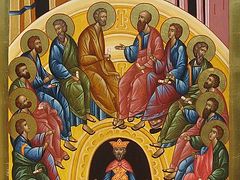
It would be proper to call today’s feast of the Holy Trinity, the day of Pentecost, the “birthday of the Church”. It was precisely on this day and through the Descent of the Holy Spirit upon the Apostles that the Lord founded His Church. His holy apostles, His disciples, were no longer a mere human community, a community of disciples of some great Teacher, but became the Church of Christ.
The apostle Paul revealed to us the amazing truth that the Church of Christ is His Body. Accordingly, the members of the Church of Christ, those who make up the Church of Christ, are not just closely connected with Christ—they are essentially a part of Him. Through the Holy Eucharist, through Communion, we affirm our unity with Christ, we affirm that we, the Church, are the Body of Christ. And the Church is Holy by its very nature, by its very essence, because the Church is the Body of Christ, because the Holy Spirit dwells in the Church, and, of course, it must have the same holiness.
But at the same time, if we look at the Church and those who make it up, very often we will not see this holiness. In the Church we can find hatred, malice, and other typical human passions, which are more or less inherent in all of us.
Then why do we call the Church “Holy”? Why do we say that the Holy Spirit lives in the Church and that the Church is the Body of Christ?
There was a wonderful Russian Church writer—Sergei Iosifovich Fudel (1900–1977), who went through Soviet labor camps and exile, and was close to many New Martyrs. Throughout his life he wrote works in which he analyzed what he had seen, as well as contemporary Church life, but he never thought that these works would ever be published—such were the times. Sergei Iosifovich died in the 1970s, and now we can familiarize ourselves with his works, in which he speaks about such a phenomenon as the “dark double of the Church”: when something that is not the Church begins to seem like the Church, and when sins committed by people who are outwardly and formally in the Church begin to seem like the sins of the whole Church. He wrote about how dangerous it is to mistake this “dark double” for the Church itself.
It is not uncommon for people who are newcomers to the Church to stumble on this. They have come to Church, gotten to know God, everything has seemed amazing and wonderful to them, and every person standing in church seemed to be a saint. But facing the reality of life, they see that it’s not like that at all. And this often disappoints people and even turns them away from Christ. But this is not the Church—this is its “dark double”. And any sin that is committed in the Church is not a sin of the Church itself, but a sin against the Church. It is very important to understand this, and this thought should lead us to humility. After all, being in the Church, living in the Church in the high sense of the word, remaining in unity with Christ, and acquiring the grace of the Holy Spirit, depends not only on external things. We all go to church, participate in the sacraments, and pray, and this is all very important. But in order to be a true member of the Church, and to be truly in unity with Christ, it is also necessary to live according to the commandments of God.
 And in this regard, it is vital for each one of us to look at ourselves and understand: “Am I in the full sense a member of the Body of Christ? Do I try to live according to the commandments of God? Do I always strive, looking at my life, to acquire the grace of the Holy Spirit and ensure that my actions, words and thoughts bring me to God, uniting me with the Holy Spirit?” After all, this is the vocation of every Christian. And it is only in this case that an individual can truly be called a member of the Church.
If we look at ourselves in this way, it will not lead us to judge those who are close to us—which, unfortunately, does happen sometimes—but to humility and the awareness that, “Lord, I have sinned in many ways against Thee and against Thy Church; and By my own actions I have done much to separate myself from Thee and from Thy grace.” And if we take Church life with such humility, the Lord will send us the Holy Spirit.
St. Macarius of Optina (1788–1860) said that humility substitutes for everything. And even if we do not have any other virtues, but humbly realize that we have nothing, then we will be ready to receive the Holy Spirit. Let us try not to forget about this, especially on this day, when we remember the Descent of the Holy Spirit upon the Apostles and the foundation of the Church. And let us live in such a way as to be worthy successors of the apostles and worthy bearers of the grace of the Holy Spirit. This is what we are all called to do—to try and humble ourselves before God and our neighbors, to fulfill God’s commandments; and then the Lord will be merciful to us. Then He will not deprive us of His grace, then in His mercy He will give us His Holy Spirit, and He will not deprive us of the Heavenly Kingdom. Amen.