Photo: iconreader.wordpress.com In the name of the Father, and of the Son, and of the Holy Spirit!
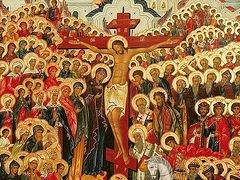
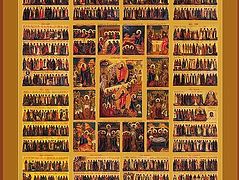
Dear fathers, brothers and sisters! If last Sunday we all celebrated the Descent of God the Holy Spirit upon the holy disciples and apostles of Christ, then today we honor the memory of the whole host of saints who received the grace of the Holy Spirit, Who descended upon the Church of Christ—all the saints who acquired and multiplied this grace. St. Theophan the Recluse emphasized that all saints became and still become saints by the grace of the Holy Spirit, which brings repentance and forgiveness of sins, and encourages Christians to fight the passions, adding that although the Church commemorates saints every day, since there were saints of God who remained unknown, All Saints’ Day was established so that none of them would be left without due veneration.
Saints are people who lived and still live close to us, but unlike many of us, they are guided neither by the spirit of the modern world, nor by changing public opinion, nor by popular views or customs, but solely by the Spirit of Christ, the Spirit of the Gospel, and the Word of God. It is this unshakable uncompromising position that distinguishes them from us. They strive to live in the Kingdom of God already here and now. Such a firm orientation is not formed in people immediately, and not only due to their desire—it is the result of long labors, following the path of the Holy Fathers. This is the path of repentance, deep awareness of your weakness, total disappointment in your own conceit and strength, and, as a result, reliance solely on God and His all-powerful help.
St. Ignatius (Brianchaninov) wrote: “Confession of the Lord joined with resolute and total denial of the world and of themselves was the sign of all the saints. Weak, ambiguous confession is not accepted, it is refused as something unneeded, as something unworthy of God. It is not enough to confess secretly within the soul; it is necessary to confess with the lips and by words. Confession with words is not enough—it is necessary to confess with deeds and by life. The Lord said: Whosoever therefore shall be ashamed of Me and of My words in this adulterous and sinful generation; of him also shall the Son of man be ashamed, when He cometh in the glory of His Father with the holy angels (Mk. 8:38).”1
“Human society is called sinful and adulterous because it has mostly inclined towards sinful life; it has betrayed and traded love of God for love of sin. The customs that reign in the world, having the weight of law higher than all laws, is contrary to, and at enmity with, a life that is pleasing to God,”2 St. Ignatius emphasizes. The Lord strengthens His disciples with the following menacing words: Whosoever therefore shall confess Me before men, him will I confess also before My Father which is in Heaven. But whosoever shall deny Me before men, him will I also deny before My Father which is in Heaven (Mt. 10:32-33).
Not only is the world hostile to God, but also our sin-loving heart and proud mind. St. Ignatius points out that “sin, which lives in the mind, heart, and body, is directly opposed to the confession of Christ, to the confession by the fulfillment of His commandments; sin stubbornly opposes this fulfillment.” This is how the world distorted by the fall and our fallen nature oppose what Christ teaches us. How can we resist the world’s love of sin and our fallen nature?
St. Ignatius answers this question: “In order to be freed from slavery to fallen nature, the Lord commands the crucifixion of nature—that is, the rejection of its mind and its will, and the nailing of the actions of the mind and the desires of the heart to the Gospel commandments. Thus, they that are Christ’s have crucified the flesh with the affections and lusts (Gal. 5:24): they have crucified the fleshly mind and will of fallen nature, on which the sinful desires of soul and body, and sinful life, are based and in which they are rooted.” This is what the holy King and Prophet David prayed for, exclaiming: Nail down my flesh with the fear of Thee, for I am afraid of Thy judgments (Ps. 118:120); and, Stablish for Thy servant Thine oracle unto fear of Thee (Ps. 118:38). In all their life activity and inner movements, the followers of Christ are guided solely by the Word of God. They have crucified, rejected all the wisdom and philosophy of the fallen world, and nailed their minds and the desires of their hearts to the Gospel commandments.
 Hieromonk Nikon
What do those who have abandoned this world of sin, where even our good deeds and intentions are not completely pure and marred by sin, gain from this way of life? Those who live holy lives will receive the grace of God a hundredfold, and this grace comforts, strengthens, clarifies, and communicates Heavenly joy and peace to ascetics of Christ. There is no man that hath left house, or brethren, or sisters, or father, or mother, or wife, or children, or lands, for My sake, and the Gospel’s, but he shall receive an hundredfold now in this time, houses, and brethren, and sisters, and mothers, and children, and lands, with persecutions; and in the world to come eternal life (Mk. 10:29–30; cf. Mt. 19:29). People will leave all earthly blessings, achievements and glory on earth, and only the grace of God will follow them into eternity. St. Ignatius writes: “As soon as you cast off your body like fetters, grace, previously constrained by the flesh, grows extensively and majestically. It serves as a pledge and testimony for the chosen of God. When you stand at the Judgment that awaits every human being after death, and present your testimony and pledge, then, in accordance with them and as a logical consequence of them, spiritual, everlasting, ineffable and boundless riches, splendor and delight are given you in Heaven.”
Today I would like to pronounce the following prayer request by St. Ignatius (Brianchaninov): “May it be granted to us, too, for faithfully confessing the Lord, to inherit this life prepared for all of us by the unfathomable, boundless mercy of the Lord Who has redeemed us by Himself.” Amen.