Colorado Springs, Colorado, June 30, 2026
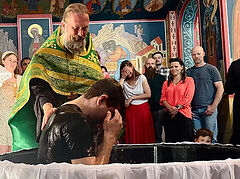
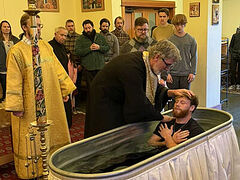
 Fr. Andreas Blom with the newest converts at his parish. Photo: theophany.org
An Orthodox priest in Colorado Springs whose parish and its daughter parish together have around 170 catechumens has described the challenges of ministering to a community growing faster than it can absorb new members, and offered his assessment of what is driving Americans to the Orthodox Church.
Fr. Andreas Blom, rector of Holy Theophany Orthodox Church (OCA) in Colorado Springs, spoke with Matthew Namee of the Orthodox Studies Institute in a recent interview. Holy Theophany’s daughter parish, St. John the Baptist Orthodox Church, was consecrated in February 2025. The two parishes currently have around 170 catechumens between them.
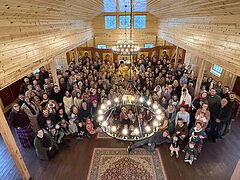
Fr. Andreas said Sunday attendance at Holy Theophany alone now runs at roughly 300 people, with around 200 communicants, and that the parish is again facing the same overcrowding that prompted the construction of St. John’s. “We’re back to having people standing outside on Sundays at Holy Theophany,” he said.
On what is drawing people to Orthodoxy, Fr. Andreas said inquirers give a variety of answers, with many first encountering the faith online. He pointed to broader social conditions as one factor. “Everything is shaking,” he said. “The economy is crazy... nothing feels stable right now, so people are looking for a foundation, people are looking for a community to be part of that is not just as volatile as everything else.” He also noted that many are “really tired of party politics” and seeking “a faith that transcends that.”
His own conclusion, however, is theological: “I’m an Orthodox Christian priest. I’m going to tell you that it is the Holy Spirit that is moving in people’s hearts and bringing people to the Church.”
Contrary to some media coverage suggesting that the convert wave is driven primarily by right-wing political motivations, Fr. Andreas said his parish is seeing people from across the ideological spectrum. “We have both the extreme right and the extreme left people coming in,” he said, adding that in most cases their political identities gradually recede. “I’ve seen person after person just kind of getting softened,” he said. He described watching converts’ bumper stickers disappear over time as they come to appropriate Orthodoxy as their primary identity. Those who cannot make that shift, he said, tend not to stay.
On the pastoral strain of serving a rapidly growing community as its sole priest, Fr. Andreas said he is managing but acknowledged things are falling through the cracks, particularly in his ability to give time to long-standing parishioners. He said he now requires newcomers to attend for three months before he will meet with them individually, and relies heavily on experienced parishioners serving as sponsors to catechumens. Ideally, he said, a community of this size would have at least two additional priests—one to focus on youth, young adults, and catechumens, and another to begin planting a third parish.
Asked why some Orthodox parishes are growing while others in the same city are not, Fr. Andreas cited Archbishop Benjamin, formerly of the Diocese of the West, who pointed to the priest’s ability to connect with the kinds of people now coming in, the beauty and prayerfulness of the services, the appearance of the church building, and the quality of hospitality—“genuine and kind” without being overbearing. “You have this sense that everyone’s sick of other people trying to proselytize you.”
Follow OrthoChristian on Facebook, Twitter, Vkontakte, Telegram, WhatsApp, and MeWe!