Sitka, Alaska, July 7, 2026
 Photo: odosa.org
The Orthodox Church in America’s Diocese of Sitka and Alaska is continuing its search for the holy relics of St. Jacob Netsvetov, and recent surveys of the historic churchyard site have brought the effort closer to identifying the saint’s grave.
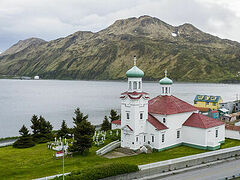
St. Jacob served as rector of Holy Trinity Church in Sitka during the final years of his earthly ministry. After his repose in 1864, he was reportedly buried outside the front doors of the church, with a wooden cross marking the site. Over time, both the church and the cross deteriorated in the wet climate of Southeast Alaska, and the exact location of his grave was lost, the diocese explains.
The modern search began under the late Archbishop David, who in 2015 arranged for Ground-Penetrating Radar (GPR) to be used at the site. While the scans didn’t clearly identify the saint’s grave, they marked the start of a sustained effort to recover the place of his repose. Following Archbishop David’s repose, the search was paused until the enthronement of Archbishop Alexei, who blessed its renewal.
Volunteers first cleared the historic site, which had become heavily overgrown with wild Alaskan salmonberries and brush. The area has continued to be maintained and beautified each year since.
 Photo: odosa.org
Since the initial clearing, the diocese, working with the National Park Service, has conducted two additional GPR surveys. A team of bloodhounds trained to detect historic burials was also brought to the site. Combined with the earlier scans, these efforts have produced the clearest picture yet of the churchyard, giving an approximate understanding of individual burial locations as well as the probable position and outline of the former church. The precise grave of St. Jacob, however, has not yet been confirmed.
Historical testimony indicates that St. Jacob was buried outside the church doors. Because Orthodox churches are traditionally oriented toward the east, the main entrance would normally have faced west. Several possible burials have been identified to the west of the church’s probable location. St. Jacob was reportedly the only priest buried in the churchyard, so any future discovery of a pectoral cross or a Holy Gospel book at a burial site could offer strong evidence identifying his grave.
The diocese is now reaching out to potential partners who could assist with additional non-invasive survey methods, including Light Detection and Ranging (LIDAR) and magnetometer surveying, to further clarify what lies beneath the site without disturbing the graves of the departed.
The diocese asks clergy, monastics, and the faithful to pray that the search bears fruit. Those wishing to make a financial offering toward the continuing search may contact the diocese for more information.
Follow OrthoChristian on Facebook, Twitter, Vkontakte, Telegram, WhatsApp, and MeWe!