In the name of the Father, and of the Son, and of the Holy Spirit!
Dear brothers and sisters,
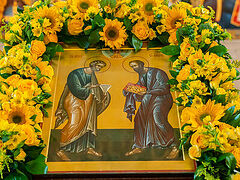
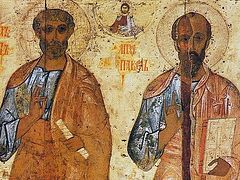
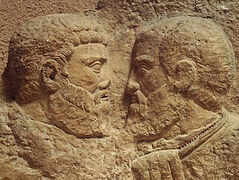
I sincerely greet you on the feast of the holy Glorious and All-Praised Apostles Peter and Paul!
The Holy Church especially honors the memory of the Chief Apostles for their labors in preaching the faith of Christ. On the Gospel pages, the image of the Apostle Peter appears before us first. He is always at the epicenter of events, always with the Lord, accompanying Him in difficult and joyful moments alike.
Let us turn our attention to the most important episodes from the Apostle Peter’s life. The first event that highlights his role is the confession of faith in Christ. When the Lord asked the disciples, Whom do men say that I the Son of man am? (Mt. 16:13), they gave different answers; and the Apostle Peter hit the nail on the head, saying: Thou art the Christ, the Son of the living God (Mt. 16:16).
 The Denial of Christ by Peter. Maxim Sheshukov (the twentieth century) He did not make this confession of faith on his own, but the Heavenly Father revealed it to him. At that moment, the Lord gave him a new name; he had been Simon, but became Peter, which means “rock”. It was on the rock of faith, on Peter’s confession, that the Lord founded the Church of Christ, and the gates of hell shall not prevail against it (Mt. 16:18).
Reading the Gospel, we learn not only of St. Peter’s strengths, but also his weaknesses and sins as a human being like us. At first, in a fit of zeal, he exalted himself above everybody else, declaring, “Even if all deny the Lord, I will not deny Him,” and then he nevertheless denied Christ. Despite his denial, Simon Peter found the strength not to despair because of the sin he had committed. He humbled himself even more and loved Christ. He offered tearful repentance and was forgiven and accepted by the loving Lord.
As we know from Church Tradition, the Apostle Peter is the gatekeeper of the Heavenly Kingdom—he has the keys to the doors of Paradise. It is very comforting for us sinners that it is not an angel who has these keys, but an apostle who will be merciful to all who, like him, sinned but repented.
***
The other soldier of the faith of Christ is the Apostle Paul. He is also called “the Apostle of the Gentiles”, since he was the first, moved by the love of Christ, to begin preaching the faith not only to Jews, but also to pagan nations.
St. Paul never met with Christ in His lifetime, but after the death and Resurrection of the Savior, he miraculously believed in Him. Unlike Peter, who was a simple and unlearned fisherman, Paul was taught by the best teachers of the time.
Being a Jew and a Pharisee, he had great zeal for his faith. Having received authority from the Sanhedrin, he persecuted Christians as a sect, as apostates from the faith of the fathers.
 Michelangelo. Fragment of the fresco, The Conversion of Saul. Vatican, the sixteenth century But his life changed drastically when, on his way to Damascus, he saw the Risen Christ in the light of the Divine glory, Who said to him: Saul, Saul, why persecutest thou Me? And he said, Who art Thou, Lord? And the Lord said, I am Jesus Whom thou persecutest: it is hard for thee to kick against the pricks (Acts 9:4–5).
After the appearance of Christ on the road to Damascus, Paul first became blind physically, and then regained both physical and spiritual sight. Having been baptized in the name of Jesus Christ by the Apostle Ananias, he received the gift of faith and apostleship. Before he began to preach the faith, the Apostle Paul retreated to the Arabian Desert where he spent his time in the feats of fasting, prayer and repentance.
Why do the Holy Church and all of us venerate the Apostle Paul so much, even though he was not even one of the twelve disciples of Christ?
We honor him as an indefatigable preacher of the Christian faith. Undoubtedly, he labored harder than all the apostles in the preaching of the Gospel. St. Paul devoted his gift of speech and his learning, and all his strength, and sacrificed himself to Christ and His Church. His prolific writing was revealed through the Epistles, of which he wrote more than all the other apostles. And if we want to see in our hearts and know the purity and depth of the Christian faith, let us turn to reading and studying St. Paul’s Epistles. There we will find abundant food for our souls and strengthen our faith.
***
Thus, dear brothers and sisters, in our deceitful times, let us keep the faith pure, as the Apostles Peter and Paul and other disciples of Christ preached it to us. The apostles attained the heights of holiness—they are like beacons and spiritual guiding lights for us wallowing in the darkness of sin.
Through their preaching, the apostles call us to the spiritual heights. The Apostle Peter wants us to become partakers of the Divine nature, having escaped the corruption that is in the world through lust (2 Pet. 1:4). And St. Paul encourages us to acquire through the feat of faith this mind…, which was also in Christ Jesus (Phil. 2:5) and attain a state when yet not I, but Christ liveth in me (Gal. 2:20).

We become partakers of the Divine nature when we partake of the Holy Body and Blood of Christ, when we approach them in repentance and with contrite and humble hearts. And in order for Christ not to leave us, but to dwell in us—in our souls and bodies—we must make efforts in our struggle against sin that lives in us.
We are called to die to sin and the world of passions so that we may be regenerated spiritually and Christ may live in us. This dying or mortification of the old man in us must take place each day of our lives. The more we refuse to indulge the flesh, our bad habits and passions for the sake of God, the more our souls will be regenerated and Christ will abide in them.
Let us take the first step towards Christ—repentance. He waits for us every day with open arms, like the father of the prodigal son. And may God grant us, through the prayers of the holy Chief Apostles Peter and Paul, to become partakers of blessed eternal life!
Amen.