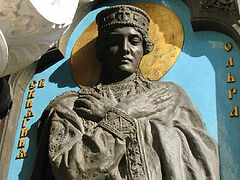
Monument to St. Olga, Equal-to-the-Apostles, in Pskov. Sculptor: Vyacheslav Klykov. There are saints whose lives we read, yet little remains in our memory. There are saints whose labors of holiness we never cease to admire, though they remain for us unattainable heights. And then there are saints who seem always to be at our side, whose lives intersect with our own again and again. St. Olga, Equal-to-the-Apostles, is one of them.
She is remarkable in every respect, and in many ways she resembles us. For a long time she did not know Christ. She spent almost her entire life as a pagan. The people of her day considered her “the wisest of women.” Yet she was also extraordinarily courageous and deeply principled—while remaining a pagan. An unbending will, a keen natural intellect, and a life of moral purity—these form a brief portrait of her character. There is little doubt that, even before her Baptism, she would have been deemed worthy of the pagan paradise, Iriy. Yet, to paraphrase a familiar saying: what is paradise for a pagan is death for a Christian.
“The wisest of women” was baptized only after she had passed her sixtieth year. She embraced the Christian faith after her son Sviatoslav had reached adulthood and assumed the rule of the principality. Sviatoslav was Olga’s only child. She raised him to possess the same unyielding character that she herself had.
When Sviatoslav was only about five years old, Olga marched against the Drevlians to avenge the murder of her husband, Prince Igor. The way she raised her son is evident from the fact that she took the little boy with her on that campaign. When the two armies met, Sviatoslav was the first to cast a spear toward the Drevlians. Thrown by the hand of a child, it flew between the ears of his horse and landed at its feet. Then the commanders of the Kievan forces declared, “The prince has begun the battle—let the prince’s retinue follow him!” The Drevlians were defeated.
Even this episode is astonishing. A five-year-old child sits astride a horse with a spear, standing in the front ranks of the army beside his warrior mother—the word Mom hardly seems to fit here. Pagan Olga never stopped to think that her son might be wounded in battle, or even accidentally killed. Her concern was that such an experience would make him a man more quickly, shaping him into a brave and fearless warrior.
Of course, we Christians cannot raise our children amid bloodshed and violence. But we should understand those harsh and turbulent times, when the life of an ordinary person was valued very little.
Instead, let us view this episode through the lens of our own attitude toward children. Today, many excessively protective mothers and grandmothers are ready to shield a child from even a mosquito bite, from every kind of work, and, in the process, from every kind of effort. Though she was still a pagan, Olga rightly discerned—or perhaps inherited through tradition—the proper direction of child-rearing. Education should prepare a child for struggle. According to Olga’s pagan understanding, the struggle was against visible enemies. According to the Christian understanding, it is against oneself, against one’s sinful desires—against the invisible enemies.
Olga knew that a boy must first of all become a warrior. We Christians must raise our children to be soldiers of Christ. It is no accident that the Church on earth is called the Church Militant—the Church that wages war against sin and the powers of evil—while the Church in heaven is called the Church Triumphant, for the saints have already won that battle.
And Olga achieved what she had intended. She raised Sviatoslav to become a valiant warrior and a wise military commander.
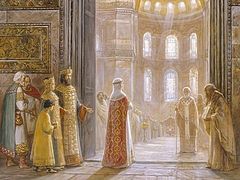
 Princess Olga Received by the Byzantine Emperor Constantine Porphyrogenitus. Miniature from the Radziwiłł Chronicle. Early thirteenth century.
Many years passed. Olga’s soul, tempered by the trials of life, found Christ. By then Sviatoslav was already ruling as prince. Olga devoted herself wholeheartedly to works of mercy and to preaching the Christian faith.
One must assume that her first efforts were directed toward her own son.
But, alas, Sviatoslav was already a grown man with a firmly established worldview. It would not be accurate to call him a fanatical pagan. Rather, he was a fanatical warrior. Questions of religion—any religion—held little interest for him. He himself had no desire to be baptized, although neither did he prevent others from receiving Baptism.
Only toward the end of her long and laborious life did Olga realize that she had raised her son somewhat one-sidedly. Pagan education, she understood, may contain certain sound elements, but true perfection comes only from Christ. Only Christ can plant within a child’s soul what is most essential: love for God and love for one’s neighbor.
 The Baptism of Princess Olga in Constantinople. Ivan Akimov, 1792.
Olga lived for about fifteen years after her Baptism. Until she died she pursued a life of lofty ascetic devotion. She sought to raise her grandchildren as Christians, yet she did not dare baptize them without her son’s permission.
How much instruction there is for us even in this small detail!
How often we try, regardless of another person’s freedom, to drag everyone into paradise with an iron hand! As one contemporary theologian remarked, “If only we could push everyone into the Kingdom of Heaven, lock the doors, and throw away the key—so that no one could escape!”
How deeply the Lord and His saints value human freedom!
When we reflect on this, it seems that there would be far fewer family quarrels over religion if believing relatives did not try to force unbelieving family members into church. Preaching by one’s life—that is the lesson we have yet to learn.
Olga’s witness through her own life undoubtedly left its mark upon the hearts of her grandchildren. They remembered their holy grandmother. One of those grandsons would later become Grand Prince Vladimir, forever known as “the Fair Sun.”
Yet Olga also bore a sorrow that is familiar to many of us.
For fifteen years she lived as a Christian. For fifteen years she spoke to her son about Christ in season, out of season (2 Tim. 4:2). For fifteen years she offered a mother’s holy prayers to God for his conversion.
And what was the outcome of these “birth pangs” (Gal. 4:19)? As she lay upon her deathbed, Olga said to Sviatoslav: “Now I have no concern except for you. I grieve that, although I have instructed you so often and urged you to abandon the impiety of idols and to believe in the true God, whom I have come to know, you have disregarded my words. And I know that because of your disobedience to me, a miserable end awaits you on earth, and after death, the eternal punishment prepared for the pagans.”
Why did it happen this way? Did the Lord truly not hear the prayers of the holy Olga?
Here let us pause for a moment.
Like every priest, I often hear parents confess with sorrow that their children no longer attend church and that they failed to raise them properly. Frequently, these are older people who themselves came to the Church only later in life, by which time their children were already married and had families of their own.
Should these parents repent of this? Should we single out individual sins from our former pagan way of life, when that entire life was darkness and godlessness? We ourselves were blind, and so we led our children without knowing where we were going. And if the blind lead the blind, both shall fall into the ditch (Matt. 15:14f).
Forgive us, Lord, for living like demons—for fornication, drunkenness, gluttony, sorcery, and every other abomination. Forgive us also for raising our children badly.
Yet notice what St. Olga laments in her final words. She does not grieve that she raised her son poorly while she herself was still a pagan. Rather, she grieves that, after she had become a Christian, he rejected the words she spoke to him in Christ.

After this confession, people often go on to say that they must not be praying enough for the conversion of their children, and that the Lord therefore does not hear their prayers, since their children still remain outside the Church.
And so we return to the same question: Did St. Olga, Equal-to-the-Apostles, truly pray too little—or without tears—for her son? Or did the Lord fail to hear her?
It would be almost blasphemous to think either of these thoughts. There is something else—something that is even more precious to God than the prayers of the saints, even than the prayers of holy mothers. That is human freedom. The Lord will never violate it.
Faith in God is a mystery accomplished within the human soul, accomplished by God’s grace. At some point in life, the Lord makes His presence known to every person, and each of us either responds to that call or turns away from it. Therefore, on the Day of Judgment no one will be able to say to Christ, “Lord, no one ever taught me. Those were difficult times. I knew nothing.”
The tragedy is that, in one way or another, everyone is given to know. Yet many people are perfectly content to live on earth without Christ, and, in the words of St. Olga, “a miserable end awaits them on earth, and after death, eternal punishment.”
We must pray for those we love. But to imagine that their coming to the Church depends solely upon our prayers is, in one sense, pride, and in another, simple ignorance. Yes, we should pray fervently for our unbelieving relatives. But the final outcome is a mystery known only to the Lord. This mystery runs throughout the whole history of the Church.
Did not the Lord do everything possible to save Judas? Yet Judas perished.
Did He not, at the dawn of Christianity, seek to enlighten the persecuting emperors through the countless astonishing miracles wrought by the holy martyrs? Yet only a handful of them were converted.
Does He not continue to confront unbelievers today with the miracle of the Holy Fire at the Lord’s Tomb and with countless other miracles of Orthodoxy that are widely known? Yet our churches remain filled with comparatively few people.
For faith is born in the heart only through the miracle of God’s grace working together with the free consent of the human will.
The Holy Fathers teach that, before faith can be born, a person must become dissatisfied with his inner life. He must be inwardly ready to change himself and his life in obedience to the Truth so that he may receive divine grace. Sadly, such willingness to change is lacking not only among outspoken atheists but also among many who call themselves believers.
 Photo: Ivan Zhuk. Did God hear St. Olga’s prayers? Of course He did. But Sviatoslav would not allow Christ the Savior to enter his heart. Thus, as his mother had foretold, he met a violent end. Sviatoslav was killed in battle by the Pecheneg prince Kurya, who severed his head and fashioned his skull into a drinking cup from which he drank during his feasts.
Of course, we do not know where Sviatoslav now stands in eternity. Perhaps St. Olga did obtain mercy for him through her prayers. After all, there are examples of saints whose prayers benefited those who died unbelieving and even unbaptized. What we do know is this: On earth, a mother’s prayers did not change Sviatoslav’s heart.
Yet notice once again that, in her final words, St. Olga does not lament that she prayed too little for her son. She laments only that he would not listen to her. She understood that another person’s freedom is more precious than even her own prayers.
Olga’s life before her conversion, and the life she lived after her Baptism, offer us many lessons. Perhaps the greatest of them is the lesson of humility and trust in God. So often we beg God to fulfill our will because it seems to us righteous and pious. Yet no one can guarantee that we are not mistaken. Even the saints were mistaken at times.
For my thoughts are not your thoughts, neither are your ways my ways, saith the LORD (Isa. 55:8) How much wiser it is simply to pray for the salvation of our unbelieving loved ones and to leave both the time and the manner of their conversion humbly in God’s hands. “Thy will be done.” That is the prayer Christ the Savior Himself taught us. Too often, however, our real prayer sounds more like this: “Lord, let my will be done.”
We should also remember that the Lord often calls people into His Church through suffering. Therefore, when our unbelieving relatives endure trials and hardships, we should not despair excessively. Rather, we should try to discern the guiding hand of God leading them toward faith.
Finally, brothers and sisters, let us strive to preach Christ to those closest to us not so much by our words as by our deeds and by the witness of our lives, so that all who surround us may without the word be won… while they behold your chaste conversation coupled with fear (1 Pet. 3:1–2, KJV).