Galilee was a special page of our pilgrimage to the Holy Land. In the time of Christ, the inhabitants of Judea looked down on its simple and uneducated people, but it was here that the Son of God accomplished His primary ministry to the human race.
The famous Sea of Galilee (Lake Tiberias, Lake Kinneret) is situated in the heart of the province that gave it its name. It is also called “Kinneret” in Hebrew. The preaching of the Gospel began on these banks. Here, after the miraculous catch of fish that horrified St. Peter, the first apostles were chosen.
The beautiful road along which our coach was moving ran between ash-yellow mountains and the bank of a huge lake blazing with blue. I admired it and struggled to understand whether it was the sky reflected in the water, or the Sea of Galilee itself radiating a blue glow. Soon we arrived at what is left of the town of Magdala.
How wonderful is the place from which St. Mary Magdalene Equal-to-the-Apostles (commemorated July 22/August 4 and on the Sunday of the Myrrh-Bearing Women) hailed! It used to be a town with a population of 40,000; now it is gone, and perhaps the most remarkable thing in this area is the Russian property, which belongs to the Gorny Convent, featuring a church in honor of St. Mary Magdalene.
From the snow-white fence, a living hedge of enormous white and purple flowers—resembling both lilacs and roses—was descending towards us. We stepped inside and... how could one not gasp? The white-stone terrace rises above the cornflower-blue expanse of the glowing Sea of Galilee, beyond which the light purple mountains of the Golan Heights could be discerned in a blue haze. In the Gospel this place is called the country of the Gergesenes. And down below to the right, tall, slender palms and dwarf palms with fan-shaped leaves are visible—a garden fragrant with the scent of wondrous, colorful flowers and orange trees. We found ourselves under the shelter of its ineffable beauty.
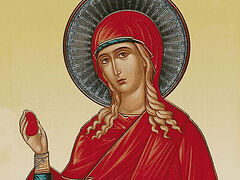
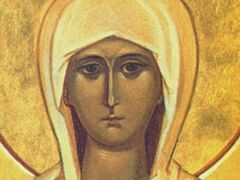
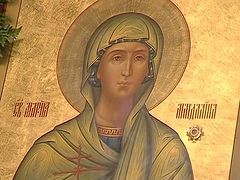
The church, sinking up to its very dome in a green sea, is low, with a small bell-tower turret and frescoes so marvelous that our souls rejoiced. A sea of icons spills across the walls all around. We saw God’s friends, the apostles, and Christ asking St. Peter who had denied Him, Simon, son of Jonas, lovest thou Me? (Jn. 21:16). On the analogion lay an icon of the Heavenly patroness of these places—St. Mary Magdalene. And young novices spoke Russian—hearing this, my heart stood still from emotion.
There are two warm radon springs right by the sea. One is small, round and dark violet. It shone brightly in the sun, and it seemed as though a tiny drop of mercury had frozen in a stone basket. The other is shaped like a pool. Small fish darted about in its crystal-clear turquoise water. Surprisingly, they would swim up to the bathers and nibble at their legs. We swam in the Sea of Galilee as well.
I was admiring this beauty and thinking how beautiful the soul of the holy Myrrh-Bearer Mary must be, for the place dedicated to her memory to blossom so luxuriously and give off such sweet fragrances! And how could it happen that in recent times, strange films and books, contrary to all common sense, have been spreading misinformation about St. Mary Magdalene? In them, she is called a “goddess of the Gospels”, the “Holy Grail”, and the “wife of Jesus”… However, this is probably not surprising, since the devil always especially attacks what is most beautiful and holy, trying to distort it; for he is the most crooked mirror in the world.
 St. Mary Magdalene. Mosaic by N.K. Bodarevsky, 1895–1907. It is known from the Life of St. Mary Magdalene, Equal-to-the-Apostles, that during the first period of her life she suffered from a severe illness—she was possessed by seven demons (cf. Lk. 8:2). How and why this misfortune happened will remain a mystery. The Holy Scriptures say that Divine Providence allows such special sufferings that the works of God should be made manifest (Jn. 9:3). A miracle occurred to St. Mary of Magdala—the Lord healed her. Mary’s grateful soul was on fire with the purest and most devoted love for her Savior, and she followed Him.
St. Mary shared in the apostolic labors, preaching the Gospel among women. And she remained faithful to the Lord not only in the days of His glory, but also at the moment of His extreme humiliation. St. Mary did not abandon Him during His Passion on the Cross, displaying a courage that even His closest disciples lacked. The fear that prompted the Apostle Peter to deny Christ was conquered in St. Mary’s soul by love. When the other apostles, who had promised to die for their Teacher, fled, she stood on Golgotha by the Cross together with the Most Holy Theotokos and the Apostle John.
According to Church tradition, Christ, having risen from the dead, first appeared to His Mother. Yet out of all the apostles and Myrrh-Bearing Women, it was St. Mary Magdalene who first beheld the Risen Lord.
In the writings of Christian preachers, the image of St. Mary Magdalene became a vivid and edifying example of sincere faith in Christ, which the saint demonstrated—unlike the other disciples—at the most tragic moment of the Lord’s life. St. John Chrysostom lauds St. Mary Magdalene for her tender love for the Savior, which compelled her to go to the tomb early in the morning to find solace and be the first to convey the news of the Resurrection to the disciples. A homily previously attributed to St. John Chrysostom (likely authored by John of Thessalonica, a seventh-century archbishop) and dedicated to the Myrrh-Bearing Women, contains a unique example of harmonizing the messages of all the Gospels. According to this homily, St. Mary Magdalene, driven by a desire to serve the Lord, came to the tomb four times on the day of the Resurrection. In the Resurrection hymns by St. Romanos the Melodist, St. Mary Magdalene is extolled akin to the Prophet Moses; while the prophet beheld God shrouded in a cloud, St. Mary Magdalene was vouchsafed to gaze upon the Lord physically.
The prominent Byzantine Church historian, writer and priest Nicephorus Callistus Xanthopoulos (†1335) in his Ecclesiastical History writes of St. Mary Magdalene’s journey to Rome and her preaching to Emperor Tiberius. St. Dimitry of Rostov (†1709) writes that St. Mary Magdalene presented the Emperor with a painted red egg. This gift aroused Tiberius’ curiosity, and the saint told him about Jesus Christ. “Having learned of the meaning and power of the impression made on Emperor Tiberius by St. Mary Magdalene’s offering of the red egg with the words: ‘Christ is Risen!’, Christians of that time began to imitate her in this and, in commemoration of Christ’s Resurrection, started giving each other red eggs and saying: ‘Christ is Risen! In Truth He is Risen!’”
 Mary Magdalene and Emperor Tiberius
In a Eulogy to St. Mary Magdalene by Nicephorus Callistus Xanthopoulos, it is additionally stated that she preached throughout Italy and Gaul, visited Egypt, Phoenicia, Syria and Pamphylia. After spending some time in Palestine serving the Mother of God, she came to the Apostle John the Theologian in Asia Minor, reposed there after a short illness and was buried in a cave in the vicinity of Ephesus. The eulogy concludes with an account of the Byzantine Emperor Leo VI the Wise (ruled from 886 to 912) translating St. Mary Magdalene’s relics to the Monastery of St. Lazarus in Constantinople, where they were placed to the left of the front walls of the altar. Subsequently, from Constantinople, the left hand of Mary Magdalene was translated to the Simonopetra Monastery on Mt. Athos.
The presence of St. Mary Magdalene’s left hand at the Simonopetra Monastery has been documented since 1644. Miracles occurred from the relic, and St. Mary Magdalene came to be considered the second Heavenly patron of the monastery after St. Simeon the Myrrh-Gusher. In 1747, the saint’s hand was stolen by Barbary pirates and taken to Kefalonia (the largest of the Ionian Islands), and later it ended up in what is now Libya. Almost twenty years later, Abbot Joasaph of Mytilene bought the saint’s relics in Tripoli for 520 florins. In 1888, Abbot Neophytos and the brethren of the Simonopetra Monastery brought a particle of the True Cross, as well as the relics of St. Mary Magdalene, the Righteous Anna and Greatmartyr Panteleimon to Russia for veneration. Until 1892, the monastery’s delegation traveled to the largest cities of the European part of the Russian Empire. With the funds raised, the monks were able to pay off their debts and restore the monastery after a fire.
In 1911, after a prayer service celebrated in front of St. Mary Magdalene’s relics, the caterpillars that were destroying crops in the town of Galatista (the Halkidiki Peninsula) died; and in 1912, the locusts devastating crops in the town of Epanomi near Thessaloniki disappeared. In 1945 and 1947, the saint’s relics saved the monastery forest from the wildfires raging at that time. On September 2, 2006, at the request of His Holiness Patriarch Alexei II of Moscow and All Russia, the left hand of St. Mary Magdalene, the relics of Martyr Cyricus and a particle of the True Cross were brought to Moscow from the Simonopetra Monastery for veneration.
The relics of St. Mary Magdalene are also kept at the Church of the Holy Sepulcher in Jerusalem (a portion of the right hand), at the Panagia Iikosifoinissa Monastery (another portion of the right hand), at the Esphigmenou Monastery (a portion of the left foot), at the Zographou Monastery (a portion of the holy skull), at the Koutloumousiou Monastery (the foot), and at the Coptic Monastery of the Syrians in Wadi El Natrun (hair). Particles of St. Mary Magdalene’s relics are kept at the Vatopedi, Dionysiou, Xenophontos, Docheiariou and St. Panteleimon’s Monasteries (on Mt. Athos), in the Archdiocese of Cyprus (Nicosia), at the Monastery of the Protomartyr Stephen (Meteora), at the Hesychasterion of the Ascension of the Lord (near Kozani), at the Church of the Transfiguration of the Lord in Plaka (Athens), and at the Monasteries of the Agia Lavra (near Kalavryta), of the Holy Cross (Samos), of St. John the Theologian (Patmos), of the Panagia Tourliani (Mykonos), Galataki (Euboea), Nea Moni (Chios) and others.
The most amazing thing is that holy relics of St. Mary Magdalene, uniquely and miraculously retain the warmth of a human body.

Involuntarily making contact with the righteous life of the Myrrh-Bearer Mary of Magdala, which for a moment became a tangible reality for me, I wondered how such ancient holiness turned out to be a reality here, retaining within itself the light of the grace of God ever since the Savior’s earthly life? While I was reflecting on these unexpected questions, our dear pilgrims were not wasting time, walking in the paradisiacal garden of Magdala. They, too, were overwhelmed by the joy of meeting the living memory of the holy Myrrh-Bearer Mary.
Before leaving Magdala, I took one last look at the Sea of Galilee. Right by the bank, a simple fishing boat was bobbing in the quiet waves. Millennia pass, yet nothing changes here, as if we had stepped back into apostolic times.
And on the Sea of Galilee, a path remains in that very spot where Christ walked on the waters. I was told that a straight strip of calm water runs through the Galilean waves as if smoothed by an iron—although it is not always visible, and we did not go to see it.