Câmpulung Moldovenesc, Suceava Province, Romania, August 14, 2026
 Photo: arhiepiscopiasucevei.ro
Orthodox faithful came out for a procession through the streets of Câmpulung Moldovenesc in northeastern Romania on Sunday, accompanying a centuries-old wonderworking icon of the Theotokos through the city for the third year running.
The Rarău Icon, kept at Rarău Monastery in the Eastern Carpathians, was carried from the Church of the Nativity of the Mother of God, where it had rested overnight, to the Cathedral of the Dormition of the Mother of God as part of the event Honoring the Mother of God, held during the Dormition Fast, reports the Archdiocese of Suceava.
His Grace Bishop Ignatie of Huși led the procession alongside Fr. Aurel Goraș, protopresbyter of the Câmpulung Moldovenesc deanery, and Mihăiță Negură, the city’s mayor, along with abbots and abbesses from monasteries in the region.
Young people from the area carried an icon depicting the Coronation of the Theotokos at the head of the procession, followed by children and youth in traditional dress. Nuns from area monasteries carried lilies and other flowers in honor of the Theotokos, and the icon itself was surrounded with white chrysanthemums, yellow roses and lilies.
Once the icon reached the cathedral, it was placed at the center of the nave beneath the dome depicting Christ Pantocrator. Bishop Ignatie spoke to those gathered about the Dormition Fast, calling on the faithful to deepen their prayer life and turn their attention to the Mother of God. He said the Theotokos represents steadfast, self-sacrificing and unconditional maternal love, rooted in the love of God himself, and that just as a mother doesn’t stop loving her children even when they drift from her, the Mother of God has remained in prayer and intercession for every person.
The Bishop also connected the Theotokos’ love to that of Christ, Who, he said, remained unshaken in His love for humanity even while facing hatred and mockery on the Cross. To illustrate the icon’s protection, he recounted a story told by Fr. Paulin Lecca about a young girl whose prayers for her father, who was fighting at the front, led to his safe return home.
A gift from a Moldavian prince
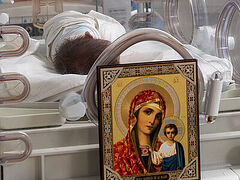
The icon was brought to Rarău from Mount Athos by Petru Rareș, prince of Moldavia, who received it as a gift from Athonite monks in gratitude for his many donations to their monasteries, and placed it in Rarău Monastery, which he had founded after 1538. It's painted in the Hodegetria style, showing the Mother of God holding Christ on her left arm while her right hand gestures toward Him.
Rarău Monastery was later rebuilt at its current site near the village of Chiril in Crucea commune after the original was burned by Austrian forces occupying the region, then known as Bukovina. It flourished after 1950 under St. Cleopa (Ilie) and drew the poet and journalist Sandu Tudor, who took monastic vows there under the name Daniil and was later arrested by the communist government in 1958, leading to the monastery’s downgrade to a skete under a 1959 decree. The icon itself was returned to Rarău from Slatina Monastery in 1968.
The monastery was restored to full monastery status in 1990. Among the miracles attributed to the icon over the centuries are the rescue of seven miners trapped for ten days by flooding in the Călimani Mountains and instances of myrrh flowing from the icon itself.
Follow OrthoChristian on Facebook, Twitter, Vkontakte, Telegram, WhatsApp, and MeWe!