Văratec and Bucharest, August 17, 2026
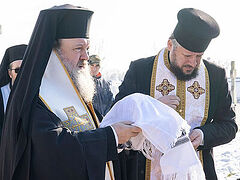
 The reading of the Synodal tomos of canonization of Sts. Nazaria, Olimpiada, and Elisabeta of Văratec. Photo: basilica.ro
Two local canonization services were celebrated in Romania on Sunday, proclaiming the holiness of four Romanian women.
The Romanian Holy Synod canonized 16 holy women in July 2025, a group that includes martyrs, monastics, wives of rulers, mothers of saints, and confessors. Their canonizations were proclaimed together in a service in Bucharest this past February. Since then, local proclamation services have been held in the places where the saints lived, served, and reposed.
At Văratec Monastery in Neamț County on Sunday, ten hierarchs and numerous archimandrites and abbots from the Moldova region, joined by Romanian clergy from the country and diaspora, served the Divine Liturgy, after which the local canonization of Sts. Nazaria, Olimpiada, and Elisabeta of Văratec was proclaimed, reports the Basilica News Agency.
His Grace Bishop Nichifor of Botoșani, read the synodal Tomos proclaiming the canonization, followed by the presentation of the saints’ icon and the singing of their troparion and kontakion.
His Eminence Metropolitan Teofan of Moldova and Bucovina read a message from His Beatitude Patriarch Daniel of Romania for the occasion. In the message, the Patriarch says the canonization of the three saints, “alongside the other 13 holy Romanian women, shows the blessed work of God among the Romanian people, from whom these holy women arose.” He adds, “Through their spiritual lives, they illuminated the souls of nuns and lay faithful, showing them the path of salvation in Christ.”
 Photo: basilica.ro
Metropolitan Teofan then offered his own reflections on the occasion. St. Nazaria, he said, shows that pure prayer isn’t a utopia. St. Olimpiada, he continued, shows that taking on external cares and administrative or leadership responsibilities doesn’t stop a person from reaching God—rather, when such service is undertaken in God’s name, it becomes a pure offering to the Holy Trinity. St. Elisabeta, he added, shows those who fulfilled the Lord’s word to the rich young man in the Gospel: “Go, sell your possessions, give to the poor, then come and follow Me.”
Abbess Iosefina of Văratec Monastery spoke about the responsibility of the community to carry forward the legacy left by previous generations. “Such a feast isn’t prepared in a day, or even in a year,” she said. “We could say it’s been in preparation for nearly 240 years, since the founding of this monastery. Generations of nuns have come here in prayer and obedience, keeping the Church’s rule and the order established by the founders of this community.”
She added that St. Nazaria brought the hesychast order, St. Olimpiada cultivated liturgical beauty, and St. Elisabeta turned prayer into almsgiving, showing that prayer, service, and love of neighbor aren’t separate paths but expressions of the same spiritual work.
A fragment of the saints’ relics was also given to Fr. Ștefan Ababei, parish priest of the Doamna Bălașa Church in Bucharest, which was founded by St. Elisabeta (Safta Brâncoveanu).
Read more about Sts. Nazaria, Olimpiada, and Elisabeta in the article, “Holy Women of Romania.”
 From the service for St. Maria Brâncoveanu. Photo: basilica.ro
At the New St. George Church of St. George in Bucharest, meanwhile, the local canonization of St. Maria Brâncoveanu was proclaimed the same day. Churches founded or supported by the saint received icons containing a fragment of her relics, including the St. Nicholas in-a-day Church, and the monasteries of Hurezi, Surpatele, Dintr-un Lemn, Berivoi, and Viforâta.
His Eminence Archbishop Casian of the Lower Danube presented the Tomos of proclamation. In it, the Church says St. Maria Brâncoveanu “endured imprisonment, contempt, hunger, and want, but didn’t fall into despair, instead being strengthened through prayer and hope in God.” It recounts how, in 1716, she secretly brought the relics of the Brâncoveanu Martyrs—her husband and four sons, executed in Constantinople in 1714—from the island of Halki and placed them in Bucharest’s New Church of St. George, which the family had founded.
 Photo: doxologia.ro
His Grace Bishop Varlaam of Ploiești then read a message from Patriarch Daniel titled “St. Maria Brâncoveanu—a Model of Faith, Patience, and Generosity.” In the message, the Patriarch says her life shows “the luminous image of a faithful wife and mother, the model of martyric patience in suffering, and the example of generous love for the Church and people.” He adds that love for God strengthened her to carry an unparalleled sorrow with faith, becoming the foundation of hope for her daughters and sons-in-law.
St. Maria Brâncoveanu was born in the second half of the 17th century to boyar Neagu of Negoești and was a niece of ruler Antonie Vodă of Popești. After the martyrdom of her husband, ruler Constantin Brâncoveanu, and their four sons, she endured imprisonment and exile. In her later years, she lived in prayer, fasting, and almsgiving at Surpatele Monastery, from where she often visited the wonderworking icon of the Mother of God at Dintr-un Lemn Monastery. The path she walked became known among the people as “the Lady’s Road” or “the Road of Tears,” for the tears she shed over the loss of her husband and sons. She reposed in December 1729 and was buried at the New Church of St. George.
Follow OrthoChristian on Facebook, Twitter, Vkontakte, Telegram, WhatsApp, and MeWe!