Bishop Alexei (Zanochkin), who began his pastoral ministry in Russia, has served in Austria for over four years now. We talked with His Eminence about the size of Russian Orthodox Church parishes in Austria, how episcopal ministry here differs from service in the Russian provinces, and the challenges faced by Orthodox believers living in Austria.
 Austrian landscapes
It is hard not to admire Austria. The wonderful beauty of Alpine nature meets neat towns, fine roads, and excellent public transport. Vienna, the capital, bears the mark of past imperial power mixed with modern office buildings that show the current economic strength of the Austrian state. Success and wealth go hand in hand here with care for ordinary people to build a cozy daily life.
Catholic Austria is becoming more Orthodox as it loses its historic Roman faith; this change is partly driven by ongoing migration from Orthodox nations rather than local conversions. Serbs arrived in the early 1990s, followed by Romanians and Bulgarians after the 2007 EU expansion, and Ukrainians since 2022. Migration from other Orthodox states, including Russia and Belarus, has been steadier and smaller in scale.
 Bishop Alexei (Zanochkin) of Vienna and Austria The Austrian Diocese of the Russian Orthodox Church is significant in its own way. Coincidentally or not, many Russian hierarchs who served in Vienna have subsequently held key positions in the Moscow Patriarchate. For instance, Metropolitan Hilarion (Alfeyev) served as the chairman of the Department for External Church Relations (DECR) for many years; Metropolitan Pavel (Ponomarev), after serving as Exarch in Belarus for several years, now heads the Department for the Affairs of Dioceses in the Near Abroad; and the current head of the DECR, Metropolitan Anthony (Sevryuk), was also among the heads of the Austrian Diocese.
However, the ROC diocese in Austria is small; it includes only seven parishes, and is much smaller in number than the Serbian and Romanian ones.
“We should not forget that the Serbian community in Vienna numbers nearly 250,000 people—five times the size of the Russian one,” noted Bishop Alexei, the ruling hierarch of the Austrian Diocese. “We are indeed few in number, but we do not strive for publicity, laboring quietly and without undue haste.”
I spoke with Vladyka Alexei in his office at St. Nicholas Cathedral in Vienna. It was an unhurried and amiable talk. During it, I not only asked questions, but also answered them myself. The tea and the Viennese apple pie, apfelstrudel, which he kindly offered, made our conversation even nicer.
Bishop Alexei (Zanochkin), a native of the city of Orel, originally earned an engineering degree and even managed to work a secular job. However, he then made a decision that directed his life down a completely different path—of total service to God as a priest and monk.
“It was the 1990s—a very dynamic time,” recalls Vladyka. “I have a certain nostalgia for those years. I believe it was a very spiritual time. The influence of that era and my introduction to science contributed to my choice of the priesthood.”
Science and the Bible
Bishop Alexei and I talked about science with special passion. After all, I am no stranger to scholarly work myself, even though my field (sociology) leans more towards the humanities than technical or natural sciences. There are frequent examples of scientists coming to God through the comprehension of the world around them and the secrets of the universe. In this lies the providential nature of scientific knowledge, which allows scientists not only to benefit people, but also to guide themselves onto the path of saving their souls.
“According to the Russian scientist and writer Mikhail Lomonosov, God gave man two books: the Bible, and nature,” Bishop Alexei says. “I have always been interested in science, and I still try to keep abreast of scientific discoveries. How many fascinating things we learn! More subatomic particles have been discovered than there are elements in Mendeleyev’s periodic table. We are told about stunning insights into cellular structure and DNA. Some scientists say that the universe requires an Observer to come into existence, since elementary particles behave differently when an observer is present. Interesting, isn’t it? Yet, for all our cutting-edge discoveries, we still cannot fully understand how the human brain works—where our thoughts originate, how they arise, and how they are controlled…”
—At the same time, Vladyka, the long-standing debate continues over the extent to which science and scientific discoveries align with the Holy Scriptures. What is your opinion— should we as Christians (especially those in the scientific community) seek some form of harmony between certain scientific facts and the Biblical text, or does it make sense to state clearly that science and the Holy Scriptures have different spheres of application?
—I see no contradictions: the Bible focuses primarily on speaking about our soul and our salvation. The Holy Scriptures raise philosophical and ontological questions. The Bible answers questions that are beyond the reach of science. Meanwhile, science gives answers to the remaining questions. Where and how can they intersect? It is hard to say. Science is unable to measure love or the spiritual bond between people. People can be on opposite sides of the globe, yet worry about each other and pray, and an invisible bond exists between them. God arranged it so that the spiritual realm is invisible and uncontrollable by any instruments. But there are many other areas where science is able to have its say. I think that for a believer, pursuing science is more interesting than for a non-believer, because we (believers) see the harmony and purposefulness of the picture of the world, which reflect the Creator’s design.
Orthodox Children’s Camps
 Orthodox camp in Merkur
The issues between science and the Holy Scriptures are very interesting to discuss, but so deep and vast that one could talk about them for hours without exhausting the subject. Knowing we had limited time, I gradually steered the conversation to other topics. While living in Russia, Vladyka (then priest) Alexei organized Orthodox sessions in children’s camps. I asked him how successful and popular this format turned out to be.
—Here, I think the issue is not so much about the success of this format, but about its utter necessity. After all, how often does it happen? A child is seven or eight years old, goes to church with his parents, takes an interest in the Orthodox faith, asks questions, and everyone around finds it heartwarming. Then adolescence arrives, and the outside world starts pulling him away. But if there is fellowship with peers in an Orthodox environment, then there is a better chance the teenager will not stop going to church. I know families where children attended Orthodox camps, interacted with Orthodox peers, and did not abandon the Church. What is more, rather many of them became priests, priests’ wives, or staff members of diocesan institutions. But for many children whose circle of friends in the Orthodox environment never formed, the path was much harder and more thorny. It does not depend on where they live—whether in Russia or abroad. Except that abroad, there is the additional challenge of preserving culture and language… In Austria, we organized such a camp for the first time in 2024. Then about sixty people came, and in 2025 and this year there were a bit more, roughly eighty people (including adult chaperones—there were about fifty children).
 Orthodox camp in Merkur
—Can you tell us more about these camps?
—Yes, of course. Our first camp was in Sonnenland, Austria. The second and third took place in Merkur in the neighboring Czech Republic. We would find a suitable spot for tents and set up a tent camp. Children came with their parents, as no other arrangement is allowed here. The camp lasts for four days, and we usually try to schedule it around the movable feast of Corpus Christi, since it is a public holiday in Austria. Those four days are filled with games, rest, and socializing. Using cellphones and tablets is forbidden, and anyway there is no time for them. I believe children under the age of fifteen should not be given an internet-connected phone, because uncontrolled internet use by children is extremely dangerous and can cause them immense harm. Therefore, the children go without the internet at camp. If they manage to spend four days without being online, it means they can do it longer. However, that responsibility falls on the parents and how they raise their children. This issue cannot be solved through Church instructions alone.
I would also note that this year (just like last year), We celebrated the Liturgy at the camp, and almost all the children received Communion. It so happens that I am mostly responsible for running the Orthodox camp, drawing on my experience in the Orel Diocese. Right now, of course, we are building up our experience in Austria, and wonderful coworkers are joining us from the cathedral and other parishes.
 The Orthodox camp participants in Merkur
On Monasticism
—Vladyka, when you served in the Orel region, you were the dean of the diocese’s monasteries. Can you compare the desire for monastic life in the Russian provinces and in Austria? Why has it happened that there is not a single Orthodox monastery in Austria, except for a small community in the east of the country, in Sankt Andrä am Zicksee (under the jurisdiction of the Patriarchate of Constantinople)?
—Austria has not become a center of Russian emigration, like France, for example. Apparently, there were not enough Orthodox emigres here to open a monastery. Those who wish can go to Mt. Athos, for example—the borders are open and there are no obstacles for Austrian residents. In Russia I once witnessed “growing pains” in monastic communities which, let us be frank, are inevitable. Today, a major plus is that good training programs for monastics are being organized, including online programs that allow monks to study without leaving their monastery. One always hopes that people with a holistic worldview will come to the monastery—that is important for the community. But sometimes people join because their family life did not work out, and they want to try a different path.
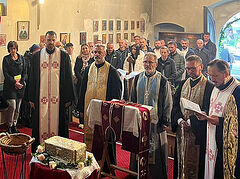
 St. Nicholas Cathedral in Vienna Of course, I would be happy to see an Orthodox monastery in Austria. But this requires a person who can build such a monastery. In the jurisdiction of Constantinople, there was Archimandrite Paisios (Jung), a very respected priest of German descent. About ten years ago, he became the abbot of a monastery opened in eastern Austria. People came to him for spiritual advice by the busload. When the OCU was established, Archimandrite Paisios asked not to be forced to serve with them, as he well understood that this “new” Ukrainian “Church” was uncanonical. Unfortunately, the administration of the Diocese of Constantinople did not meet him halfway. Fr. Paisios left Austria, moved to the jurisdiction of the Serbian Church, and together with some monks founded a monastery in Bosnia, where he lived until his repose in 2024. By the way, he attended our services at St. Nicholas Cathedral (although he did not concelebrate) and held the Russian Church in high regard, venerating the holy Royal Martyrs.
He was a unique figure in Austria, although such people do exist among Germans and Austrians who, when they come to God, do so wholeheartedly and with deep commitment. However, you cannot build a monastery around a Christian convert; a person must have some monastic experience. In the Austrian Diocese of the ROC, it is hard to find people with such experience—we are very few in number.
—Perhaps this small number is also due to the fact that some emigrants are leaving Orthodoxy?
—The world outside the Church is, if not hostile, alien to Orthodoxy. A person living in Austria must make a certain effort to remain Orthodox. But I am glad to say that our parishioners are conscious people who are truly interested in keeping both themselves and their children in the bosom of the Orthodox Church. We are still small in number, but we are growing.
Orthodoxy and the Outside World
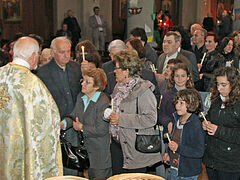
 Paschal Cross Procession in Vienna
—You have noted that the outside world is alien to Orthodoxy. Does this mean the external environment—at school, university, or work—alienates you from the Church, or are we talking about an external indifference that still does not hinder a Christian’s free choice?
—Christianity tells us about three enemies: the world, the flesh, and the devil. Love not the world, neither the things that are in the world (1 Jn. 2:15), wrote St. John the Evangelist. In Austria, another nuance is added: the surrounding people are mostly of another faith—Catholics. Plus, there is growing disbelief and rejection of Christianity.
—Is there one more problem related to liberal laws—the possibility of registering same–sex “marriages” or the imposition of gender ideology in schools? After all, Orthodox Christians, basing their position on the Holy Scriptures, have a different view of these things.
—I cannot say with certainty whether all this liberalism reflects the official position of the Austrian state. Rather, there are certain forces in the European Union pushing an agenda alien to Christianity. People even talk now about a “new democracy”, where a minority rather than the majority is supposed to rule. Of course, Austria is a country with deep religious traditions and a multi-party system, so it is hard for me to say why such an agenda has become a reality here. But it truly causes problems, because absolutely unacceptable things are being forced on schools. You have probably noticed that rainbow flags are hung all over Vienna. Unfortunately, over the past generation or two, humanity has drifted far down the path of sin. As a result, even when drafting conciliar documents today, we sometimes struggle to find language appropriate for a church text.
It is clear that such things must be tackled at the family level by explaining everything to children to counter outside influences. Yet overall, Austria has many sensible people with a Christian worldview. Some of them are interested in Orthodoxy, and we look for common ground for dialogue. For instance, we talk about the pre-Schism Austrian saints. We know of fourteen such saints, and we have submitted this list to the Commission for the Canonization of Saints. We really hope to establish a feast-day for the Synaxis of the Saints of Austria on October 26, which is a public holiday and national day in Austria. When our dialogue with Austrians—especially those interested in Orthodoxy—focuses on these common saints, it becomes meaningful, productive and interesting.
—Are there any such Austrians who later convert to Orthodoxy—specifically out of conviction, rather than due to, say, a family situation (marriage to an Orthodox person)?
—Yes, such people exist, but this is a rare occurrence rather than a mass phenomenon. There are probably more such cases among Serbs or Romanians, whose diasporas are much larger than the Russian one. But the Lord guides everyone along His own paths, known to Him alone. In family situations, the Orthodox spouse is usually more active, while the Catholic one is more neutral. So, through a husband or wife people are saved... They come to our services. Even our church services are a witness to Orthodoxy. Here I can mention those Austrians who are deeply interested in Russian music and culture. Before the start of the Special Military Operation (SMO), representatives of one Catholic monastic order used to come to our services. They just stood at the church and prayed.
—It turns out that 2022 unfortunately became a turning point for them… What about Ukrainians living in Austria? Do they still attend Russian Orthodox Church parishes?
—Ukrainians who used to come to us before the start of the SMO keep coming. After the beginning of the Ukrainian conflict, new people from various regions of Ukraine arrived here. The faithful of the UOC-MP have mostly joined our parishes. By the way, Ukrainians really want their children to grow up as normal people, where faith and the Church face no persecution, and where there is no inversion of values or imposition of same-sex “marriages” and the like. The fact that Russia strives to endorse Christian values matters a great deal to them. I myself feel and understand that I have a vast Motherland behind me where traditional values are supported and encouraged… I will also note that in Austria, new Ukrainian communities have been established as part of the Serbian Church and the Patriarchate of Constantinople. The Patriarchs of these Local Churches are commemorated there.
On the Teaching of the Basics of Orthodoxy and the Clergy
—Since the number of Orthodox Christians in Austria is growing, is it possible to organize the teaching of the Basics of Orthodoxy in schools? As far as I know, Austrian laws provide such an opportunity.
—Austrian law specifies that children have the right to study the basics of their religion at school. Even if there are two or three Orthodox students in a school (which is usually the case thanks to the Serbian and Romanian diasporas), the state is obliged to provide a salaried teacher whose credentials are recognized in Austria. Currently, Orthodoxy is taught in schools mostly by Serbs and Romanians. Only one person from our diocese has secured this opportunity.
—Apparently, this is also because the diocese is small…
—We are few in number, but, as I have already noted, the diocese is growing. Over the four and a half years that I have been serving here, not a single parish has been closed. Two parishes have received state registration (there are now five parishes with state registration). We have succeeded in keeping our relations with the state stable, although it was not easy, since after the start of the SMO there was a lot of negativity towards us from secular media. Thank God, we have managed to endure it all. In Austria, and indeed in overseas ministry in general, it is better not to have any great achievements than to make one mistake, as the price can be very high. We try to avoid excessive publicity—it does more harm right now. Incidentally, we have more priests in our diocese now—that is also an undoubted plus.
—Are these priests from among the locals, or are you inviting candidates from Russia?
—I believe we need a balance here; parity must be maintained. If the majority of priests are locals, we will lose our identity as the Russian Church and acquire a pronounced foreign accent. But if priests who came from Russia predominate, the local traditional ties will be missing. After all, it is important for us to understand the problems of believers living specifically in Austria, rather than in Voronezh or Orel. When I arrived in Vienna, the diocese was unbalanced because local priests were in the majority. So, we invited a few more people who strengthened our Russian presence. The parishioners reacted to this positively.
—Can the diocese afford to pay the clergy a full salary? Or do priests, as in many other European countries, have to work secular jobs?
—Unfortunately, we cannot fully support the clergy with all their insurance. That’s why many work secular jobs. Of course, this is a double-edged sword: if a priest works, less is expected of him; although for locals, this is part of the usual order and they see nothing unusual in it. I also see no point in changing this established tradition.
—If a parish is recognized by the state, can it expect financial assistance from the budget?
—No, nobody pays us. Official recognition makes a parish a public law corporation, which allows it to interact directly with government authorities—for example, to request parking spaces at a nearby facility under construction and to open a bank account. Overall, the state views the growing number of registered parishes of the Russian Church as a sign that this denomination is important and in demand.
—What differences do you see between the spiritual state of churchgoers in Russia and Austria?
—I think that in Russia, on average, parishioners’ religious knowledge is higher, partly thanks to the labors of Professor Alexei Osipov, Archpriest Dimitry Smirnov, Archpriest Andrei Tkachev, and many others. In Austria, parishes are stronger and closer knit; here, parishioners typically communicate and know each other’s needs and problems. I cannot help but note that in our St. Nicholas Cathedral in Vienna this year there were very many people at Pascha—probably the largest number of people in ten years. The overwhelming majority stayed until the end of the service and took Communion. There was no such fuss or walking around that sometimes happens at Paschal services. The people prayed, and a reverential mood and silence filled the church.
—Vladyka, having served for many years in Russia and for several years in Austria, in what ways did you see the differences in the episcopal ministry here and there?
—A bishop must always safeguard the purity of the faith, oversee the clergy, and guide church preaching. Issues of church discipline, ordination, and the consecration of churches exist in both Russia and Austria. But the difference in scale is clear. In Austria, the challenge of interacting with other faiths and receiving people from other denominations into Orthodoxy is more visible than in Russia. Yet keeping church unity matters everywhere—in the Orel Diocese, the Austrian Diocese, or any place in the world.