Photo: iz.ru
In the name of the Father, and of the Son, and of the Holy Spirit!
Dear fathers, brothers and sisters, today our Church commemorates the finding of the Honorable and Life-Giving Cross. This event took place 300 years after the Resurrection of our Lord Jesus Christ and shortly after the recognition of the Christian Faith by the Edict of Milan in 313 A.D., when the Roman emperor himself, through Divine providence, inclined toward accepting the Christian Faith.
The finding of the Precious Cross of the Lord was accomplished by St. Helen, the mother of Emperor Constantine, Equal-to-the-Apostles. As this pious empress visited the holy sites sanctified by the life and sufferings of the Savior, the Holy Spirit stirred a desire in her heart to find the Cross of Christ, which had fallen into obscurity because of the persecution of Christians. The Jews and pagans, unable to tolerate the worship of God, wished to erase all traces of the Savior’s life. As we know, the Lord’s Cross was buried in the ground, and a pagan temple was built over that very site. When the temple was destroyed and they began to dig into the earth in search of the Cross, an ineffable fragrance was perceived.
The tradition of the Church of Jerusalem has preserved for us the testimony that the holy Empress Helen, in order to expedite the search for the Cross, threw gold coins to the slaves as they cleared the heaps of stones with which it was buried. And when three crosses were discovered, St. Macarius, the Patriarch of Jerusalem, ordered a terminally ill woman to be brought forward. The hierarch touched her first with one cross, then with another. And when they brought the Cross bearing the inscription and touched the ailing woman with it, she rose up completely healthy. This miracle made it clear that this was the True Cross of Him Who is the Resurrection and the Life (cf. Jn. 11:25).
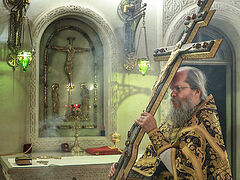
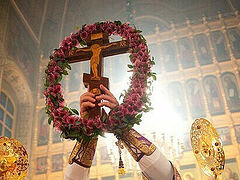
Everyone desired to see the Cross, but a massive crowd made it difficult. To help them see, Patriarch Macarius began to elevate the Cross of Christ, giving rise to the feast’s name: the Exaltation of the Precious and Life-Giving Cross of the Lord. Today, on this feast day, the Patriarch of Jerusalem, accompanied by a host of clergy, believers, and pilgrims, processes with the Cross from the Lithostrotos along the Way of the Cross—the path our Lord Himself walked―to Golgotha, the site where the Church of the Holy Sepulcher (of the Resurrection of Christ) now stands. As we know, it is here, at the Lord’s Tomb on Holy and Great Saturday, that the Holy Fire descends in answer to prayer. Deep within this church, in its lowest chapel, lies the place where the Lord’s Cross was discovered. It is a major site of veneration for Orthodox pilgrims. We know that the True Cross has not survived intact as a whole; individual fragments of its wood remain, and they are kept by the primate at the Holy Sepulcher.
If we were asked what the Lord has done for us through His death on the Cross, each one of us would rightly answer that He granted us salvation. But if we were asked what the Lord saved us from by His death on the Cross, perhaps not everyone would answer correctly. The great Russian theologian, St. Philaret (Drozdov) of Moscow, says that the Crucifixion of the Son of God was necessary in order to save us from sin, the curse, and death. Sometimes people ask: why does sin still retain such great power, even among believers, after the atoning death? This happens because man does not make use of the grace given in the Church Sacraments, and rejects it. However, true Christians, who make use of the grace provided in the Sacraments, gradually overcome sin with God’s help, and make progress in goodness.
Before His Crucifixion, Christ told His disciples, No man taketh it [life] from Me, but I lay it down of Myself (Jn. 10:18). And in the prayer before the consecration of the Holy Gifts, the priest does not say that the Lord was betrayed to death—He was not betrayed, but rather He gave Himself up to death on the Cross for our salvation.
In addition to the bodily veneration of the Cross, spiritual veneration of it is also necessary. This involves a constant feeling of gratitude for Christ’s Passion on the Cross, which delivered us from eternal perdition. Spiritual veneration of the Cross means forgiving all offenses and maintaining a sense of constant humility. The Lord said, If any man will come after Me, let him deny himself, and take up his cross, and follow Me (Mt. 16:24). Self-denial means not considering yourself better or higher than others, not considering yourself wiser than others, and not repeating after the Pharisee the words, “They are worse than me, and I am better than them.”
Spiritual veneration of the Cross means having no desire for personal gain at the expense of the people around you. The inner cross is an invisible warfare against your own passions; it is a daily labor to overcome them. The inner cross is inherently linked to repentance. Let us recall the Wise Thief: in the final hour of his life, he looked into the depths of his heart, recognized all his guilt before God and man, and saw the filth and baseness of his soul. Yet, he overcame this sorrow and turned to the Lord Jesus Christ in a prayer of repentance, pleading for His mercy and forgiveness of sins. And the Lord answered the thief’s repentant supplication, Verily I say unto thee, Today shalt thou be with Me in Paradise (Lk. 23:43).
In the Cross are our life and resurrection. In the Cross are our victory, salvation, and glory. And celebrating the victory of good over evil, we exalt the Cross and venerate it. The Apostle Paul says, But God forbid that I should glory, save in the Cross of our Lord Jesus Christ (Gal. 6:14). But St. Paul had much to boast of–he enjoyed the privileges of a Roman citizen, possessed a profound mind, and was a highly spiritual, educated man who held a prominent position in the Church of Christ. No one in the world spoke as the Apostle Paul did, but he remains silent about all of this. For him, boast and joy are found in the Cross of the Divine Master, Who died and rose again, that whosoever believeth in Him should not perish, but have everlasting life (Jn. 3:16).
The sign of the Cross possesses immense power, as evidenced by numerous accounts in the lives of the saints. For instance, St. Benedict of Nursia’s enemies came to hate him for his strictness and resolved to kill him. To this end, they offered him wine laced with poison during dinner. The saint, foreseeing their evil intent, made the sign of the Cross over the cup, and it immediately shattered as if struck by a stone. Similarly, when malice-minded men gave a cup of deadly poison to St. Julian, Bishop of Bostra, he made the sign of the Cross over it, drank it, and suffered no harm whatsoever. Regarding life’s trials, St. Ephraim the Syrian instructs: “If you happen to fall into any sorrow, do not resort to worldly aid or human intervention. Instead, learn patience and humility, awaiting mercy from God so that He may guide you in all things.” Furthermore, St. Mark the Ascetic teaches: “When a sorrowful temptation overtakes you, do not search or try to find out why or for what reason it came on you, but strive to endure it with thanksgiving.”
The Irmos of Ode 3 of the canon for the feast of the Exaltation of the Cross speaks of how the Wood of the Cross blossomed. The Cross, once an instrument of execution, became a blossoming tree, bearing fruit. And our damaged nature constantly stands in need of sorrows as an antidote, because they extinguish our affinity for the sinful poison of the passions, according to St. Ignatius (Brianchaninov). Similarly, St. Dmitry of Rostov states: “The Physician of our souls and bodies, seeing our spiritual wounds, applies the appropriate remedy. He ‘burns’ with adversities and ‘cuts’ with sorrows and sicknesses, doing so not to destroy us, but to heal and quicken us.” This is why the King and Prophet David says in one of his psalms: With chastisement hath the Lord chastened me, but He hath not given me over unto death (Ps. 117:18).
The Cross is a symbol of the victory of good over evil, for it pleased God the Father that the Son should be crucified on the Cross and accept His death on it, redeeming the human race from sin, the curse, and death. May God grant that, in addition to your love for yourselves, for anyone or anything, you would have love for our Lord Jesus Christ, Who will be with you in joy and sorrow. May the Lord help us bear the cross, which is given according to each person’s strength, with patience, humility, and fortitude. Amen.