October 7, 2026
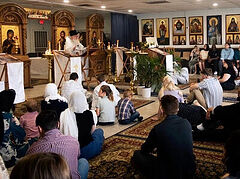
 Photo: gosaintgeorge.com
Parishes of the Russian Orthodox Church Outside of Russia (ROCOR) posted the biggest membership gain among US Orthodox jurisdictions since 2020, according to a report from Alexei Krindatch, National Coordinator of the US Census of Orthodox Christian Churches, who analyzed data from the latest Faith Communities Today survey.
The typical ROCOR parish saw the number of its regular participants grow by 166% between 2020 and 2025. The figure was 65% for the Antiochian Archdiocese, 37% for the Orthodox Church in America (OCA) and 33% for the Greek Orthodox Archdiocese. Orthodox parishes overall grew by 35%, compared with 17% for US congregations nationally.
The survey, coordinated by the Hartford Institute for Religion Research, was conducted in December 2025 and included 7,500 congregations, 270 of them Orthodox. Krindatch broke out data for the four jurisdictions that had enough participating parishes: the Antiochian Archdiocese, the Greek Archdiocese, the OCA, and ROCOR.
Median Sunday attendance in Orthodox parishes rose 36% from 2019 to 2025, while the national figure was flat. The Antiochian Archdiocese led on this measure at 87%, followed by the OCA at 67%, and ROCOR at 60%. The Greek Archdiocese posted 12%. Overall, 78% of Orthodox parishes said they’re stronger than before the pandemic, versus 56% of congregations nationally. The Greek Archdiocese was the lowest of the four at 68%.
The jurisdictions handled the pandemic differently. Only 11% of ROCOR parishes closed for in-person services, and 21% now stream worship online. In the Greek Archdiocese, 75% closed and 75% now stream. Across Orthodox parishes, 44% never closed, compared with 21% of congregations nationally. Krindatch found that parishes that stayed open and offer no online worship saw attendance grow by 48%, versus 11% for those that closed and now stream.
ROCOR parishes also had the youngest membership, with 27% young adults and 12% seniors, while Greek parishes had 17% and 26%. Orthodox parishes overall had 22% seniors, compared with 33% nationally. Nearly half of ROCOR members (49%) had joined within the past five years. Women made up 43% of ROCOR members, compared with 49% in Orthodox parishes overall and 58% nationally.
Clergy of the jurisdictions differed as well. ROCOR’s priests had the highest median age of the four jurisdictions at 61, and 28% held a Master of Divinity degree, compared with 95% in the Greek Archdiocese and 78% across Orthodox parishes. Some 73% of ROCOR priests served full-time. Still, 93% said they had never considered leaving ministry, the highest share of any jurisdiction.
When clergy were asked whether their parish is spiritually vital and alive, 70% of ROCOR priests strongly agreed, compared with 33% in the Greek Archdiocese, 56% in the OCA and 63% in the Antiochian Archdiocese. On having a clear mission and purpose, ROCOR stood at 83% and the Greek Archdiocese at 35%. Across Orthodox parishes, 49% strongly agreed on vitality, compared with 39% of congregations nationally.
ROCOR parishes had the lowest median giving, at $742 per participant a year. That compared with $1,241 in the Greek Archdiocese, $1,248 in the OCA, $1,200 for all Orthodox parishes and $1,657 nationally. Their annual spending of $553 per participant also trailed the Greek Archdiocese’s $2,108. Even so, 71% of ROCOR parishes described their finances as good or excellent, the highest share among the four jurisdictions.
Across jurisdictions, Orthodox parishes put more emphasis on fasting than other congregations (39% versus 10%) and were more likely to avoid political discussion (65% versus 45%). Only 12% of Orthodox clergy said their parish was actively involved in its local community, compared with 33% nationally.
The full report, “Orthodox Tradition in Transition: What New Data Reveal About US Orthodox Christian Parishes,” is available here.
Follow OrthoChristian on Facebook, Twitter, Vkontakte, Telegram, WhatsApp, and MeWe!