Tallinn, October 9, 2026
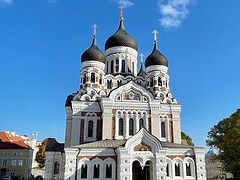
 Pükhtitsa Convent. Photo: S. Mudrov / Pravoslavie.ru
The Estonian Christian Orthodox Church and the Pükhtitsa Convent in Kuremäe have asked the European Court of Human Rights to strike down a law that forces them to cut ties with the Moscow Patriarchate or face dissolution, their lawyers announced.
The law, which the Supreme Court upheld on June 8, requires the Church to sever administrative links with the Moscow Patriarchate and appoint a new Metropolitan by December 28 (His Eminence Metropolitan Evgeny was expelled from the country in 2024 despite authorities openly acknowledging that he posed no threat. He remains Metropolitan of Tallinn). If it doesn’t, the Interior Minister intends to seek the Church’s compulsory dissolution, according to the Church’s lawyer, Artur Knjazev, reports err.ee.
President Alar Karis twice declined to promulgate the law before it was passed a third time on September 17, 2025. He then petitioned the Supreme Court, arguing it was unconstitutional. The court sitting en banc upheld the law by interpreting it as prohibiting administrative ties rather than religious ones. Six of the 17 judges, including the chief justice, dissented, finding that the law failed to meet the requirement of legal certainty.
“The Church and convent are not simply being asked to amend a document,” Knjazev said. “In Orthodox Christianity, you can’t rewrite the rules of the Church yourself and remain Orthodox. Anyone who does so has renounced the faith they’ve chosen and have considered true until now.”
He said the Interior Ministry is in effect offering “a choice between two impossible options—choose another Church or we’ll put an end to your current activities.”
Knjazev also pointed to the European Convention on Human Rights. “The state may regulate how religion is practiced publicly,” he said. “It may not force a person to change their faith. That is exactly what is happening now.”
Attorney Steven-Hristo Evestus, who also represents the Church, said the Supreme Court’s reasoning doesn’t match the law as written. “The concept under which this law was rescued doesn’t appear anywhere in the law itself,” he said. He added that the Ministry has maintained throughout the process that both administrative and religious ties must be severed, and that the Church and convent fall under the prohibition on that basis.
“No Estonian authority has established that the Church or convent has done anything unlawful,” Evestus said. “There is a punishment, but no offense.”
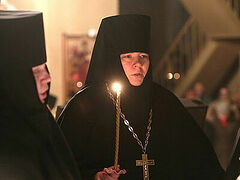
Knjazev also spoke about the convent itself, which is home to around 90 nuns whose average age is over 60. Nuns have been praying there for more than 135 years, he said, and they always pray for Estonia too. “If the prayers of 90 elderly women can undermine national security, then the problem is not with the nuns,” he said.
The amendments to the Churches and Congregations Act entered into force on June 27, 2026, giving religious associations six months to comply. In January 2025, the Church dropped “Moscow Patriarchate” from its name. The Interior Ministry judged that change insufficient, since the Church’s statutes still require Patriarch Kirill’s signature on major decisions.
Follow OrthoChristian on Facebook, Twitter, Vkontakte, Telegram, WhatsApp, and MeWe!