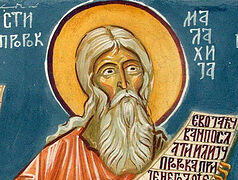
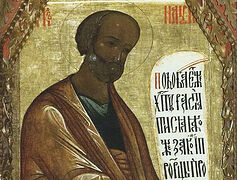
The Prophet Zephaniah. Mosaic at Daphni Monastery Among the twelve “minor” prophets of the Old Testament, Zephaniah stands apart. While Amos was a shepherd and Micah a simple villager, Zephaniah belonged to the highest ranks of Judah’s aristocracy. His prophetic ministry took place during the reign of King Josiah—an era that bears a striking resemblance to our own times.
At that time, the king embarked on a large-scale restoration of the Temple, the destruction of idols, and the revival of the prescribed order of worship. Outwardly, everything appeared to be flourishing, much as it did in our own not-so-distant past. Recall the spirit of the 1990s [in Russia]: church domes gleamed with gold, there were ten applicants for every place in the seminaries, and the faithful gathered regularly for the great feasts. Yet the prophet’s penetrating gaze discerned something very different in Judah. He saw that behind the splendid façade of public piety lay hearts growing cold, double-mindedness, and spiritual lukewarmness.
Motorists know that a tire can suffer a sudden puncture, but it can also develop a microscopic crack through which air escapes imperceptibly, day after day. The car keeps moving, the driver suspects nothing, but the tire pressure steadily drops. The greatest danger in spiritual life is precisely this second scenario. At first, a person comes to Christ filled with fervor, reads the Gospel every day, and can hardly wait for the Divine Liturgy… But then he begins to grow cold. The fire in his heart gradually dies down, slowly and almost imperceptibly.
The Book of the Prophet Zephaniah is an attempt to shake the people out of their complacency and show them that a “religion of comfort” has nothing to do with faith in the True God, but is instead a direct road to catastrophe. For us, living amid the frantic pace of big-city life, surrounded by the constant clamor of information and the temptations of an easy existence, Zephaniah’s voice sounds not like a dry historical chronicle, but like a living voice calling us to awaken from our spiritual slumber.
The Book of the Prophet Zephaniah is an attempt to shake the people out of their complacency and show them that a “religion of comfort” has nothing to do with faith in the True God, but is instead a direct road to catastrophe. For us, living amid the frantic pace of big-city life, surrounded by the constant clamor of information and the temptations of an easy existence, Zephaniah’s voice sounds not like a dry historical chronicle, but like a living voice calling us to awaken from our spiritual slumber.
The Book of the Prophet Zephaniah seeks to show that a “religion of comfort” has nothing to do with faith in the True God.
To break through this crust of indifference, the prophet begins his message with a shocking declaration:
I will utterly consume all things from off the land, saith the Lord. I will consume man and beast; I will consume the fowls of the heaven, and the fishes of the sea… (Zeph. 1:2–3).
Modern humanism recoils at such words. How can this be? For what reason? Why is God so severe? Fr. Daniel Sysoev often reminded us that we have forgotten that God is not only Love, but also a consuming fire. That very “Day of Wrath” of which Zephaniah speaks is not an outburst of Divine emotion. It is the natural response of absolute Holiness to the cancerous growth of sin.
Remarkably, the prophet’s principal accusation is directed not against those who consciously oppose God, but against those whose faith in Him is merely superficial.
But whom exactly does the prophet rebuke? Remarkably, his principal accusation is directed not against those who consciously oppose God, but against those whose faith in Him is merely superficial. Zephaniah conveys these terrifying words of the Lord:
And it shall come to pass at that time, that I will search Jerusalem with candles, and punish the men that are settled on their lees: that say in their heart, The Lord will not do good, neither will he do evil (Zeph. 1:12).
To be “settled on their lees” is a vivid image of old, thickened wine that has not been poured from one vessel into another for a long time. It is an image of people whose souls have become covered with an impenetrable crust of self-satisfied indifference. They are convinced that God is somewhere far away, that He does not interfere with their comfortable lives. This is precisely that religion of comfort in which the Creator is relegated to the role of a mere provider of religious services.
From this lukewarmness, a divided faith inevitably arises. The prophet rebukes those that worship the host of heaven upon the housetops; and them that worship and that swear by the Lord, and that swear by Malcham (Zeph. 1:5).
Who are these people today? They are us, whenever we try to serve two masters. They are the person who wears a cross around his neck but, “just in case,” spits over his left shoulder, avidly reads horoscopes, or believes in karma. We sincerely desire the joy of Pascha, yet we are utterly unwilling to part with the idols of worldly prosperity. What in ancient Judah took the form of worshipping both Yahweh and Baal has become, for us, a belief in the evil eye and superstitious omens. If the prophet condemned his contemporaries for worshipping the “host of heaven,” today the equivalent is our fascination with astrology, numerology, and psychic phenomena. The essence remains unchanged: distrust of God’s Providence, a desperate desire to control our own future, and an unwillingness to surrender our hearts entirely to God.
And swearing allegiance to the idol Malcham finds its modern counterpart in the cult of endless consumption, ruthless careerism, and the sacrifice of family life on the altar of personal success. The spiritual essence of this phenomenon is the idolatry of comfort and power.
Moreover, the prophet warns: I will punish... all such as are clothed with strange apparel (Zeph. 1:8). Historically, the Jewish nobility had simply adopted the fashions of the surrounding empires. But for us, the image of “strange apparel” takes on a far deeper meaning. Today, it represents alien values and ways of thinking. When a Christian begins to live according to the patterns of secular mass culture, he puts on this foreign attire. When success is measured solely by money rather than by the acquisition of the Holy Spirit; when false tolerance of sin is placed above God’s commandments; when we are ashamed to make the sign of the Cross before a meal in a café for fear of appearing to be “fanatics”—we are clothing ourselves in this strange apparel. The loss of our spiritual identity is always the beginning of the end. If we “dress” (that is, think) like those who do not know God, we cease to be the people of God.
Where does such spiritual complacency lead? To the inevitable collapse of our illusions, sooner or later.
The great day of the Lord is near, it is near, and hasteth greatly... That day is a day of wrath, a day of trouble and distress (Zeph. 1:14–15).
For those who have become inextricably attached to earthly things, an encounter with God becomes a veritable catastrophe
For those who have become inextricably attached to earthly things, an encounter with God becomes a veritable catastrophe. Why? Because the wrath of God is not a desire on His part to inflict suffering upon us, but the inherent incompatibility of light and darkness. When the sun rises, the dampness of the night disappears. If a person has willingly allowed the “dampness” and “mold” of sin to take root within him, the Sun of Righteousness will scorch him. But if he has purified his heart, that same Sun will fill him with Light.
Priest Anthony Lakirev observes that sin makes a person blind. Without God, we lose the ability to see the abyss directly before us. This is precisely why the prophet issues his urgent appeal: Gather yourselves together, yea, gather together… Before the decree bring forth (Zeph. 2:1–2). Salvation always begins with unsparing honesty toward ourselves.
If judgment is so inevitable, who will survive this spiritual catastrophe? Not the strong, not the influential, not the wealthy—for their silver nor their gold shall be able to deliver them (Zeph. 1:18)—but the meek.
Seek ye the Lord, all ye meek of the earth... seek righteousness, seek meekness: it may be ye shall be hid in the day of the Lord’s anger (Zeph. 2:3).
In a world where we are taught from our schooldays to dominate others and trample anyone who stands in our way, the call to seek meekness sounds like madness. The prophet does not mince words when describing the social injustice of his time, when those in power were like “evening wolves” that leave not a single bone until morning. Authority is a form of service, not an opportunity for personal enrichment, and when God sees the oppression of the weak, He intervenes. But Scripture is uncompromising: only humility can pass through the eye of the needle.
Amid the darkness of human malice and apostasy, God promises a miracle: He will preserve His “Remnant”: I will also leave in the midst of thee an afflicted and poor people, and they shall trust in the name of the Lord (Zeph. 3:12). As long as there remain among a people those simple, guileless souls who wear no false masks and sincerely trust in their Father, that people will live.
And here, as the prophet speaks of the salvation of this meek remnant, we come to the most astonishing thought in the entire book—to a revelation for the sake of which, perhaps, all the preceding words of stern warning were spoken. What will God do for those who have remained faithful to Him? The conclusion of the Book of Zephaniah contains one of the most moving passages in all of Scripture, the profound meaning of which is unfortunately often obscured in translation.
The Lord thy God in the midst of thee is mighty; he will save, he will rejoice over thee with joy; he will rest in his love, he will joy over thee with singing (Zeph. 3:17).
The Russian Synodal translation uses the beautiful word likovanie (“exultation”). But if we turn to the original ancient Hebrew text, an utterly astonishing picture unfolds before us. In the original, the phrase reads: יָגִ֥יל עָלַ֖יִךְ בְּרִנָּֽה (yagil alayikh be-rinnah).
According to the authoritative Brown–Driver–Briggs Hebrew Lexicon (BDB), as well as Strong’s Concordance, the verb yagil signifies more than a quiet, inward joy. It denotes joy expressed with extraordinary intensity—exultation. And the word rinnah means a loud cry of joy, ringing song, or a jubilant shout. If we turn to the classic English translation of the Bible, the King James Version (KJV), we find the same idea expressed in the word “singing.”
Just imagine it: God sings!
We have grown far too accustomed to the stern image of God as Judge and strict Lawgiver. But the Prophet Zephaniah reveals to us God as an infinitely loving Father. When He brings back His prodigal son—humanity—and cleanses him of his defilement, He does not merely receive him back with cold restraint. He sings a song of joy!
Why, then, was that terrifying Day of Wrath necessary? To burn away the infection. Why were sorrows necessary? To shatter the deadly “religion of comfort” and lead us to repentance. And the true purpose of this entire arduous historical process is that very Song of God over a soul that has been saved!
The Lord hath taken away thy judgments… (Zeph. 3:15). In these ancient words, we can already hear the proclamation of the Resurrection to come. The sentence of death has been annulled. We are no longer standing accused before the Judge. We are beloved children, and the Creator of the universe sings for joy as He looks upon us.
What, then, should we who live in the twenty-first century do upon hearing this ancient prophecy?
We must undertake an honest examination of our spiritual lives: Has my faith become nothing more than a comfortable habit that demands nothing of me?
-
First, we must stop the “leak” in our hearts and stir up the “lees.” We must undertake an honest examination of our spiritual lives: Has my faith become nothing more than a comfortable habit that demands nothing of me?
-
Second, we must cast off the “strange apparel”: Stop thinking in the categories of the secular world and measuring our lives solely by the standards of earthly success.
-
Third, we must seek humility. We must always remember that before the Face of God, neither status nor connections can save us, but only His mercy toward a contrite heart.
-
And most importantly, we must not be afraid. We must live in such a way that the coming of Christ will be for us not a catastrophe, but a long-awaited encounter with the One we love, so that we may joyfully cry out, “Maranatha!”
As Fr. Oleg Stenyaev constantly reminds us, the Bible is a book not about the past, but about the present. It is as though the Prophet Zephaniah were looking today at our exclusive residential communities, our bustling office complexes, and our churches, whether half-empty or overflowing, and imploring us: Hold thy peace at the presence of the Lord God (Zeph. 1:7).
Let us strive, at least occasionally, to put aside our phones, shut out the noise of the world around us, and, even more importantly, quiet the endless turmoil of our own thoughts. And perhaps, in that grace-filled silence, we will finally be able to hear the very song of joy sung by God as He welcomes His creation!