Christ says in the Gospel: Again, the kingdom of heaven is like unto a merchant man, seeking goodly pearls: Who, when he had found one pearl of great price, went and sold all that he had, and bought it (Matt. 13:45–46). Moved by fervent love for their Savior and Lord, many people forsake the world, glory, and riches in order to dwell forever in inseparable communion with God. For the sake of the Lord and the salvation of their souls, they endure many hardships and privations, knowing that their only treasure is the grace of the Holy Spirit. The Lord often bestows miraculous gifts upon these chosen servants of His—the gifts of healing, clairvoyance, and consolation. To avoid the praise of men, they assume the outward appearance of madness, putting to shame the vain pride of this rebellious world. Such a Christian ascetic struggle is known as foolishness for Christ's sake. Many have followed this path, among them Blessed Domna of Tomsk.
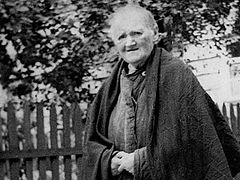
She was born into a noble family in the early nineteenth century. Orphaned at a young age, Domna was raised in the household of her aunt. She received an excellent education and spoke several languages fluently. In her youth, Domna was a beautiful maiden, and many suitors sought her hand in marriage. But the righteous maiden desired to preserve her virginity for the sake of the Lord. Learning that her relatives intended to force her into marriage, she secretly left home, exchanged her fine garments for simple clothing, and set out as a pilgrim to visit holy places. Having no documents to establish her identity, she was arrested and exiled to Siberia. There, settling in the city of Tomsk, she undertook the ascetic struggle of foolishness for Christ's sake.
Domna Karpovna had no permanent dwelling and often spent her days and nights beneath the open sky. Her clothing consisted of knots of various sizes, tied together and draped over her almost naked body. Domna would often finger these knots as though they were prayer beads, thus concealing her unceasing prayer from the eyes of men. When compassionate people gave her a fur coat during the bitter winter frosts, she would accept it with gratitude, only to give it away to another poor person a few hours later, continuing to suffer from the cold herself. Such was her love for her neighbors. Knowing how harshly prisoners were treated at the Tomsk police station, Domna would begin walking about nearby, singing spiritual hymns, for which she herself would be arrested. Upon learning of this, the merchants of Tomsk and their wives, who held Domna in great reverence, would bring her heaps of pies, pancakes, tea, and sugar. All of this she distributed among the suffering prisoners.
Remembering the words of Holy Scripture, A righteous man regardeth the life of his beast (Prov. 12:10), the saint also showed compassion for stray animals and chained dogs. She often fed them, and when she found dogs tied up and neglected by their owners, she would set them free. The animals, in turn, loved the righteous woman and would gather around her in great numbers at night. Yet Domna Karpovna did not forget God even among these irrational creatures, and the inhabitants of Tomsk would often hear her prayerful cries amid the howling of dogs in the darkness of the night: “O Most Holy Theotokos, save us!”
The blessed woman also prayed fervently and earnestly in church, but only when there was almost no one was present. “Once I happened to look into one of the side chapels of the church, and there was Domna Karpovna, kneeling in prayer. Oh, how she prayed! And the tears, the tears! They streamed from her eyes in two torrents.” But as soon as she noticed anyone witnessing her prayer, she would once again begin to behave as a fool for Christ’s sake, moving from place to place, talking, and extinguishing candles.
Thus, amid her ascetic struggles of foolishness for Christ's sake, St. Domna preserved her virginity, embraced voluntary poverty, mortified her sinful passions, and endured both scorching heat and bitter cold. Toward the end of her life, the Lord bestowed upon her the gift of clairvoyance, which she used for the spiritual benefit of her neighbors. She surrendered her soul to the Lord on October 16 (October 29, New Style), 1872, and was buried at the Convent of St. John the Baptist in Tomsk. Near the site of her grave, which was desecrated and destroyed in the years following the Revolution, in our own time a chapel dedicated to her has been erected.