Cavadinești, Galați County, Romania, October 29, 2026
 The Church of Sts. Michael and Gabriel in Smârdan
Two churches connected with the life of St. Constantin Sârbu, a Romanian hieromartyr who was canonized in 2024, were consecrated earlier this week.
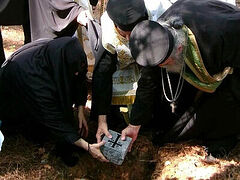
On Sunday, His Eminence Archbishop Casian of Lower Danube consecrated the church in Cavadinești, Galați County, the village where St. Constantin was born and baptized in 1905, reports the Basilica News Agency.
The Archbishop called the church, which received St. Constantin as its patron, “a little house of clay, shaped as well as could be with the souls of the villagers.”
“Only in the presence of God and the holy hero, Constantin Sârbu, does man become the altar, the church, the cathedral, the saint, the healer and life itself,” the Archbishop said. “St. Constantin Sârbu remains forever on the altars of our hearts, in our homes, in the surrounding villages and everywhere in the world,” he added.
The program in Cavadinești included the Divine Liturgy and a procession with an icon containing a fragment of St. Constantin’s relics.
 Photo: basilica.ro
On Monday, Archbishop Casian consecrated the Church of the Holy Archangels Michael and Gabriel in Smârdan, Galați County, where St. Constantin spent part of his childhood. The consecration service was preceded by a procession with a reliquary icon holding a fragment of St. Constantin’s relics and by a reading of his Akathist.
In the consecration, the church received the saint as its co-patron.
The first church in Smârdan was built starting in 1896 and was consecrated in 1905. St. Constantin lived in the churchyard for several years as a child with his grandmother, Ioana. The two lived in a modest room, and the future hieromartyr worked as an unpaid farmhand until age 15, when he began studies at the St. Andrew the Apostle Theological Seminary in Galați.
An earthquake in 1960 badly damaged the old church, and it could no longer be used for services. The cornerstone of the current church was laid in 1990, when Archbishop Casian blessed the site of the future building.
Follow OrthoChristian on Facebook, Twitter, Vkontakte, Telegram, WhatsApp, and MeWe!