It is Saturday morning in the winter of 1856. A horse-drawn cart lined in dark cloth slowly approaches the holy gates of Optina Monastery. A tiny coffin, freshly dug from the grave, arrives at the monastery mounted atop the hearse. Accompanying the hearse is the reposed girl’s father—a retired lieutenant of the Moscow Dragoon Regimen Nikolai Alexandrovich Shchegolev, bent with grief, yet still a relatively young man. His daughter died of influenza last year, and he was now going to fulfill his vow before God. In the inner pocket of his overcoat, he had a document with the personal signature of the Minister of Internal Affairs of the Russian Empire, Sergei Stepanovich Lansky. This document granted him permission to open his daughter's grave back home in Orel province, and rebury her in the monastery.
A tiny coffin freshly dug from the grave was brought to the monastery atop the hearse
The girl was only six years old, but she prophesied her final journey. It was she, Maria Shchegoleva, who would become the one responsible for the Church of St. Mary of Egypt, built in one of the most famous monasteries in Russia.
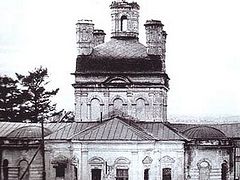
 The Church of St. Mary of Egypt (under restoration for a long time, but it is currently being prepared for consecration). Photo by author
The prophecy
Walking slowly next to the hearse, Shchegolev steadies the coffin with his hand and the last words of his dying daughter mercilessly resurface in his memory. Having a presentiment of her imminent death, the girl said:
“Papa, I will die, but you won’t bury me in the village, and you won’t live here yourself, because you will go to the monastery…”
He thought of the trembling voice of his sick child worn out by disease and how he was sitting helplessly at the head of her tiny bed. It was unbearable for him to hear such words, and he turned away so that his daughter wouldn’t see his tears. “But how did she know that? he was asking himself. He had never told anyone about that conversation—probably the most important conversation in his life—his conversation with God.
The promise
By the time Maria was born, he had already suffered an unbearable fourfold parental loss—all of his children died at birth. When his wife became pregnant for the fifth time, Shchegolev knew that they would probably suffer yet another heartbreak. But he still cherished hope, pleaded, and prayed. And when it became clear that everything was well with this newborn child, he rushed to the monastery and tearfully thanked God for the fact that his “unworthy prayer was heard.”
He later recalled leaning his forehead to the icon of the Savior and uttering those very words:
“I am thoroughly happy, I love my daughter utterly, but if it pleases You, my Creator, to take my consolation from me, and if my daughter dies, then here is my pledge: I’ll sell the land in my estate and build a church in the name of my daughter's patron saint, where she will be buried. I will free my serfs and give them small plots of land, and I myself will go to the monastery taking my daughter’s remains with me.”
The bride
For six years, everything went well. Nikolai Alexandrovich loved his Mashenka with all his heart and soul. He spared neither effort nor time for her sake. He turned things around in his estate, put his affairs in order, and worked hard trying to earn money “so that his daughter would become a wealthy bride.”
When his daughter fell ill, Nikolai Alexandrovich realized that he was losing the only person for whose sake he lived
“The Lord allowed me to gain profits in any undertaking of mine, and so I worked even on feast days, working my peasants to death and saved everywhere only to acquire ever more wealth for my daughter.
But simple, temporal happiness didn’t last long. When Masha was five, her mother Varvara died. Difficult births and the death of her four children had worn down the fragile and meek woman. So, when his daughter fell ill, Nikolai Alexandrovich realized that he was losing the only person for whose sake he lived.
The dowry
 Sergey Stepanovich Lanskoi, Minister of Internal Affairs of the Russian Empire (who played a key role in the preparation of the Emancipation Reform) He was beside himself with grief. Mashenka was buried in the family estate in the village of Troitsky in Orel province. Nikolai Alexandrovich remembered his pledge only after some time had passed, when he was facing the need to dispose of property and the accumulated funds. As he was holding a bank deposit certificate in his hands, he saw that this was her dowry, and then it suddenly dawned on him: He clearly realized that she did become a bride, after all! The bride of the Heavenly Bridegroom. And he himself was left with his debt—the word he had given to God.
He emancipated his peasants, distributed his land among them and sold the estate. His position in society and impeccable service in the regular army of the Russian Empire allowed him to direct his appeal to the Minister of the Interior. This was how he received an exhumation permit with Lansky’s personal signature, which allowed him to rebury his daughter. The second burial of Maria Shchegoleva took place on the grounds of Optina Monastery near the left wall of the old refectory on January 31, 1855. The burial site was not chosen at random.
The benefactor
 St. Moses of Optina At the time, the future St. Moses of Optina was the abbot of the monastery. The number of monastics had increased, the monastery was growing, and a large refectory for monastics was built. At the same time, the old refectory building (built with the funds provided by the local landowner Anna Sergeevna Rtishcheva) could not be allocated for household needs, because its walls were painted with icons depicting the saints and biblical events. The fathers decided to build a church there, and prayed to the Lord to send benefactors. That is why Father Moses perceived the officer’s intention to build a church as God’s plan. Shchegolev donated everything he had for the reconstruction of the building and its beautification: five thousand eight hundred rubles in silver (as a reference, around that time Optina Monastery had assisted fire victims in the village of Nizhny Pryski by allocating two thousand one hundred rubles. This rebuilt forty-two burnt houses.—K.P.).
From the documents of Father Moses, the abbot of Optina Monastery
“For the arrangement and interior decoration of this church of God, some of the benefactors willed to make voluntary donations, particularly the retired lieutenant Nikolai Alexandrovich Shchegolev, by installing in this church an altar dedicated to St. Mary of Egypt and the Holy Righteous Anna the Prophetess… for the eternal memory and commemoration of the child Maria, the daughter of Shchegolev and Boyarina A. S. Rtishcheva, buried under this church.”
Interestingly, two icon painters, Nuns Maria and Anna, are now serving in this church…
The crowd crush
 The exact location of Maria Shchegoleva’s burial is unknown. Her remains were buried in secret. The photo shows the grave of Anna Rtishcheva History is silent as to why Nikolai Alexandrovich chose Optina Monastery or whether he had other options. But he always felt the presence of God in his life. For example, as he was serving in the regiment of the future Russian Emperor Alexander II, he found himself in a fatal crowd crush. During the tsar’s military inspection in Kherson province, his squadron, along with other battalions and regiments, became disoriented due to a cloud of airborne dust. Nikolai Alexandrovich described this event in his biography, which he compiled when he joined the monastery. He was sure he was saved thanks to Divine Providence.
From Nikolai Shchegolev’s biography:
“I had under me a good riding mare, and she jumped over a pile of soldiers, while I flew off her and found myself in front of the whole heap of people. My face was completely scratched with sand, and blood gushed… Other people bumped into us and also tumbled off, so I part of my busby was pierced with a horseshoe (in the Russian army under Alexander II, this was a tall, rigid headdress that protected against indirect saber blows.—Author’s note), my saber with its thick leather harness was torn off, and the saber was bent; and finally, the horseshoe tore across the back of my jacket, in other words, it slipped sideways along my back. Then, the wind turned away from the 6th squadron and riders began to maneuver around the crush, in which four people were killed, and others wounded.”
The fever
Nikolai Alexandrovich cited yet another case of miraculous Divine intervention, when he was overcome by a serious illness in Moscow. He had a high fever for a week, and the doctors feared he had little chance of survival:
“I lay stiff as a board for as long as seven or more days, and, finally, upon seeing that there was no cure whatsoever, they let the chief military doctor, a general, know that there was an officer who was hopelessly ill, that he had no more than two or so hours left to live. But they tried one last remedy—a leech applied to each nostril. In ten minutes, just after as the leeches had sucked my blood and detached themselves, I was able to talk and sit up.”
The beginning
 The grave of Nikolai Shchegolev behind the Church of the Kazan Icon of the Mother of God These two episodes fortified Lieutenant Shchegolev’s faith. A challenging path filled with sorrows finally led him where his heart longed to be. He was tonsured a monk, but he never saw the consecration of the Church to St. Mary of Egypt; he died just before it happened. May 25, 1857 fell on Holy Trinity Ancestral Saturday—one of the two ancestral Saturdays when people pray for all Orthodox Christians who have reposed since earliest times. The monastery knew that this was a special day for the newly-tonsured father Nikolai; they knew for whom he prayed, and whom he longed to meet… Therefore, his repose on the following morning—on the eve of Pentecost—was for Optina not the end of the story of a man with a sorrowful fate. It was the beginning of the new, eternal life of a man who had found his abode in heaven.