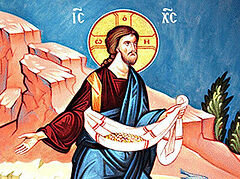
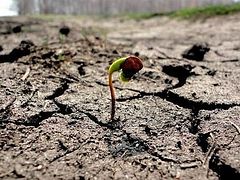
I opened the Bible and there,
“The sower went out to sow…”
The myth of human strength to cast
Through Holy Spirit to the air.
O. Nesterenko

Once, a young priest came to Father John of Kronstadt with a sorrow that weighed upon his pastoral heart: “Batiushka, how can this be? I constantly preach the word of God to my parishioners, admonish them during confession and in other conversations, yet nothing ever changes! I see no improvement in them; on the contrary, they even seem to be growing worse. What am I to do?”
The God-wise pastor, who was well acquainted with such sorrow, answered him, “Yes, I know this sorrow well. But we, the pastors of Christ’s Church, must sow the word of God without expecting to see the fruit, for Christ said: One soweth, and another reapeth (John 4:37). So you too must sow the word of salvation in God’s field, and leave the fruit to God's own providence. Somewhere, unbeknownst to you, that seed will surely spring up and bear fruit.”
Such sorrow is probably familiar to every priest. Sermons, spiritual conversations, almost unceasing confessions… It would seem that there ought to be constant, steady progress in the spiritual life. Yet in reality, things often turn out quite the opposite—our prayer does not become more attentive; because of our weakness, we increasingly reduce our prayer rule to the short Rule of St. Seraphim; we cannot seem to rid ourselves of the habit of judging others; and sometimes we even fall into mortal sins. Where, then, are the fruits? Can it really be that everything sown by the priest—a humble apprentice of the true Sower in this world—has fallen only by the wayside, upon stony ground, or among thorns?
“Even a stone can be changed”

A similar question—why the Sower scatters most of His seed upon ground unprepared to receive it—had troubled me ever since my very first encounter with the Gospel. Just consider: A diligent farmer who desires to reap a harvest and values his time and labor would never scatter seed before the ground had been plowed and the stones and weeds removed—that is, before the soil had been properly prepared. Why, then, does Christ act differently? He sows His seed mostly where He knows (for He cannot but know) that it will never sprout! This is all the more astonishing because His seed is more precious than anything imaginable—it is not the seed of some plant, but the very word of God! This is indeed a question worth pondering. And before long, I found the answer in the writings of St. John Chrysostom:
“Is it reasonable, you may ask, to sow among thorns, upon stony ground, and by the wayside? Certainly, with regard to seeds and soil, this would be unreasonable; but with regard to souls and teaching, it is most praiseworthy. If a farmer were to act in this way, he would rightly deserve reproach, for a stone cannot become soil, nor can a road cease to be a road, nor thorns cease to be thorns. But it is not so with rational beings. Even a stone can be changed and become fertile soil; the road can cease to lie open to every passerby and to be trampled underfoot, and can become a fruitful field; and the thorns can be uprooted, allowing the seeds to grow unhindered. If this were impossible, Christ would never have sown.”
So that is how it is! Christ is not passing sentence upon that great majority to whom the word of God was addressed—the majority who disregarded it. Rather, through the parable of the sower, Christ exhorts this very majority to reconsider their attitude toward God's word and to labor upon the soil of their souls.
And here is something truly marvelous: when such exhortations go unheeded, the Lord Himself begins to “cultivate” this unfruitful soil, acting just as an experienced farmer would! What I mean is that when a person fails to give proper heed to the word of God, the Lord helps him cultivate the soil of his soul, plowing it with various sorrows and softening it through illnesses. And such divine instruction bears fruit a hundredfold.
Souls like the “wayside,” for example, when confronted with profound sorrow, “shake off the dust” and become receptive to the word of God. They find faith, and with it, consolation in their grief. Experience shows, for instance, that parents who have buried their children, though previously far removed from the faith, often begin attending church, participating in the Sacraments, and learning about their faith. The death of a child sometimes opens for them both the path to God and an understanding of the meaning of life.
“Thorny” souls, when afflicted by illness, are cleansed of the thorns of riches and various attachments that had been choking the seed, thus making room for it to grow. This happens, for example, when a darling of the world, a profligate pleasure-seeker, encounters the devastating consequences of his dissolute life and begins to realize how illusory were all the things for which he had previously lived.
“Stony” souls, having experienced genuine suffering, cast out the “stones” of faintheartedness and fearfulness. Thus, a person who finds himself in a prison cell or at war begins to understand how insignificant were all the troubles he had encountered before, and that all he had really needed was a little patience.
We must admit that such situations are all too common in our lives, and they all testify to the fact that, at a given moment in our lives, we have failed to create favorable conditions for the word of God to bear its proper fruit. Therefore, we must urgently set about “clearing” and “weeding” the “soil” of our hearts in order to provide such conditions.
But what exactly do this “clearing” and “weeding” mean? This question is more serious than it might initially appear, given the gardening terminology. We must proceed from the understanding that the word of God must be alive in our hearts, and if it is alive, it will also be active. And it remains alive when we continually reflect upon it.
Metropolitan Anthony of Sourozh once said somewhere that a text becomes truly one's own only when, after reading it, a person has reflected deeply upon it and fitted it into the “puzzle” of his worldview. Incidentally, this is why the process of reflecting upon what we have read should take no less time, and perhaps even more, than the reading itself—provided, of course, that what we have read is worth such reflection.
And this should apply above all to the word of God. While we may spend half an hour (or even less) each day reading it, we should reflect upon what we have read throughout the entire day. If we return once more to our gardening analogy, this process is akin to nourishing the seed in the soil. And this is the first important condition for keeping the word of God alive and active within us.
The second condition, which we might liken to watering the seed, consists in putting into practice in our own lives what we have read and pondered, for we are called to be not merely hearers of the word of God, but doers of it as well: But be ye doers of the word, and not hearers only, deceiving your own selves (James 1:22).
Fulfilling these essential conditions will enable the word of God to bear fruit in our hearts, and all that will remain for us to do is to remove the occasional “stone” and pull up the few “weeds” that appear.
Christ's parable of the sower, prophetically proclaiming that the seed of the word of God will remain largely fruitless among mankind, above all sounds a warning to us Christians. Commentators on the parable agree that, because of such a negligent attitude toward the word of God, few will be saved, for a person's salvation depends upon his attitude toward that word.
The seed sown throughout the world by the Great Sower has the power to save every human being. But for those who neglect this seed, it will become the instrument of their perdition.
He that hath ears to hear, let him hear (Luke 8:8).