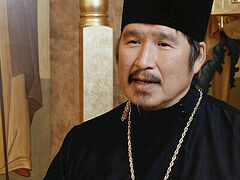
Innocentia Wellman is an American who worked at Fort Ross for over thirty years before converting to Orthodoxy. Her conversion was directly inspired by St. Innocent (Veniaminov) of Moscow and the Martyr Peter the Aleut.
—Innocentia, could you tell us how you discovered Orthodoxy?
—My deep familiarity with Orthodoxy truly began through my work at Fort Ross. I started working there in 1990. I first visited Russia in 1989 with a group from Stanford University, and a year later, in 1990, I began my career at Fort Ross, where I ended up working for almost thirty years. Technically, I retired from my official position there in 2017, but I still serve on the board of directors and remain quite active in everything that goes on. Honestly, I have even more freedom now because I don’t have a boss anymore—I’m my own boss [laughs—Auth.]!
 Innocentia Wellman I could talk about Fort Ross for hours, but the most important thing to know is that, outside of Alaska, it occupies a unique place in America, with a history deeply intertwined with Russia and Orthodox Christianity. Fort Ross, founded in 1812, was the very first Russian fortress in America, excluding Alaska. In my professional capacity, I am directly involved in connecting this site with Russia and Russian academic circles. Thanks to this work, I have traveled to Russia numerous times. I regularly give presentations at the Russian Academy of Sciences, the Russian Geographical Society, as well as universities and other institutions with an interest in Russian-American relations. For our part, we want to ensure that the history of Fort Ross is conveyed accurately.
Fort Ross has a very rich history, and I could say so much about the amazing people who lived and worked there at different times. The contribution made by Russians to American history, especially to the history of Northern California, is invaluable! But for Orthodox Christians, this place is unique (I knew this even before I became Orthodox myself and, while working at Fort Ross, often shared this with the Orthodox priests who visited us), because it is home to the first Orthodox church in America outside of Alaska—a small chapel dedicated to the Holy Trinity. That is why not only Russians, but all Orthodox Christians in the United States make pilgrimages to Fort Ross.
Fort Ross has a very rich history, and I could say so much about the amazing people who lived and worked there at different times
Fort Ross is a place that was visited by five Orthodox saints at different times. The first was Martyr Peter the Aleut, who gave his life for Christ, becoming the Orthodox Protomartyr of America outside of Alaska. The second was St. Innocent of Moscow, who stayed at Fort Ross for only five weeks because his diocese was immense—he was primarily the bishop of Alaska, but Fort Ross was also part of his diocese. He visited Fort Ross to perform Baptisms, weddings, and funeral services, and to conduct catechism. There is a touching story about how he stood on the steps of the church and sang for the Native American children. By the way, once when I was working at Fort Ross, Archimandrite Innocent (Veniaminov), St. Innocent of Moscow’s great-great-grandson, came to visit us. It’s a pity that back then I didn’t realize what a unique person he was. He has since passed away, but I hope to visit his grave someday!

The third saint to visit Fort Ross was St. Sebastian of Jackson, the first Orthodox priest born in the United States. The fourth was St. Tikhon (Belavin), who later became Patriarch of Moscow and All Russia. He visited Fort Ross in the early twentieth century while ruling the Aleutian and North American Diocese. And lastly, the fifth saint was St. John (Maximovitch) of Shanghai and San Francisco.
Fort Ross is truly a holy place. Archbishop Kirill of San Francisco and Western America, our ruling hierarch, doesn’t like it when I call Fort Ross the “Holy Land”, because there is only one Holy Land, so we refer to Fort Ross as “Sacred Land”. It means a great deal to all of us that we live so close to this holy place, that we visit this chapel, and that services are celebrated there—it is absolutely wonderful!
When the Russians left Fort Ross in 1841, church services stopped there, and the chapel stood empty. Then, in 1925, services resumed at Fort Ross. So in 2025, we celebrated the 100th anniversary of services at the Holy Trinity Chapel in Fort Ross, which is probably a record for the United States. We had large-scale events, and I was on the organizing committee for these celebrations. I keep in touch with Metropolitan Maximilian of Irkutsk who baptized me. So I told him, “Vladyka, if you are able to come, it will be a real miracle!” And he actually came! There were two other metropolitans there as well, making a total of three metropolitans, nine bishops, over thirty priests, and a multitude of laypeople… The priests stood in two rows on each side—it was something unforgettable!
—What stands out to you the most from your time working at Fort Ross?
—Once, during the very first years of my work at Fort Ross, Archbishop Anthony (Medvedev), who then headed the Western American Diocese of ROCOR, was due to visit us. I had never seen him before; I wasn’t even Orthodox back then and didn’t know any of the customs. But I was young and naive, and my work “uniform” happened to be an authentic sarafan from Kargopol (the Arkhangelsk region), so I was asked to go out and welcome His Eminence with the traditional bread and salt. I agreed, saying, “Sure.” They put a karavai (round loaf) into a basket, placed a saltcellar on top of it, and handed it to me, without really explaining anything.
And there I was, standing with the basket. Vladyka Anthony arrived, and I welcomed him. He was very touched by the warm greeting, broke off a piece of the loaf, and said, “Thank you!” And I told him, “Take some more, if you liked it!” Everyone around us was like, “Oh no, what are you saying!?” He, of course, didn’t break off any more. So I set the basket down on the ground... and hugged him! Vladyka stood rooted to the spot, not knowing what to do. There were so many people there, and everyone was staring at us. I hugged him really tight, and he said, “Well then… Shall we go into the church?” He did his best to pretend nothing had happened. But after that, every time he came to Fort Ross, he always asked where the young lady who had welcomed him was, and we would talk a little.
And a couple of years later, His Holiness Patriarch Alexei II was scheduled to visit us, and I was asked to welcome the guest once again. Back then, everyone accompanying the Patriarch on that trip arrived at Fort Ross ahead of time to talk to me, and they warned me, “Don’t hug him!” I replied, “Alright, alright, I get it, I won’t!” It was actually very sweet. To be honest, I really, really wanted to hug His Holiness, but what held me back was knowing that all those people standing around us were thinking of nothing but how to keep me from pulling some kind of stunt.
I absolutely loved my job at Fort Ross; every single day I worked there was different from the last. It was truly amazing!
 Innocentia welcomes His Holiness Patriarch Alexei II
—Indeed, it’s awesome! Innocentia, you mentioned that Metropolitan Maximilian of Irkutsk baptized you. Tell us how that happened. How did you two meet in the first place?
—It’s an interesting story. In September 2021, before I was even Orthodox, I came to Irkutsk with a small delegation made up mostly of American priests to open the “St. Innocent and Fort Ross” exhibition in the village of Anga, St. Innocent of Moscow’s birthplace. Since the funds to open this exhibition were raised by dioceses of the Orthodox Church in America (OCA) and ROCOR, they wanted their priests to go with me—people I know very, very well, my very close friends. Of course, I was delighted and agreed to the offer!
We all arrived in Irkutsk together. On one of the days of our trip, our priests were blessed to concelebrate with the metropolitan at the Theophany Cathedral in Irkutsk. The service was absolutely magnificent! Holiness filled the cathedral so deeply that I could almost physically smell its fragrance. And then, one of our priests, Fr. Stefan Pavlenko—a distinguished mitered archpriest with two pectoral crosses—walked up to me after the service and said, “The metropolitan is inviting us to trapeza.”1
I wondered,
“What is a trapeza?”
“It’s a luncheon.”
“Ah, alright!”
This wasn’t planned, but of course, we agreed.
Everyone suddenly fell dead silent on hearing my question to the metropolitan, thinking: “Oh no! What is she doing!?”
We arrived for the meal. Vladyka Maximilian invited me to sit next to him and asked me to share more about St. Innocent’s ministry at Fort Ross and the exhibition I had put together. Our conversation was interpreted by my friend Mikhail, who is originally from Irkutsk. I had absolutely no idea who metropolitans were or how one was supposed to behave around them. So, when Vladyka paused for a moment, I said to him, “Tell me a bit about yourself. Who are you as a person? What do you do in your free time?” I knew nothing! Imagine this: It was a long, long table, and everyone suddenly fell dead silent on hearing my question to the metropolitan, thinking: “Oh no! What is she doing!?” I was like, “What else do you do, aside from this church stuff?” And the metropolitan replied, “Oh, thank you! No one ever asks me about that!” With those words, he pulled out his cellphone and started showing me pictures of him fishing, playing the guitar, and chatting with friends… The priests from his diocese had never seen anything like it! I pulled out my cellphone, too, and started showing Vladyka photos from my fishing trips, hikes, and family dinners; and for a while, we were just having this sweet conversation, showing each other different pictures.
And then my friend Mikhail, who was interpreting for us, said to me, “Why don’t you tell Vladyka about the icon you found?” I went, “Nooo!” I really meant no! I had absolutely no idea whether it was even appropriate to speak about it, and I didn’t know how to put it into words. But Vladyka said, “An icon? That’s interesting. Yes, do tell!” And so, I told him the story about the icon…
—What is this story about? Please tell us too!
—Oh, I don’t even know where to begin, because this is such a personal story… As I mentioned before, I worked at Fort Ross for thirty years, and I know the Lives of Sts. Innocent and Peter the Aleut very, very well. Even before I became Orthodox, I often told people about them. I probably know more about these saints than many Orthodox Christians do, simply because I have done the research, talked with fellow historians, and so on.
During my last week working at Fort Ross, I was completely devastated because I have always loved my job so much, and then it turned out that my position was being eliminated. I cried every day; it was so hard for me. Then one day, lost in my sad thoughts, I went out for a walk on the beach. As I walked, I was picking up trash that had washed ashore following a storm. After walking for a bit, I was just about to head back up when I suddenly felt an overwhelming urge to return to the beach and thank God for everything He had given me in life, including those wonderful years spent at Fort Ross.
I don’t usually do that, but this time I turned around. And suddenly, I saw something in the sand. I thought, “Oh, more trash! I should go back and pick it up,” because I never leave it on the shore. I took my shoes off again, went back to the beach, walked closer… and saw it was the corner of some wooden board painted red. I thought, “What is this?”
I got even closer and realized it was the corner of a painting that was almost completely buried in the sand. I started digging it out. And once I did, I realized it was an icon of the Martyr Peter the Aleut. I couldn’t believe it! I was bewildered, trying to figure out how it even got there and why it was me who found it. Apparently, a storm had washed it ashore from the ocean, but it was just mind-blowing!
 The icon of St. Peter the Aleut found on the beach I took the icon and went back up. I am very close friends with the Holy Dormition Convent in Calistoga, California, so I called the abbess, Mother Melania, and told her, “You won’t believe what just happened!” and she replied,
“If it happened to you, I’ll believe anything!”
“No, no, this is something really strange. I found an icon… on the beach.”
“What??? Can you bring it to us?”
“Yes, I’ll bring it tomorrow.”
The next day, I took the icon to the convent. Everyone venerated it—it was awesome! After the icon had been at the convent for two weeks, we celebrated a prayer service in front of it at the Cathedral of St. Seraphim of Sarov in Santa Rosa, California. It was an incredible moment for me, because this icon, which I had found on the beach, had suddenly truly become a part of the Orthodox Church. It was also remarkable that one of the priests who came for the prayer service was called Fr. Peter: he was baptized in honor of the Martyr Peter the Aleut.
But after that, things kind of quieted down. That was when Vladyka Benjamin blessed me to travel to different parishes with this icon and share its story. I can’t say I regret agreeing to it, but I felt then—and still feel now—that it is somehow prideful on my part. In any case, I obeyed the blessing and began visiting various parishes with the icon.
And so, one day I was in Sacramento, at the church of Fr. Paul Volmensky. I was sharing the story of the icon, and everyone felt the same awe that I did. A man I didn’t know came to that meeting. From his facial features, it was perfect clear he was a Native American. He listened and listened, and then, when Fr. Paul and I were leaving the church with the icon and heading toward my car, this man caught up with us and said, “I really wanted to meet you. I must see this icon up close and tell you something…” It was time for me to leave, and Fr. Paul and I were not very happy about the delay, but I replied, “Alright, go ahead.” And the man said, “You should know that it was my ancestors who killed the Martyr Peter.”
It was my ancestors who killed the Martyr Peter
It turned out that this man belonged to the Chumash people, who live in the San Pedro area near Los Angeles. He said that his ancestors were in the service of the Spanish Catholics who had captured Peter and his friend John Kyglai, and who were the actual killers of the Martyr Peter. The memory of this had been preserved in his family history even after two centuries! Saying this, the man began to weep. We tried to comfort him, saying that he was not personally to blame. But he kept repeating, “No, it is me, it is me, it is my family! I know this story; it has been passed down in our lineage. And now I must reckon with this, I must cleanse myself, I must pray to God for forgiveness for this murder!”
It struck me to the core, and I burst into tears. Fr. Paul could barely contain his emotion either. We just couldn’t believe it! This man’s name was James, and a year later, he was baptized as Peter after the Martyr Peter the Aleut. As it turned out, they were both Native Americans, and the ancestors of one had slain the other—it was absolutely mind-boggling!
Peter and I became close friends and started hosting these meetings together, telling people about St. Peter the Aleut. We did not want these talks to be just a story about a miraculously found icon, so we began including the Life of the Martyr Peter the Aleut in our presentations. We wanted to tell people about him—they just have to know about him because he is the Protomartyr of North America! And many priests who heard the story of how I found the icon told me, “You have not found the icon—the Martyr Peter has found you! And it happened at just the right moment: St. Peter knew it, God knew it. It happened so that you could tell everyone the story of the Martyr Peter!” Mind you, at that time, I wasn’t even Orthodox yet!
But you know, it happens sometimes that when someone finds something, people appear claiming it belongs to them. And that very temptation happened with this icon. An Aleut woman I know learned that I had found the Martyr Peter’s icon and said, “That’s our icon!”, meaning that I should give it to the Aleuts.
Then, people from the historical park administration contacted me and said that since the icon had been found on the reserve’s territory, it belonged to them. I replied, “No, it is not yours and it will never be yours! This icon will never go to a museum! And if you want to take it, try negotiating with twenty nuns… Just try it!”—because the icon was at the convent. I said, “You will never take it from the convent, never! It is not yours—it belongs to God! To you, it would just be trash, but to the nuns, it is a holy relic.” I made it perfectly clear to them that they would never get the icon. I had nothing to lose. I wouldn’t lose my job over this situation because I was no longer working at Fort Ross anyway, so I didn’t care if they complained about me to anyone. So, the icon remained at the convent in Calistoga. And Metropolitan Nicholas, the First Hierarch of ROCOR, came to the convent specifically to venerate it and to testify that it is indeed an icon of the Martyr Peter the Aleut.
“And if you want to take it, try negotiating with twenty nuns… Just try it!”
We rejected the claims of both that woman and the museum, but after some time another person appeared and said that the icon belonged to him. A certain man called Abbess Melania and said, “I think this is my icon.” But he was not insistent. She replied, “Please, talk to Robin.”2 We got on the phone. I said, “Chris, do you have any proof? Why do you claim that this is your icon?” And he replied, “I will show you a photo.” And he sent me a picture of himself standing with this icon in his hands against the backdrop of Fort Ross. I exclaimed, “Lord, have mercy! It cannot be! How did this happen? We need to talk!” After a while, we all gathered in Calistoga, at the Convent of the Dormition of the Most Holy Theotokos; its nuns, myself and Chris, as well as Peter, because he also wanted to be present. And Chris told us his story.
 Icon of St. Peter the Aleut and its author Chris It’s absolutely unbelievable, but it turns out he is a distant relative of the Martyr Peter! That is, Chris is from the exact same Alaska Native people as St. Peter the Aleut. It’s just mind-blowing!!! Anyway, he is an artist, and he was invited to participate in an exhibition alongside other indigenous American artists. The exhibition took place in Berkeley, not far from San Francisco. Chris agreed and decided to paint a portrait of the Martyr Peter the Aleut for it, since they come from the same people. Chris isn’t Orthodox—he’s not even particularly religious—but he was just so inspired by this and wanted to share the Martyr Peter’s story. And since St. Peter is an Orthodox saint, Chris decided to paint his portrait specifically in the style of an icon. It wasn’t some kind of competition with prizes or anything—just an exhibition.
When the exhibition was over, the organizers called and said, “You can come and pick up your work.” Chris collected his “painting” from the exhibition and brought it to Fort Ross… to burn it, because his people have a tradition of burning works of art. So, he arrived at Fort Ross and built a bonfire. He laid down some firewood, placed the icon on top, and piled more wood over the icon… But when the fire burned out, the icon remained intact! There are indeed slight scorch marks visible on it, but it didn’t burn!!! Chris was absolutely shocked. And since the icon wouldn’t burn, he swam out into the ocean as far as he could and cast it into the waves... Yet a few months later, the current washed it ashore in the exact same spot! How is that even possible, tell me?!
I wondered, “Chris, how do you feel about the icon being in a convent now?” And he replied, “I believe it couldn’t have turned out any better. I am overjoyed! This is exactly where it belongs!” After everything that happened, Chris began to think about God.
—Wow! Innocentia, let’s now return to the story of that lunch with Vladyka in Irkutsk. Tell us, what happened next when you told Metropolitan Maximilian about how you found the icon of the Martyr Peter?
—Hearing this story, Vladyka said, “You worked at Fort Ross for so many years! Now you have organized an exhibition about St. Innocent, you are connected with so many Orthodox saints, and you even found the icon of the Martyr Peter… What more do you need? Why haven’t you embraced Orthodoxy yet?” I answered, “I… I don’t know.” And once again, the whole table fell silent. All my priest friends were delighted by Vladyka’s direct question.
What more do you need? Why haven’t you embraced Orthodoxy yet?”
But I said, “You know, yes, I interact a lot with Orthodox Christians… I am a good Christian, Christ is the center of my life, but I don’t think I could be a good Orthodox Christian. You have so many rules!” Vladyka replied, “Don’t worry about that—we will stay in touch, and I will help you.” Then I added, “You know, all these priests we came with have known me for a long time, we are close friends, they all love me, I love them, and we always hug when we meet… But I’ve never seen them hug their parishioners. What if I become their parishioner and they stop hugging me? That would be terrible for me!” Then Vladyka stood up, asked me to stand up too… and gave me a big, tight hug. It was so sweet! I said, “I must be frank: I love God, but I can’t make a decision right now. I need to pray about it.” Vladyka answered me, “Yes, of course!”
 The Baptism of Innocentia Our main event was planned for two days later in Anga, St. Innocent’s home village. But the day before that—the morning after our conversation over the meal—I went to the Theophany Cathedral with Elena, who is now my godmother, and we bought me a baptismal cross. I silently showed the cross to Vladyka, and he said, “Wonderful! When?” I replied, “Maybe tomorrow morning? I’m afraid I’ll change my mind!” He said, “Good!”, and asked the priest, Fr. Maxim, to prepare everything for the Baptism.
At seven in the morning, we all met in the lobby of the spiritual and educational center where we were staying during our visit to Irkutsk. From there, we headed to the Anga—the very river where St. Innocent of Moscow was baptized long ago! This means I was baptized in his native village, and this happened right on his birthday, September 8! I remember feeling terribly cold. Fr. Maxim went into the water with me, but the Metropolitan himself read all the prayers.
Ever since then, Vladyka Maximilian and I have been very close friends. And just now, while you and I were talking about my Baptism in Anga, he texted me! Can you believe that?
 With Nun Callista, the interviewer —Innocentia, all of this is just incredible! Your story is so inspiring and truly strengthens one’s faith. How close the saints are to us! Thank you so very much for this talk!
—No, thank you for your time and for letting me share this story. I am so happy to be here! I love Russia so much! Russian people often believe that we over here in the United States don’t think about Russia. But I want people in Russia to know that we, Orthodox Americans, pray for the Russian Church, for Patriarch Kirill, and for Russia at every single service. In this way, we are all deeply connected. And that is exactly why I chose the Russian Orthodox Church (although there are parishes of various Orthodox jurisdictions in the USA)—because I feel a very strong bond to Russia. I don’t speak Russian, and sometimes I attend OCA churches, where the services are in English. But even in ROCOR churches, where they serve in Church Slavonic, I don’t need an interpreter—I feel everything with my heart! And every single parishioner of the Russian (let’s call them that) parishes in America hopes and prays that Russia stands strong and that everything goes well for it!