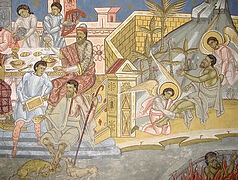
There was a certain rich man, which was clothed in purple and fine linen, and fared sumptuously every day: And there was a certain beggar named Lazarus, which was laid at his gate, full of sores, And desiring to be fed with the crumbs which fell from the rich man’s table: moreover the dogs came and licked his sores. And it came to pass, that the beggar died, and was carried by the angels into Abraham’s bosom: the rich man also died, and was buried; And in hell he lift up his eyes, being in torments, and seeth Abraham afar off, and Lazarus in his bosom. And he cried and said, Father Abraham, have mercy on me, and send Lazarus, that he may dip the tip of his finger in water, and cool my tongue; for I am tormented in this flame. But Abraham said, Son, remember that thou in thy lifetime receivedst thy good things, and likewise Lazarus evil things: but now he is comforted, and thou art tormented. And beside all this, between us and you there is a great gulf fixed: so that they which would pass from hence to you cannot; neither can they pass to us, that would come from thence. Then he said, I pray thee therefore, father, that thou wouldest send him to my father’s house: For I have five brethren; that he may testify unto them, lest they also come into this place of torment. Abraham saith unto him, they have Moses and the prophets; let them hear them. And he said, Nay, father Abraham: but if one went unto them from the dead, they will repent. And he said unto him, if they hear not Moses and the prophets, neither will they be persuaded, though one rose from the dead.
The parable of the rich man and Lazarus raises several questions in our minds concerning the religious worldview and the Christian faith.
 The Rich Man and Lazarus (Gustave Doré, 1891)
The first question concerns the nature and causes of inequality, which we see, among other places, in this parable, and God’s attitude toward that inequality. People of the older generation [in the Soviet Union] still remember a society in which the greater part of the population, albeit under compulsion and living in relative poverty and deprivation, existed under comparatively equal conditions. Those who were, as people later began to joke, “more equal than others” were not particularly conspicuous, and they themselves tried not to display their privileged position. The realities described in today’s parable are quite comparable to those of our own lives, in which we encounter the very same contrasts: Here is a destitute homeless man lying near a railway station or a subway entrance, and towering above him like Mont Blanc are people who inhabit entirely different social worlds, people for whom, just as for the rich man in the parable, this homeless man simply does not exist as a human being, as a person. This inequality poses a question to the Church, one to which Christianity has given different answers in different centuries.
In the twentieth century, an entire movement known as liberation theology arose within the Roman Catholic Church in Latin America. One of its founders, the Brazilian Archbishop Hélder Câmara, described how he came to embrace the idea of the Church’s social involvement: “A mother comes to me from the favelas (the slums surrounding Brazilian cities) and tells me that her family has had nothing to eat for three days; that her daughter, driven by the horrors of life and desperate poverty, has become a prostitute; that her son was forcibly turned into a drug addict by being injected several times with narcotics; that all she sees around her is the law of the jungle.” And Archbishop Câmara asked himself: “What am I supposed to tell her? That she must endure, and that this is the only answer Christianity has to offer people in such circumstances?” But we send personalities to heaven—not human beings who by the end of their earthly journey have been reduced to sacks of battered flesh. And we must not close our eyes when such flagrant injustices occur. Today’s parable, however, is not about social activism, but about the ultimate recompense that may await even someone who, by outward standards and criteria, is not a bad person.
But let us begin with Lazarus, the poor man. To many, Lazarus’s existence might seem meaningless. Here lies a man, tormented by a disease from which many people in the Middle East suffered, whose entire life consists of enduring affliction. Yet, as it turns out, everything depends on whether a person regards his life not as meaningless torment, not as something from which he simply wishes to escape into oblivion and sleep, but as a mystery of human existence—a mystery that may be incomprehensible to the mind, yet can be embraced through faith, through the soul and the heart. For some reason, whether for his entire life or for a considerable part of it, he has been allowed to find himself in circumstances so grievous and so unjust—according to human reasoning. Consider this: The Lord makes it quite clear that Lazarus did not complain, did not rebel, did not come to the conclusion that not only he but thousands of others were suffering undeservedly, and did not establish a party of suffering Lazaruses whose purpose would be to overthrow the existing order. Rather, he inwardly accepted the mystery of God’s Providence concerning himself. And this inward acceptance, without murmuring or rebellion, not even in the depths of his soul, made him an heir of eternity.
And what of the rich man? The rich man, who dressed in fine linen and purple and arrived home in a splendid chariot (you may supply the modern equivalents yourselves—the clothing brands and makes of automobiles), is not described in the Gospel as someone who acquired his wealth through criminal means, or as one who collaborated with the occupiers of his homeland, served a criminal regime, or committed any other such wrongdoing. He simply remained within the confines of his own social circle and never took a single step beyond it. Perhaps he was a delightful conversationalist and the life of the party, someone whose company people eagerly sought. He was probably neither pompous nor arrogant. Indeed, the fact that crowds gathered at his banquets suggests that, in a certain sense, he was a pleasant man. But his inability to step beyond the boundaries imposed by his social status rendered him unfit to enter the Kingdom of Heaven.
Let me give you an example from contemporary life. Recently, a woman from our parish told me a story. During a heavy downpour, she came out of the subway, opened her umbrella, and headed either toward home or toward a bus stop. The rain was pouring down. Walking beside her was a young Tajik man, an ordinary migrant worker. When she said to him, “Come here, under my umbrella, and we’ll walk to the bus stop together,” he burst into tears. In Moscow, no one except his own compatriots had ever treated him as a human being with whom one might share an umbrella, even for the few yards it took to walk together.
This genuine willingness to reach out to another human being, stepping beyond the boundaries of our social status and, indeed, beyond the entire familiar world in which we are accustomed to being good, responding to requests, respecting others, and showing mercy—this is what today’s Gospel speaks of as a condition of our being able to enter the Kingdom of Heaven.