Recently representatives of the Zaporozhie diocese of the Ukrainian Orthodox Church met with the head of the State Service of Ukraine for Ethnopolitics and Freedom of Conscience, the body responsible for making decisions regarding the canonical Church in Ukraine. In an atmosphere and era of unrelenting persecution against the canonical Church. Metropolitan Luke of Zaporozhie comments on this meeting.
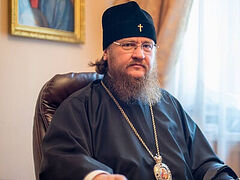
 Metropolitan Luke (Kovalenko) of Zaporozhye and Melitopol
Christ is in our midst, my dear readers!
The meeting between representatives of our diocese and Viktor Yelensky, head of the State Service of Ukraine for Ethnopolitics and Freedom of Conscience, left a deeply troubling yet highly revealing impression. Certainly, the official deserves credit for the very fact that he found the time to come and speak personally with the clergy and faithful. Nevertheless, we must regretfully acknowledge that his answers were neither convincing nor satisfactory.
The discussion clearly revealed two fundamental points.
First, no one intends to engage in genuine, honest dialogue with our Church. No one is willing to hear Her pain or respond to the flagrant injustices She faces. Today, one may present any number of documented cases of violent church seizures, brutal beatings of believers, and even the violent deaths of monks, yet the response from government representatives amounts to little more than a single refrain: “You have only yourselves to blame.”
Second, while the state verbally proclaims its commitment to constitutional rights and freedoms, in practice it flagrantly interferes in the internal life of the Church.
This demonstrates a complete unwillingness to seek common ground between the Ukrainian Orthodox Church and the Ukrainian authorities and, consequently, the futility of the course advocated by some—that of making compromises with them.
The Constitution clearly states that a religious organization cannot be banned or persecuted if its activities are lawful. The Ukrainian Orthodox Church has violated no laws. Moreover, if our Church were engaged in any corrupting or anti-national activity, the faithful would simply abandon Her of their own accord. Yet our Church embraces people from all walks of life, holding a wide variety of political, ideological, and philosophical views. Nevertheless, what invariably unites us all is the one Eucharistic Chalice during the Divine Liturgy. These same people continue to fill our churches and pray to God within their walls. Is this not the most compelling proof that people regard our Church as their own, as something dear and close to their hearts?
This is because it is precisely through Her that the Lord bestows His saving grace upon the faithful. If we were to yield to political pressures and effectively turn ourselves into a political party or an ideological appendage of one, we would inevitably forfeit this grace and become a “Church” in name only. That is precisely why we remain steadfast in our present position.
The truths of the faith and the sacred canons belong to a realm into which neither politics nor geopolitics has any right to intrude. Eternity cannot be subordinated to fleeting interests and shifting political circumstances. Otherwise, the Church would simply have vanished amid the struggles of competing powers and states, which over the centuries have repeatedly changed sides, with yesterday’s enemies becoming today’s friends, and vice versa.
From this follows an obvious conclusion: We must not cast the sacred treasures of our faith and canons before the dogs of political passions, manipulation, and deceit.
Indeed, if we follow the reasoning of the Church’s contemporary critics, we can easily arrive at absurdity. For example, one might issue a decree declaring the law of universal gravitation “invalid” simply because, at some point, it was deemed incompatible with a particular political agenda or branded an instrument of “foreign influence” because it was formulated by a foreigner. The consequences are obvious. Such a law could be abolished by decree at even the highest level of government, but in reality it would continue to operate just the same.
The same holds true for spiritual laws. People may try as much as they please to ignore them, dismiss them as absurd, or declare them erroneous, but these laws will continue to operate. No prohibitive seal can be placed upon them, nor can they be suppressed or hidden away, for the grace of God transcends all human authority. Therefore, there is only one thing we should fear: losing this grace—not forfeiting the favor of the powers that be.
And so I call upon you, my dear ones: Stand firmly on the side of the sacred canons, and do not waver. Better to suffer for God than to betray Him!