Zaporozhye, November 17, 2026
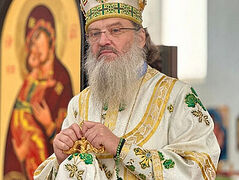
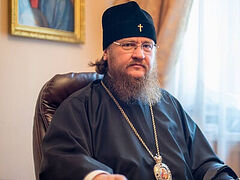
 Church persecutor Yelensky and Met. Luke of Zaporozhye. Photo: pravlife.info
Viktor Yelensky, Head of the State Service of Ukraine for Ethnopolitics and Freedom of Conscience (DESS), met with clergy of the Zaporozhye Diocese of the Ukrainian Orthodox Church (UOC) on November 13 at the invitation of His Eminence Metropolitan Luke of Zaporozhye and Melitopol.
About 42 priests attended, the remainder of a diocese that once had around 180, Metropolitan Luke notes (in March 2024, the Russian Holy Synod established authority over portions of the diocese). They had submitted more than 60 questions.
Yelensky opened by saying the state wants only one thing from the UOC: an explicit decision to leave the Russian Orthodox Church (ROC). He said DESS’s July order to the Kiev Metropolia contained four points, including leaving the ROC Holy Synod and annulling the statute provisions that, in his view, bind the UOC to Moscow.
The clergy’s questions covered persecution, seized churches, mobilization, and the state’s reliance on ROC documents, and the answers kept returning to that same demand. When a priest asked about a media campaign against UOC clergy and the killing of a monk at the Svyatogorsk Lavra, Yelensky spoke of Russian occupiers and His Holiness Patriarch Kirill. “But the question wasn’t about military action,” a questioner said.
Asked about reports of violent church seizures, Yelensky claimed the main persecution of believers takes place in occupied territories. A priest replied by listing clergy expelled from their parishes after 20 years or more of service, noting that “This is not Russia” doing this.
The exchange the clergy pressed hardest concerned evidence. Yelensky said the UOC remains part of the ROC, but a priest asked for a single concrete example of Moscow governing the UOC since 2022. Yelensky was unable to give a single one. “I may or may not know the facts about whether the Moscow Patriarchate governs,” he said. “I only want to be convinced that it doesn’t.” He then asked the clergy to leave the ROC.
Metropolitan Luke said that in 21 years as a bishop, he had never received a directive from Moscow. Clergy added that the UOC sends no contributions or funds to the Russian church.
Another priest quoted the UOC’s official statement on the 2022 Council in Theophania, which removed the statute’s references to the ROC, ended the Kiev Metropolitan’s membership in the ROC Holy Synod, and declared the Church fully self-governing. He asked why this did not satisfy the state’s first demand. Yelensky said the Church should instead issue a decision to leave the ROC, not one about who had suspended or terminated membership in anything. A priest asked what more the Local Council, the Church’s highest authority, could do. “A louder voice the Church doesn’t have,” he said.
The clergy also questioned the religious-studies expertise on which DESS based its conclusions. One priest noted that the expert commission included longtime public critics of the UOC but no UOC representative and no foreign canon lawyer. He also asked why it relied on materials from the official ROC site, which Ukraine’s National Security and Defense Council has sanctioned. Yelensky said a UOC representative had been invited and declined to take part, and that the commission’s vote was unanimous. He said the law directs attention to the ROC’s own statutes, and that the expertise was based on those, not the UOC’s. Metropolitan Luke pointed out that the decisions of the Theophania Council were not taken into account.
On mobilization, a priest asked why UOC clergy were left off the list of religious organizations whose staff qualify for draft deferment, when priests were being taken from checkpoints and even from funerals. Yelensky said the criteria had been agreed with several ministries and require that an organization’s statute not have lost force in the part concerning its name, which, he said, UOC communities’ statutes have. “I’m not to blame for that,” he said.
However, the UOC’s current statutes, adopted in 2022, which enshrine its independence, are even hosted on DESS’s own website, though the relevant authorities have simply refused to legally register them.
Yelensky added that priests should not bear arms and that DESS supports a bill on alternative service. Metropolitan Luke described priests at the front who had been beaten and pressured to join the schismatic “Orthodox Church of Ukraine” (OCU). A priest said a donor with a rare blood type had been turned away from a donation point after saying he was a UOC priest.
Yelensky did give direct answers on some points, including the number of hierarchs facing criminal cases (13 or 14, by his count) and the mobilization criteria. Asked how a diocese could change its status when its statute was approved by the Synod, he offered to put the questioner in touch with DESS lawyers.
Near the end, a priest with 27 years of service asked Yelensky what exactly he was demanding of him. “To leave the Russian Church,” Yelensky answered, again ignoring the decisions of the UOC’s 2022 Council.
Follow OrthoChristian on Facebook, Twitter, Vkontakte, Telegram, WhatsApp, and MeWe!