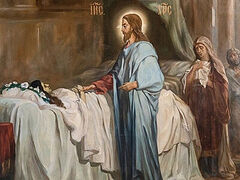
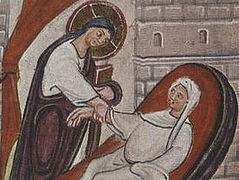
Photo: gallerix.ru Today we have once again heard the account of two wondrous miracles of Christ: the healing of a woman and the restoration to life of a young girl who had died. And each time we hear these accounts, I think that the hearts of all of us are filled with such gratitude, such joy, that once, when our Living God, the great God of Heaven, walked upon the earth as a simple man, God’s love and mercy so tenderly and so powerfully reached out to every human need: to hunger, sickness, death, and sin. And it often seems to us that those days are gone, that such things no longer happen. Yet we are mistaken in two ways about this.
On the one hand, it is indeed true that throughout the world, suffering and sick people are healed bodily in the name of Christ. How often we witness an incurable disease somehow swept away, leaving a person once again healthy, alive, and full of strength. And it frequently happens that through such healing, just as in these accounts of the woman with the issue of blood and the daughter of Jairus, not only is the bodily affliction removed, but a certain veil is also lifted from people’s eyes, and they behold what they could not see before: the Face of God’s infinite, boundless love and the power of God reaching out to them.
On the other hand, these accounts also tell us that all this could continue to happen among us—not always in the body, but in the soul, that is, in what is most significant, most precious in a human being—if only we truly believed in the responsibility that the Savior has entrusted to us for the whole world and for everything within it.
Let us briefly consider these two accounts.
Jairus was filled not only with anxiety, but with anguish of soul, with horror at the thought that his little daughter was dying. Christ responded instantly to his suffering and his need. He left everything He was doing in order to go to him… In one passage of the Gospel, the Savior tells us: I have given you an example of how to live, that you should follow it… And here is the first lesson: When you encounter someone in need, when you hear a cry of anguish, when you learn of another’s suffering—go, leaving behind everything you are doing for yourself. Drop your conversation, your reading, your rest, even what seems most necessary, because someone needs you. Go…
And Christ went. He came to the house of Jairus, and there lay the little girl, already dead. Everyone knew that she had died, and they said: Why have You come? We know that there is nothing You can do! How often this happens! We encounter someone in spiritual distress—not somewhere far away, but in our own midst—and someone wishes to care for him. Yet how many voices he hears saying: Why? Can you not see that nothing can be done, that there is no way to change this person? How many years will you labor over him before you realize that it is both useless and pointless? That is what they said to Christ: Why have You come? What do You expect to accomplish? The girl is dead! We know it for certain, we know it beyond all doubt! And Christ spoke these wondrous words: She is not dead, but only sleeping; her soul has fallen asleep…
The same could be said of countless people whom we encounter and of whom we think that everything within them has died: sensitivity, humanity, everything that makes a human being beautiful, leaving nothing but a lifeless body dwelling among us. Let us then remember the words of the Savior: This person is not dead—he has merely fallen into slumber; his soul has fallen asleep, grown cold and numb. But let God speak just one living word, and that soul will awaken!..
And it is we who are called to speak this word, not someone else. A long time may pass before a person takes the Gospel into his hands and hears the Savior Himself speaking, because it is all written down, printed on paper, and does not yet come alive for someone who has not encountered the Living Christ face to face. But when those same words are spoken to him by another living person, someone like himself, one of us, speaking from the depths of a troubled soul, a bleeding heart, and living compassion; when that person, through his compassion, assures him that God is love—then he, too, may come back to life… Let us not listen to anyone who says: Why trouble God, the Master? She is already dead! It is not true!
There is one more thing I wish to say: among those in need of spiritual help, there are often people who are unfamiliar with the Church, unfamiliar with its customs, with how one should behave and live within it. They struggle to reach God by unfamiliar paths, perhaps even by ways that are not generally accepted—like the woman with the issue of blood, who touched the Savior amid the crowd, doing something that was forbidden in those days, as though defiling Him by her touch. And the Savior said to her: Daughter, be of good comfort: thy faith hath made thee whole (Matt. 9:22). How careful we must be not to behave like the Pharisees and scribes, like those who cling to the dead letter of the law, and say to such a person: Let your suffering remain with you if you cannot approach God, or approach us, in the prescribed manner. How dare you struggle toward God in a way that offends our customs and conventions?
This is what rises before my eyes from these two accounts: a grateful joy in God, a heart exulting in Him, and a solemn warning that Christ did not give us His example in vain. We must follow that example; we must learn from Him how to receive those whom the wise and experienced have already pronounced dead, and how to treat those who, in their desperation, throw themselves toward God along paths unfamiliar to us… Let us learn this—and then the spirit of Christ will truly dwell among us.