On October 31, the Church commemorated the uncovering of the relics of St. Joseph of Volokolamsk, celebrated as the patronal feast of St. Joseph of Volokolamsk-Holy Dormition Monastery. For more than twenty years, the monastery has been led by its abbot Archimandrite Sergei (Boronkov). Fr. Sergei kindly answered questions about his path to monasticism, about the Holy Mountain, about the monastic life, and the hermits of the Caucasus.
 Archimandrite Sergei. Photo: iosif-vm.ru —Fr. Sergei, bless. Tell us about your path to monasticism, please.
—My monastic path developed gradually, step by step. I didn’t decide immediately to become a monk; it wasn’t a sudden outward departure from the world. I certainly didn’t find God right away. I was born and raised in an ordinary Soviet family. Before I went to college, I didn’t know practically anything about the Church. I had no understanding of faith at all. My college years in Moscow ended up being a turning point in my life. I went to the Kosygin Moscow Textile Institute from 1988 to 1993.
In late 1989, I became fascinated with a variety of philosophical literature, and this search for truth eventually led me to an Orthodox church. Our dormitory was next to Donskoy Monastery. We always heard the bells ringing at the start of the Liturgy. At first, I’d walk past the monastery walls, then one day I went inside. Over time, I started going there more and more. Then I got a spiritual father. I began to get involved in Church life, and I gradually started to feel like this was the path for me.
At that time, Archimandrite Daniel (Sarichev) was serving at Donskoy Monastery, and I sang and read in his choir. Then I met Elder Naum (Baiborodin). Donskoy Monastery opened in 1991, and before that, services were held in the small cathedral, where there was an atmosphere of love for monasticism. I was gradually drawn to this too. At first, I didn’t rule out starting a family. But when I started going to church, I read a lot of monastic literature, which was just beginning to be published. I remember the publication of St. Paisius Velichkovsky’s book, Field Flowers, back then. It made a deep impression on me. My inner experiences, the books, the atmosphere of that place, my interactions with spiritual fathers—all of this was pushing me towards thoughts of monasticism.
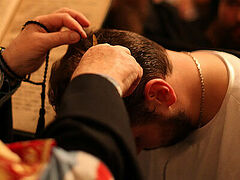
In 1992, the Athos representation church was opened. Fr. Naum (Baiborodin) blessed me to go there as a layman. He probably already saw that I was ready to take monastic vows. I asked him once: “You bless me on this path, don’t you?” He said: “Well, what do you want?” Then I had to say that I wanted to follow this path. In 1994, I was tonsured as a riassaphore monk at the Athonite dependency.
—How did your monastic path develop from there?
—Living and serving here naturally awakened a fervent desire in my heart to go to the Holy Mountain, although it took a while for this desire to be realized. When I came to the representation, the abbot was Igumen Peter (Pigol). I had a problem because I didn’t have a registered address, so I was in a kind of limbo. And the overall atmosphere there changed over time. The abbot changed, and the place began slowly dying. A few of the monks left for Athos.
Relations within the dependency were becoming increasingly difficult, and staying there became unbearable. The brothers started leaving. One other brother and I held out until 2000. We went to Elder Naum for spiritual advice. Before that, he had tried to console us, to reconcile us to the circumstances, and urged us to be patient. But this time, he heard us out and blessed us to write a petition to transfer to the St. Savva of Storozhevsk Monastery. Patriarch Alexei II blessed us, and we moved there in 2000.
 Nativity of the Theotokos Cathedral at St. Savva of Storozhevsk Monastery —Did you end up making it to the Holy Mountain?
—The way it worked out, I never got to visit Mt. Athos while I was living at the dependency. The only exception was in 1996, when pilgrim ships set out from Odessa going to the holy sites of the Mediterranean, and we stopped near Athos, among other places. I remember how our ship docked across from St. Panteleimon’s Monastery, and some of the Athonite brothers came out to us in motorboats. They came aboard with relics of the Great Martyr Panteleimon and St. Silouan and served a moleben. We venerated the relics, spoke with the monks, then went on our way.
My first trip to Athos came just a few months after I moved to the new monastery. I’ve been to the Holy Mountain many times since then, but my first trip left a particularly lasting impression. There were five of us, traveling there on our own by bus. Border crossings were easier then. If you had a Greek visa, you could transit through countries along the way. It was an unforgettable journey. We drove through Ukraine, Romania, and Bulgaria. It took us three days to get from our monastery to Thessaloniki. We got to Ouranopolis, and from there, we finally set sail for the Holy Mountain. We got there just in time for the feast of Pentecost.
We spent the night at St. Panteleimon’s Monastery. Abbot Jeremiah (Alekhin) was still alive then. We spent most of that trip in the Cell of St. Modestos of Jerusalem, whose abbot was Hieromonk Avraamy (Orlov). They were doing construction at the cell, with building materials lying everywhere. The rooms we had were barely fit for sleeping.
Sometimes Fr. Avraamy lent us a car, but most of the time we walked between monasteries. Of the twenty monasteries on Mt. Athos, we visited about fifteen. Sometimes we traveled by ferry. Of course, we climbed to the top of Mt. Athos, where we served Liturgy. It was quite difficult by the end, but we managed to see the main sacred places and items. Our trip turned out to be quite eventful.
Monastic life at St. Panteleimon’s is governed by strict rules. The daily routine is merciless. I remember on one of my later trips, I only got to sleep a few hours after the night service, because they woke me up to go work in the garden. I said: “But I didn’t get enough sleep. I was praying all night. Let me sleep.” “No, that’s enough. Get up and go weed the onion bed.” That experience clearly showed me that true asceticism lies in daily, monotonous effort, in the strictest discipline and readiness to work without complaining for the glory of God, no matter how tired you are.
On Mt. Athos, the presence of Divine grace is felt in a unique, tangible way, which is directly related to the exceptional veneration of the Most Holy Theotokos. After all, the Holy Mountain is her earthly domain, where she has appeared many times. The face of the Queen of Heaven greets you absolutely everywhere there. Every monastery, without exception, has her miraculous icons, whether Greek, Serbian, Bulgarian, Russian, etc.
I’m not talking about a literal physical vision of the Most Holy Theotokos. This was something completely different—a deep inner feeling. It was born from the very atmosphere there, from the unceasing prayer. Every corner of Athos is steeped in reverence, and absolutely everything there is literally permeated with sincere love for the Mother of God. That’s why your heart sees Athos as a place of special grace, where the living memory of the Queen of Heaven is everywhere.
—In your view, why do people become monastics?
—There is no single, universal answer or common reason for everyone. Everyone has their own path. The Lord leads everyone in their own way. For example, I never thought I’d become a monk. I only started going to church in college—I didn’t know where, what, or how. Of course, I saw that my grandparents had icons. But what’s that? A Soviet upbringing didn’t teach you anything about that. The ways of the Lord are inscrutable. St. John Climacus says in The Ladder of Divine Ascent: “All who have willingly left the things of the world, have certainly done so either for the sake of the future Kingdom, or because of the multitude of their sins, or for love of God” (Step 1.5). The Lord knows how to guide every man from the womb.
Of course, synergy is essential. The Lord guides, but each man must make his own decision. A divine calling never supersedes your own personal, free choice. Sometimes someone desires monasticism and strives for it, but his weaknesses pull him back. He might seem to want it, but circumstances, whether internal or external, conspire against it. Of course, his own decision is also very important.
—What would you say is the most important thing in the monastic life?
—We enter monasticism to fulfill the commandments and to live a more strict, attentive Christian life. Exceeding spacious is Thy commandment (Ps. 118:96), Scripture says. St. Seraphim of Sarov says that if you feel that some virtue brings you more grace, then do that. But absolutely any monastic endeavor, even the most sublime, loses all meaning if it’s not connected with deep humility and meekness. You might exhaust yourself with the strictest fast, stand in prayer for hours, and work till you sweat, yet still internally exalt yourself over the weaker brethren, with pride and vanity. Then it’s a lost cause, of course. So any virtue has to be strengthened by meekness and humility. All of this gives birth to love for God and neighbor. Everything in the monastic life depends on it. Asceticism’s impossible without humility and meekness.
The Apostle Paul says: And every man that striveth for the mastery is temperate in all things. Now they do it to obtain a corruptible crown; but we an incorruptible (1 Cor. 9:25). In his Ascetical Homilies, St. Isaac the Syrian writes that we must “remain collected in one place and fast perpetually” (Homily 40.1). That is, we all have to practice temperance, not only in food, but in everything.
There was a schemamonk on Mt. Athos named Chariton, who lived in Karoulia. Here in Russia, people love to talk about hesychasm. We asked him: “Fr. Chariton, do you practice hesychasm there in Karoulia?” to which he responded: “No.” He was offended when people called him a hesychast. The Greeks have a bit of a different approach to this word. There’s a book called Prayer Journal of Elder Theodosios of Karoulia, written by his disciple, Elder Nikodemos. Fr. Chariton was a disciple of Elder Nikodemos. The Elder died in his arms. Then Fr. Chariton placed the skull of his elder in his prayer corner and allowed visitors to venerate it. He said of himself that he wasn’t a hesychast, but an ascetic. Asceticism is abstinence in all things.
 Archimandrite Sergei and Fr. Mikhail Zavitaev serving a panikhida at the burial site of St. Joseph of Volokolamsk’s mother. Photo: iosif-vm.ru
—That is, monasticism is an ascetic life?
—Of course, but that’s not all of it. That’s just the beginning. You can lead an ascetic life in the world too. Sometimes someone goes to a monastery and feels empty inside, because the virtues he strove to acquire in the world were held together by vanity. He thought he was different from other laymen and grew vain. He goes to a monastery, and everything collapses. Therefore, asceticism in a monastery is a little different from that in the world, on the one hand.
On the other hand, monasticism isn’t just asceticism. It’s a path, to one degree or another, toward perfection, as far as is humanly possible. Asceticism is what we have to do, but it’s not an end in itself. St. Isaac the Syrian writes in his Ascetical Homilies: “Therefore the recompense is not for virtue, nor for toil on account of virtue, but for humility that is born of both. But if humility is lacking, the former two are in vain” (Homily 57).
Abba Dorotheos says in his Discourses and Sayings: “As one passion leads to another, so too do virtues.” A man practices humility, for example, and he develops simplicity and meekness. He remains silent, restrains his tongue, and gradually learns humility and self-control. Asceticism is one of the weapons of monasticism that helps in his inner battle and inner ascent, and it serves as a crutch for him. But I repeat, it’s not an end in itself.
Asceticism protects you from the world—for example, from unnecessary chatter and news, from gluttony, from the unnecessary things of the world. Asceticism helps you keep yourself in check. This is very good; this foundation is very important and necessary. But at the same time, you have to have inner focus, contemplation of God, and prayer. All this helps us produce fruit. But you can be an ascetic outwardly, yet be empty and lacking in virtue inwardly. The Gospel says: Bring forth fruit with patience (Lk. 8:15). The Apostle Paul lists the fruit of the Holy Spirit: But the fruit of the Spirit is love, joy, peace, longsuffering, gentleness, goodness, faith, meekness, temperance (Gal. 5:22–23). That’s what we should strive for. And asceticism helps us; it’s how we protect ourselves from things we don’t need, from things that hinder and distract us.
To be continued…