In the name of the Father, and of the Son, and of the Holy Spirit!
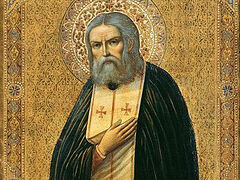
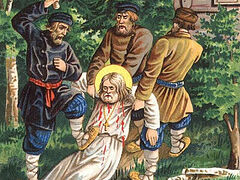
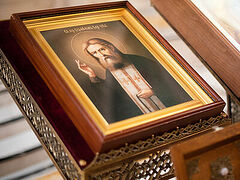
Today we celebrate the memory of a great Russian saint—St. Seraphim of Sarov. He is a saint for whom the people of God have a special love, regardless of their social status or education. Learned and uneducated, rich and poor alike—everyone deeply loves St. Seraphim. It was this love, coming from the believing heart, that once played a key role in his canonization.
The bureaucratic tradition that flourished during the Soviet era also existed in the Russian Empire, and perhaps particularly in church life. This was especially the case from the moment when, under Emperor Peter I the Great (ruled from 1682 to 1725), the Russian Church was effectively subjugated to the State: there was the so-called Synodal period, when we no longer had a Patriarch. Essentially, both the Most Holy Synod and the bishops were accountable and subordinate to the Ober-Procurator (Chief Procurator) and the Emperor. This bureaucracy, among other things, hindered the canonization of St. Seraphim. For a very long time, it could not come to pass; there were always smart, highly educated people who put forward various arguments claiming that the popular veneration of and love for St. Seraphim of Sarov were unhealthy and of an exalted (overly emotional) nature, and they found justifications for this both in the Holy Scriptures and in the Patristic teachings.
However, the will of one man played a huge role in the canonization of St. Seraphim of Sarov. His name was Emperor Nicholas II, who literally ordered the glorification of St. Seraphim. Of course, other people also worked in this direction—for example, the Hieromartyr Seraphim (Chichagov), who collected the entire archive of the Sarov Monastery—testimonies that many laughed at and doubted. And so Hieromartyr Seraphim, as it were, seeing that bureaucratic machine was not working and so bypassing it, presented all the testimonies to the sovereign. There is evidence that, through the prayers of St. Seraphim of Sarov, even before his canonization, the Romanov dynasty had received special grace-filled gifts. And the Emperor’s will contributed to the canonization of Father Seraphim.
And in fact, this was not the only such case. The very same thing happened with St. Joasaph of Belgorod (†1754; commemorated September 4/17 and December 10/23), and with a number of other saints, since more saints were canonized during the reign of St. Nicholas II than had been glorified in the preceding couple of centuries.
Now we are given enormous freedom to know God, study the Holy Fathers, and follow the Church. But all of us lack that simplicity that St. Seraphim showed to this world, and that sincere love and desire to serve his people and his Church—a simplicity that Emperor Nicholas II portrayed. And his deed is actually a very important one—perhaps more important than many of the things he did for his people and his State.
 Emperor Nicholas II and his family in Sarov
Then other people came, who killed the Tsar, reviled the Church, set up a huge number of idols all over our land that still stand on every corner, and worshipped madness. This exhausted our people, and in the end, it all collapsed.
And now we especially lack the love and humility that St. Seraphim taught, very simple things: studying the Holy Scriptures, confession, Communion, and the renewal of our souls through the Communion of the Body and Blood of Christ, of which St. Seraphim of Sarov, an ascetic, spoke so much. That is what will truly heal Russia. And if the people who govern it come to realize this, if they draw closer to this ideal, then our country has a future; but if they do not realize this, nothing good awaits us.
But we hope for the best, and we will pray to St. Seraphim, Tsar-Martyr Nicholas, and all the saints who were canonized together with St. Seraphim of Sarov. We will hope that the Lord will open the eyes and soften the hearts of our fellow countrymen, and that they too will understand how important is this path of acquiring the grace of the Holy Spirit, which St. Seraphim and many other Russian saints walked. Amen.