An account of St. Herman’s life was first compiled by the brethren of Valaam Monastery in 1867. In 1868, it was published under the title The Life of the Valaam Monk Herman, an American Missionary.
In 2005, based on new information about the saint’s life discovered by Doctoral Candidate of Historical Sciences Sergei Korsun in the Peter the Great Museum of Anthropology and Ethnography of the Russian Academy of Sciences (Kunstkamera), Valaam Monastery published a new study entitled, Venerable Herman of Alaska: A Valaam Ascetic in America.
Sergei Korsun has worked for many years in the field of ethnography of the peoples of Alaska and has authored more than fifty articles. In the archives, he came across intriguing documents related to the Russian Mission in Alaska:
—I began searching for more precise information about St. Herman, and in 2003, in St. Petersburg, at the Central State Historical Archive, I discovered two documents.
The first is a record of the issuance of passports to five novices of the Sarov Monastery, who, under the leadership of Igumen Nazarius, traveled to Valaam. Among them was the future St. Herman.
The second document is a letter to the Holy Synod, in which the abbot of Valaam Monastery, Fr. Gabriel, reports that in 1782, the former Sarov novices received the monastic tonsure from him. Among them, under the name Herman, was tonsured Yegor Ivanovich Popov—this St. Herman’s name before the tonsure.”
—Are there any other details about the venerable one mentioned there?
 Yes, the year and place of his birth. He was not born in 1757, as was previously thought, but in 1751. In our calendars, it is still written that the venerable one was from Serpukhov and from a merchant family. In reality, he was from the peasant class, from the Kadom district of the Voronezh Governorate. His family lived near the town of Shatsk. At the age of seventeen, Yegor Popov was drafted as a soldier. He served in the army for eleven years, after which he entered the Sarov Monastery.
St. Seraphim of Sarov and Herman of Alaska are very similar. Even in icons they are often depicted alike—near a forest cell, feeding a bear. They were ascetics of the same generation, of the same spirit. They even entered Sarov Monastery at the same time, in 1778, and certainly knew each other personally. Only St. Seraphim remained in Sarov, while St. Herman went to the North.
—It’s been a century and a half since Russia sold Alaska. I wonder, does anyone there still speak Russian?
—150 years ago, the capital of Alaska was Novo-Arkhangelsk (now Sitka), where Russians made up the majority of the population. In other settlements, Creoles and native peoples predominated. They rather quickly shifted to either English or their own Eskimo languages. Most of the Russians eventually moved to the “lower states”—to the mainland U.S., closer to civilization. The main wave of emigration occurred between 1920 and 1940; during that period, a large “Alaskan colony” formed in San Francisco. Many Creoles left along with the Russians, although some remained.
Indeed, one interesting fact is also known. In Alaska, on the Kenai Peninsula, there is a Russian village called Ninilchik. After the sale of Alaska, not a single ship docked there for seventy-seven years—the people lived in complete isolation. And when in 1935 the first Protestant preacher arrived in Ninilchik, he was astonished to find that no one understood his speech—people spoke to him only in Russian.
—In your book, you write that during his time in the Mission in Alaska, St. Herman was an ordinary monk who fulfilled the obedience of a baker. And yet, he ends up leading the Mission; governors of Russian America come to him on Spruce Island, where he later lived as a hermit, not only for spiritual counsel but also for matters of governance. What was so extraordinary about this man?
—The venerable one was not even a priest; he died as a simple monk. And he became head of the Mission against his own will. St. Herman was always burdened by worldly life—even on Valaam he lived as a recluse. I believe he did not even want to be a missionary, though he volunteered to go to Alaska. The other members of the Mission went mostly out of duty or by order, not by desire. When the opportunity arose, Herman withdrew to Spruce Island to live the life of a hermit, in prayer. But the Lord ordained otherwise.

In 1819, a terrible epidemic struck Alaska, and many people died. Herman took in a two-year-old Creole orphan named Gerasim Zyryanov. This was a sign to Fr. Herman that he was called to be a missionary. He stopped fleeing from people, and several disciples came to him on Spruce Island. Later, having heard of the father’s spiritual labors, an Aleut woman named Sophia Vlasova came to join him, and soon twelve more female disciples joined her. Thus, next to Herman’s desert cell, a true monastery began to form.
—Perhaps it was precisely Herman’s reluctance to be a missionary that led to true missionary work? That in prayer he acquired grace, and the natives were drawn to him?
—Yes, St. Herman worked real miracles and cared deeply for the local population, and that is what attracted people to him. But he never sought it out deliberately. I believe that out of his humility, the monk considered himself unworthy of such a difficult task as missionary labor.
Preserved is the first letter written by St. Herman upon arriving in Alaska, addressed to Abbot Nazarius on Valaam. In it, Father Herman—the baker of the Mission—writes with admiration about the missionary labors of his brethren.
It should be noted that the missionaries labored selflessly, and along the way, baptized thousands of natives. But at first, this was a largely formal baptism, for our fathers did not yet know the local languages and could not explain the essence of the Orthodox faith. The true mission began later, once the ground had been prepared—including through the prayerful struggles of St. Herman.
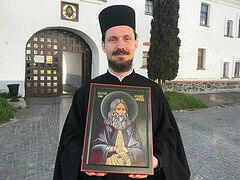
All-Night Vigil to St. Herman of Alaska in Valaam Monastery