Schitu Hadâmbului, Iași County, Romania, May 20, 2025

The Romanian Orthodox Church festively celebrated the 35th anniversary of the resumption of monastic life at Hadâmbu Monastery in Iași County over the weekend.
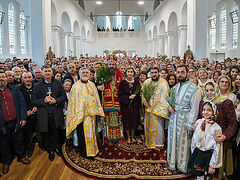
The holy habitation, founded in the mid-17th century, was closed by the communist authorities in 1959. It was revived in 1990. And on Sunday, May 18, three hierarchs, a host of clergy, and a multitude of pilgrims gathered to celebrate the monastery, reports the Basilica News Agency.
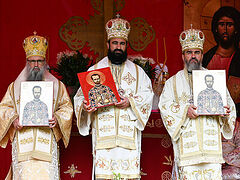
The Divine Liturgy was officiated by His Eminence Archbishop Casian of Lower Danube with Their Graces Bishop Antonie of Bălți and Bishop Nichifor of Botoșani from the Archdiocese of Iași.

“The holy altars in all Orthodox churches worldwide are, on the one hand, the tomb in which the Savior placed eternal life, and on the other hand, they have become the throne of eternal life, from which our Lord Jesus Christ gives us the medicine of eternal life: His Body and Blood, for the forgiveness of sins and eternal life,” said Abp. Casian in his teaching.
His Eminence explained that the Savior Jesus Christ “placed in the tomb, instead of death, His Body, which is eternal life.”
At the end of the Liturgy, Bp. Nichifor recalled the moments after the reestablishment of Hadâmbu Monastery.
“35 years ago, the gates of this monastic settlement were reopened, after a long period in which God allowed many monasteries to be closed, deserted, remaining not only without inhabitants but also without a trace of life between the walls that remained,” said the hierarch.
“Abbot Nicodim was 26 years old and found a monastery that hardly had a place to rest your head.”
“It was, however, the Lord’s blessing that, during all these years, many monasteries were reopened, and beautiful things were accomplished in the Church, with blessing and with the understanding that God works both through permission and through blessing. And His blessing is abundant and works through people as well, when they respond to the divine calling,” added the vicar bishop.
“Everything that has been accomplished here has not been achieved without difficulty, without toil, and sometimes without tears.”
Abbot Nicodim spoke about how the brotherhood has “only done what was [its] duty.”
Pilgrims had the opportunity to venerate relics of St. Panteleimon the Great Martyr brought from Greece, which will remain at the monastery through Friday.
***

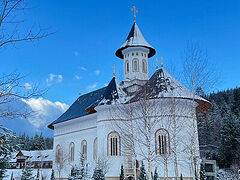
Hadâmbu Monastery, founded in 1659, is one of the most beautiful monasteries in the Iași area, but its most precious treasure is the miracle-working icon of the Mother of God, before which thousands of pilgrims kneel and receive comfort and miraculous healing.
The establishment was named “Hadâmbu” after its founder, the Greek boyar Iani Hadambu. It is a fortified monastic complex, built in the second half of the 17th century. The church and walls are made of quarry stone in the form of a fortress, due to those harsh times when Turks and Tatars would invade, plundering monasteries.
Around 1810, Hadâmbu Hermitage was affiliated with Galata Monastery, and then for 3 years with the Holy Sepulchre in Jerusalem. Several generations of Greek monks lived here until the time of ruler Alexandru Ioan Cuza, when the law of secularization of monastery assets was passed. Following this law, foreign monks were forced to leave the monastery.
Only in 1937, through the will of Abbot Iov Mazilu and with the blessing of Patriarch Miron Cristea, was the holy place repopulated with monks and renovated, experiencing a short period of flourishing until 1959, when the brothers were driven away by the communist authorities and scattered through the poor villages in the surroundings.
Hadâmbu Monastery was reopened in 1990, when His Beatitude Patriarch Daniel, then Metropolitan of Moldova and Bukovina, appointed Archimandrite Nicodim (Gheorghiță) as abbot.
The monastery is especially known for its philanthropic work, including funding homes for large, needy families (see here and here) and providing Christmas gifts for children from low-income families.
Follow OrthoChristian on Twitter, Vkontakte, Telegram, WhatsApp, MeWe, and Gab!