Chicago, June 5, 2025
 Photo: Sveta Paraskeva Petka Church
Thanks to a gift from the Diocese of Kumanovo and Osogovo of the Macedonian Orthodox Church-Ohrid Archbishopric, the faithful of St. Paraskeva Petka Church in Chicago can venerate the relics of a recently canonized saint whenever they gather for worship.
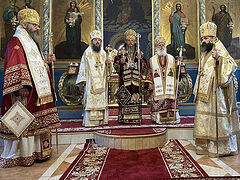
Last month, during the Hierarchical Divine Liturgy led by His Eminence Metropolitan Metodij of America and Canada, a particle of the relics of St. Joakim Krčovski were presented to the parish on the saint’s feast day, May 23, reports Liturgija.mk.
The hierarch was joined by local and visiting Macedonian clerics and Fr. Alexander Koranda, dean of the OCA’s Holy Trinity Cathedral in Chicago.
St. Joakim, an 18th-19th century ascetic and enlightener, was canonized by decision of the Macedonian-Ohrid Synod on May 10, 2022. His liturgical glorification was celebrated on May 22 at St. Joakim of Osogovo Monastery in Kriva Palanka, where his relics are treasured.
“From now on, his physical presence in the MOC-OA Church of St. Paraskeva Petka and the Macedonian community in Chicago will be an opportunity for all our people to learn how to preserve and protect the Macedonian script, language, and faith in Christ the Savior, through the teachings from the works of the saint, the venerable Joakim Krčovski, Macedonian enlightener and teacher,” comments Liturgija.
***
 Photo: mpc.org.mk
St Joakim Krčovski is the first author of the new Macedonian literature. In the second half of the 18th century, for a better tomorrow and better life, the Krčovski family, which was engaged in iron processing and iron products, most likely moved from Kičevo (then Krčevo) to Samokov, from there to Kriva Palanka and later to Kratovo. The future priest Joakim, born into a craftsman’s family in 1750 devoted himself to the spiritual cultivation of his heart and to the enlightening spirit for developing God’s image in the soul of every person from his people.
To improve and deepen his faith and knowledge of God, he went to study in Constantinople. Joakim’s father, as a successful craftsman, was able to enable his son to study and be educated in a Constantinople school, which was rare at that time and a privilege of wealthier citizens. And from his signature with the name Hadži, we learn that St. Joakim had been on pilgrimage to the holy places in Jerusalem.
Before being ordained as a priest in 1787, he married Dostana and with her had three sons. Of the three sons, two became priests. Although he carried the burden of marriage and the priestly cross, strengthened by God’s grace, he began teaching first in Kratovo and Kriva Palanka, and then deepened his endeavor with constant travels, together with his sons priest David, priest George and Ivan, preaching in various churches and monasteries from Štip to Kyustendil, all with the goal of finding those hungry and thirsty for God’s truth and to feed and water them from it.
After the death of his presbytera Dostana, Joakim received monastic tonsure in the Osogovo Monastery in Kriva Palanka. Receiving the same name in monasticism, Joakim gained a great intercessor and advocate in St. Joakim of Osogovo. Around hieromonk Joakim Krčovski gathered a brotherhood from which priests and teachers emerged.
The role of the monastery of St. Joakim of Osogovo during the difficult time of Ottoman slavery is invaluable. It was confirmed not only as a religious and spiritual center, but also as a hearth of literacy and enlightenment. In this monastery, St. Joakim Krčovski taught for several years, wanting to please God, and especially learning from the Apostolic and holy blessing that every people should have the opportunity to learn from the Gospel words in the language they understand, that is, their mother tongue.
He adapted his sermons everywhere to the language that was understandable to the illiterate, that is, to the unlettered or those who did not understand Church Slavonic and Greek. The time in which St. Joakim of Krčovo worked was after the fall of the Ohrid Archbishopric in 1767, when there was an invasion of various influences from neighboring Churches.
Therefore, St. Joakim Krčovski called upon the priests to teach the people through the example of their lives and the mother tongue in order to instill the spirit of Christian life and faith in their people. That is, life in repentance worthy of an Orthodox Christian.
In his five printed works: A Word Concerning Death, A Tale of the Terrible and Second Coming of Christ, Miracles of the Most Holy Theotokos, This Book on the Toll-Houses, and Various Instructive Teachings, we also encounter his interpretations. He is the first known composer in the vernacular language who gave interpretation of seventy-four Gospel texts, four Apostolic ones as well as several psalms. Then two interpretations of the Lord’s Prayer, as well as interpretation of “Rejoice, Virgin Theotokos,” and also of the Symbol of Faith which he gave in eight interpretations.
And in his entire work we can see the depth of his spiritual personality, his confession of faith and theology which does not differ in spirit from that of the Church Fathers. He taught the people about the constant Jesus Prayer and repentance, constantly turning the people away from pagan fortune-tellers, soothsayers and sacrifices which were more present among the people due to Ottoman slavery and Islam which was suffocating Christianity.
Until the end of his life, Righteous Joakim did not change his way of acting and remained in the endeavor of teaching and tireless pastoral care in the Lord’s field. In the last years of his teaching he resided in Kratovo where he led a new principle in schooling—that male and female children should learn together, which until then was unknown and unseen among the people.
He peacefully reposed in the Lord in 1820, resting from his many labors, surrendering his soul into the hands of Christ the Savior. The faithful people testified for many years afterward about the teacher who was a man of God.
Before the Palanka church of St. Demetrius was built in 1833, liturgical services were performed at Hadži Joakim’s grave, and due to the great respect of the citizens of the city, which they expressed at the burial place, some Turks demolished and desecrated St. Joakim’s grave.
In 1926 the cemeteries were moved to the present old cemeteries and during the relocation, the bones of St. Joakim and his son priest David were brought with special honors into the interior of the church where they are kept to this day.
The Orthodox Church includes St. Joakim Krčovski in the assembly of saints as an enlightener and teacher for Christ’s righteousness and God’s commandments who shone in the priestly order and received monastic tonsure. He was canonized and included in the diptych of saints on May 22, 2022 by His Beatitude Archbishop Stefan of Ohrid and Macedonia together with the hierarchs of the MOC-OA, and May 10/23 (new style) was chosen as the date for his celebration.
Through the prayers of St. Joakim Krčovski, Lord Jesus Christ have mercy on us! AMEN
Follow OrthoChristian on Twitter, Vkontakte, Telegram, WhatsApp, MeWe, and Gab!