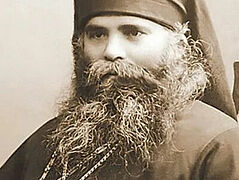
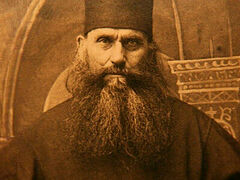
The Church recently commemorated the Synaxis of All Venerable and God-bearing Fathers Who Have Shone Forth on Mt. Athos. In this regard, let us turn to the example of Hieroschemamonk Ieronim (Solomentsov), who has not been glorified among the saints but who greatly influenced Russian monasticism on Mt. Athos.
 The future elder was born in 1805 into a God-fearing merchant family. He was named John. He was raised by his grandmother, who attended daily services with her grandson. At the age of six, John became an altar server, and from the age of twelve he refused meat and began to avoid worldly entertainment. The growing lad wanted more and more to dedicate his life to God. He revealed his desire to his father, who told him to wait till he came of age (twenty-three at that time) and help him in the merchant business.
At one point, John fell ill with cholera and was near death when the Mother of God appeared to him in a shining robe and healed him. In 1831, John, together with a spiritual friend, with knapsacks on their back, went to search for a monastery where they could labor and be saved. Having visited several Russian monasteries, by the providence of God, the friends wound up on Holy Mount Athos.
In 1836, John set foot on the Holy Mountain, becoming a disciple of Elder Arsenios the Athonite, a clairvoyant wonderworker and man of prayer. Almost immediately, the elder tonsured him into the small schema with the name Ioanniky. For four years, Monk Ioanniky lived carefree in the Cell of the Holy Prophet Elijah, learning the Jesus Prayer from his spiritual guide and carrying out obedience in the olive groves.
But one day, the elder called his disciple to him and said: “Fr. Ioanniky! The Lord blesses you to go live at the Russian monastery with your disciples, for the Lord wants to build something there.” The future restorer of St. Panteleimon’s Monastery tried in every way to refuse the obedience placed upon him, but his spiritual father answered: “It is fitting for you to develop the Russian monastery, and through you it will be glorified. Do not oppose God’s will any longer.”
On October 6, 1840, St. Panteleimon’s Monastery solemnly welcomed its humble new abbot. He was immediately ordained a hierodeacon and hieromonk and tonsured into the great schema with the name Ieronim. He took over the management of the monastery under difficult circumstances. It was in poverty and debt. It was necessary to preserve the spirit of the monastery while adjusting its typikon and addressing the everyday needs of the brothers, becoming a kind father and wise mentor for them. When Fr. Ieronim began this ministry, despite his youth, he was distinguished by spiritual experience, mental strength, strong will, and loving-kindness. Under him, the number of brothers increased from eleven to several hundred, the monastery buildings were rebuilt and beautified, the monastery cells were restored, and many benefactors were found.
For a more complete picture of Fr. Ieronim’s ministry and personality, let us turn to the testimonies of people who knew him during his lifetime. A certain Monk Partheny left the following reminiscences about him:
He was meek and forbearing; he could bear all our infirmities in such a way that I’ve never seen such a meek and patient man in all my life, and he was perfect in all virtues; he taught us not in words, but in all things he showed us and was an example for us; and in his words he was sweet-spoken, firm and discerning, and had such power that even if a man was stone-hearted, he could persuade anyone and bring them to tears, and could exhort anyone and guide them on the true path… He was of above-average height, with long light-brown hair, a long and broad light-brown beard, his face clean and white and always cheerful, his gaze most pleasant, but very pale and thin from great labors and weak health. He often engaged in spiritual conversation with us, and we would often go without sleep all the way up to Matins. It was a joy for us to have such conversations with him… When we saw his face, we forgot ourselves. And when he happened to be ill, we would weep throughout those days and entreat God to grant him health.

A contemporary of Elder Ieronim, Schemamonk Selenky, spoke of him as follows:
He instructs and comforts everyone in word and deed: To some he gives money, to some rusks, cheese, olives, pasta, and some he consoles with spiritual conversation. His words are seasoned with the salt of grace, and his gaze penetrating… He gives teachings and instructions that we might strive not to give ourselves over to laziness and despondency, but rise for Matins and make prostrations at the midnight canon, and especially that we might not eat to satiety and might eat without salt, so as to drink less water... He was of tall stature and lean, his face so comely that it can’t be described perfectly, like the face of an angel. His hair was light-brown with gray, his appearance cheerful, and an extraordinary kindness was reflected in his eyes.
Another Athonite, Hieromonk Non, said that Fr. Ieronim
was so merciful that it’s impossible to count and relate his great benefactions and mercies by word or pen. And he had such love for his neighbor that he often deprived himself of his own benefit for that of others... He had great patience, and was exceedingly forbearing toward the weaknesses of others but was extraordinarily strict with himself. And he never allowed anger or irritability toward anyone to overcome him, but always and at all times he freely conquered all his passions through the grace given to him from above.
Indeed, Hieroschemamonk Ieronim was famed on the Holy Mountain for his generosity. Many people in need would gather in St. Panteleimon’s after the services, and he generously distributed alms, food, and clothes according to the needs of each. Regarding material alms, the elder himself explained in one of his letters: “From old materials we sew vestments, sticharia, stoles, veils, and we give them out.”
Another Athonite named Agathodor testified about the elder:
Fr. Ieronim had a serious and thoughtful character; he never laughed, smiled, or joked, but also didn’t get annoyed, but always spoke calmly, barely audibly, without extraneous words, saying only what was necessary. He was restrained in all things, and it was obvious that he was always mentally occupied with something. He had unceasing grace-filled prayer; he was mentally with God and therefore wasn’t talkative and didn’t engage in idle talk.
According to the recollections of other inhabitants of the Holy Mountain, the elder possessed an all-forgiving love of neighbor, and as a true monk, he did everything he could to avoid praise.
Konstantin Leontiev, being a consul in Macedonia and having spent a year on Mt. Athos, knew the elder personally. He later said about Fr. Ieronim:
I’ll call him great, straight out. He was not only a monk of high life, he was a man more than remarkable, with a great soul and extraordinary mind… Firm, unshakable, fearless and enterprising, bold and cautious at the same time, a profound idealist and extremely businesslike, still strikingly comely in his advanced years, Fr. Ieronim easily won people over, and I even noticed that he influenced those who were themselves intellectually and morally superior even more strongly than he did ordinary people. It’s understandable. The latter perhaps only feared him; intelligent, independent people who knew how to judge character surrendered themselves to him with amazement and love. Father Ieronim was always so calm and unflappable that I ... never once saw him either get angry or laugh as others laugh. He would barely smile occasionally, never raise his voice, never show either particular joy or sorrow. Sometimes he was only a little brighter, sometimes a little darker and more severe.

After ten years of spiritual ministry at St. Panteleimon’s, the elder’s health weakened. He thought and prayed about a successor. Finally, when the layman Mikhail Sushkin arrived on the Holy Mountain, the elder said: “This is the man we entreated from the Lord.” Over time, Mikhail became a novice and devoted disciple of the elder, was tonsured into monasticism with the name Makary, ordained a hieromonk, and appointed an assistant in the monastery’s external affairs. Internally, Fr. Makary grew spiritually in obedience next to his mentor, lovingly accepting lessons in humility from him. Fr. Makary perceived his time on the Holy Mountain as Paradise, and as he himself explained, “especially as long as my spiritual father lives... He’s my only treasure on earth,” meaning Elder Ieronim. The elder said of Fr. Makary: “I thank the Lord that He sent to my aid such a grace-filled man, who, if God blesses, will become the abbot of the Russian brethren after my repose.”
We learn about Hieroschemamonk Ieronim’s daily hardships from a letter to his sister:
My health is unstable; my chronic illnesses are always with me… Sometimes I have enough time for prayer, reading, and other things in my cell, and sometimes not, or very little: The brethren constantly occupy me with administrative questions, and most of all about Confession… I don’t sleep when I want, but when my convulsions allow me to fall asleep, so I can’t always even fall asleep before Matins… At those times, I walk around my cell more, which is why my cell was intentionally made long—ten steps… I often doze off at Matins, and because of my great laziness I don’t resist my drowsiness, and sometimes I want to fall asleep in church—that’s how I labor!...
Currently, they send me many letters from Russia with various questions, and I must dictate responses to all the most necessary letters, but to letters of confession I respond in my own hand—what can I do?—sometimes with great effort, groaning and sighing all the while.
 The brethren of St. Panteleimon’s Monastery
At the same time, the elder wrote honestly about himself:
But you perhaps think that I do everything with good cheer? No. I often ask myself with surprise: “How did I fall into such trouble, getting entangled with such an enormous family? How many cares and worries, concerns, labors, sorrows, illnesses and calamities! Neither means nor security”... Many of my brethren greatly comfort me with their God-pleasing life, and this greatly encourages me.
In 1882, sensing that he had little time left on earth, the elder composed a spiritual testament. In another letter to his sister from the same time, he wrote:
I’m dying every day. I was seriously ill and thought I was going to die; I said goodbye to everyone, and finally I was given Unction, and I was waiting for death. But my brethren were grieved by this, and out of the pain of their hearts, they all wept and cried to the Lord for my recovery and the prolongation of my life. The merciful Lord heard their cry, and I’m getting better now, and they rejoiced that I was left to live here with them a little longer. But for how long? God knows. It’s time for me to die already.
They constantly served molebens for the elder’s health in the monastery, as he faced great physical suffering. Finally, he forbade the brethren to pray about it.
In the last days of his life, in November 1885, Fr. Ieronim ascended his personal Golgotha, unable to hold back tears from the pain he endured. At the same time, he told the brethren:
My brethren and children! Strive as much as possible to please the Lord. No one can humiliate God, but we can grieve and offend Him, which is why the angels who didn’t keep their obedience and submission to God are punished with eternal separation from God not for the precision of their service, but for their deviation from the Creator. Thus, we must always steadfastly look to God mentally. I’ll tell you, my children, about myself, your sinful spiritual father. All my life I’ve tried to please the Lord as much as possible, both in prayer and in deeds.
On his deathbed, the elder softly said:
Lord, help me. I’m weary from my difficult bodily illness, and my mental and bodily powers are exhausted. I fear lest I murmur against my unbearable sickness and sin in this before You, my Creator.
The last earthly words of Elder Ieronim were: “Glory to God for all things.” In the arms of his beloved disciple, Hieroschemamonk Makary, he departed quietly and peacefully into blessed eternity. The elder’s repose was announced by twelve strokes of the bell. After his repose, the elder left many spiritual children, appearing to some of them in dreams standing at the throne of God.
 The elder on his deathbed, with Fr. Makary
Let’s turn to a small part of the spiritual edifications of Elder Ieronim. Here is what he said about prayer:
Prayer is the highest virtue and the beginning of any other virtue, for through prayer we can entreat everything from our Heavenly Father. As the Lord Himself said: “Ask in faith, and you will receive” (cf. Mk. 11:24). But the Lord only accepts prayer that ascends to Him with humility and love. But if anyone with pride or has anger in his heart against someone, the Lord rejects such prayer. In prayer, as in any virtue, you must force yourself and have patience, without which it’s impossible to succeed in anything good.
When we go to church, we have to remember that we’re going to the divine services and examine ourselves as to whether we have a contrite and humble spirit and heart and whether we listen attentively to all the divine services. Standing in church, reflecting, and maintaining the remembrance of death, the Dread Judgment, and the future retribution for the righteous and sinful… The Lord expects even dry prayer from us, but you say it’s useless. Indeed, you hang on the cross when you’re mournful, gloomy, and despondent, but you pray. If you don’t pray, you’ll be like the demons… When starting any good deed, we must fervently pray to God, entreating His blessing. Only then can our affairs be successful.
He also taught:
Strive to not be lazy but hurry to church. Paying attention to what is read, you’ll find a precious pledge of love for the Lord… Eat, drink—don’t fall into temptation but maintain self-reproach and don’t condemn others. Be attentive to yourself. If they drink tea—drink, if they eat—eat, if they speak—respond, if they laugh—laugh, but inwardly pay heed to yourself with self-reproach... Let them slander, revile, calumniate us, so long as we don’t repay them in kind. Otherwise, it’s impossible to be saved. It must be so, that through our weaknesses we may be perfected, without which we can’t know ourselves... Both rich and poor, kings and commoners, monastics and laymen have been saved and continue to be saved—the entrance to the Kingdom of Heaven is open to all.
But above all, Hieroschemamonk Ieronim taught those desiring salvation by his life itself, and it’s believed he reached the dwelling places of the righteous.