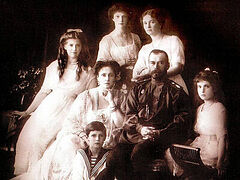
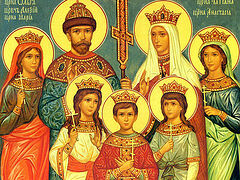
On July 17, the Russian Orthodox Church honors the memory of the holy Royal Passion-Bearers who were martyred in 1918.
 St. Nicholas Alexandrovich [Tsar Nicholas II], the heir to the Russian throne, constantly examined his country’s life. He went on long journeys across Russia, talked a lot with representatives of different strata of society, and was Chairman of the State Committee that oversaw the construction of the Trans-Siberian Railway. He undertook military service with great joy, attaining the high rank of colonel. Military service revealed in Nicholas Alexandrovich such Christian qualities as sincere concern for his subordinates and helping others, regardless of ranks and titles. The heir to the Russian throne took care of the soldiers on a level with the officers, examining their living conditions in barracks and supervising their food and material supplies.
One day, Nicholas Alexandrovich walked about twenty miles with a full soldier’s kit together with the soldiers to see if it was worth approving such a soldier’s kit. He provided aid to soldiers’ families in need. St. Nicholas Alexandrovich simply and directly communicated both with peasants and middle-class people who were conscripted into the Army.
One of the Tsarevich’s comrades in the regiment used to say that in the future Tsar’s character there was a lot of “unsophisticated simplicity”—a truly Christian quality, so rare for a monarch.
Emperor Alexander III tried his best to prepare his son for the role of head of the Russian Empire, but, unfortunately, the monarch died in 1894 after a serious illness. There are many entries in St. Nicholas II’s diaries that show the depth of his grief over the premature death of his father and worries about the destiny of the Russian State. These records show that St. Nicholas II was very conscious of his high duty and well aware that he had to meet the expectations of his people.
St. Nicholas II’s life was filled with love for his Motherland and service to the good of Russia, even to the detriment of himself.
The following objective statistics (as of the beginning of the First World War) indicate the results of his reign.
First of all, they demonstrate unprecedented demographic growth. Over the twenty years of Emperor Nicholas II’s reign, the population of Russia grew one and a half times. By 1914, Russia’s population had increased from 129 million (1897 figures) to 178 million. In 1913, over ten percent of the world’s population lived in Russia. This demographic growth was a consequence of the reduction in child mortality, because medical care became more accessible and sanitation conditions improved. Behind all this was the Emperor’s concern for the development of the healthcare, and large funds from the State Treasury were spent on this.
The following facts demonstrate the growth of the Russian economy during the reign of St. Nicholas II. The volume of machine production increased from 1,500 machines in 1894 to 6,500 in 1916. The average yield of wheat per tithe increased from thirty-three poods (540.54 kg) in 1901 to fifty-eight poods (949.98 kg) in 1913.1
Coal production amounted to 466 million poods (7.63 million tonnes) in 1895 and 1983 million poods (32.47 million tonnes) in 1914. Oil production increased from 338 million poods (5.54 million tonnes) in 1895 to 560 million poods (9.17 million tonnes) in 1914. The increase in sugar production showed: 30 million poods (491.4 thousand tonnes) in 1894 and 104.5 million poods (1.71 million tonnes) in 1914. Steel production was developing: 70 million poods (1.15 million tonnes) in 1895 and 229 million poods (3.75 million tonnes) in 1914. Russia’s gold reserves grew from 648,000 poods (10.62 tonnes) in 1894 to 1,604,000 poods (26.3 tonnes) in 1914.
 Cross procession with the relics of St. Seraphim of Sarov. July 19, 1903
During the reign of Nicholas II, numerous monasteries were opened in Russia, and new saints were canonized. He participated in the preparation of the canonization of St. Seraphim of Sarov and St. John of Tobolsk. At that time, the number of Orthodox churches in Russia was increasing. In a report presented to him, the Tsar wrote: “Building churches in Siberia is especially dear to my heart. I want every church to have a school.”
The school system in Russia under St. Nicholas II was organized in such a way that the country came very close to universal literacy. The Treasury’s expenditure on education increased sixfold during his reign. The number of high school students grew from 14,000 to 40,000 in twenty years. The number of secondary school students tripled. In 1913, the number of primary, parish and zemstvo schools exceeded 130,000, and about 16.5 million children from the lower orders were enrolled. Primary education was free, and in 1908 it became compulsory. In 1914, the majority of Russian youth, even from the lower classes, were literate. There were gymnasiums (classical schools) in all the chief towns of uyezds (districts), of which European countries could not boast.
Secondary and higher education for women was developing rapidly in Russia, and the country was even ahead of Western Europe—in 1914, there were 965 women’s gymnasiums and higher courses for women (equivalent to universities) in all major cities. There were 117 public and private universities in Russia, where there were over 120,000 students (for comparison: at that time France had 40,000 students). The training was affordable. For instance, it was twenty times cheaper at Law Departments in Russia than in the USA or the UK. Students who were unable to pay for their education were exempt from tuition fees and even received scholarships.
Just before the First World War, 255 metallurgical plants, 568 coal-mining enterprises, 170 oil-producing enterprises, fifty-four oil refineries, and 1,800 large and small metalworking plants worked in Russia. The total capacity of the power plants was 1,098 thousand kilowatts.
Agriculture was developing rapidly. The grain harvest doubled. In 1913, the harvest of cereals in Russia was a third higher than in the USA, Canada and Argentina combined.
The rate of Russia’s economic and cultural development was impressive. The French economic commentator Edmond Thery (1854–1925) wrote: “If things go the same way for most European nations between 1912 and 1950 as they did between 1900 and 1912, then by the middle of this century Russia will dominate Europe politically, economically and financially.” Russia was becoming a rich and prosperous state.
Prince Nicholas Zhevakhov (1874–1945) wrote about Emperor Nicholas II: “He was above all a seeker of God, a man who fully surrendered himself to the will of God, a deeply believing Christian of a high spiritual make-up, who stood immeasurably above those who surrounded him and with whom he was in contact. Only boundless humility and touching delicacy, to which even his enemies unanimously testified, did not allow the Sovereign to emphasize his moral advantages over others.”
St. Nicholas II was distinct from all the statesmen and rulers of his age by his wisdom, justice and kindness.
On the eve of the First World War, Russia, represented by its Tsar, showed a desire for peace and, if necessary, its willingness to compromise. But it was obvious that Russia would not allow the betrayal of the Orthodox Serbia. It is also obvious that when Russia joined the First World War, it acted after a thorough consideration.
But in February and March 1917, there was a catastrophe that did not begin at the front, but in the capital. The Emperor was forced to abdicate by the intrigues of the Grand Dukes, the conspiracy of the Duma oppositionists, and the treason of the senior military figures.
 Nicholas II at the review of the cadet corps students during the celebrations on the occasion of the centenary of the 1812 war
Emperor Nicholas II abdicated in favor of his brother Michael. He did it out of duty because, as Emperor, he was first and foremost the Supreme Commander of the Russian Armed Forces. At that time, the Russian Army numbered over 1.3 million soldiers and officers and was one of the largest armies in the world. And the sovereign had no greater concern than to bring Russia and its Armed Forces to a victorious end of the war.
St. Nicholas II was faced with a tough choice: either to unleash a civil war in Russia or abdicate the throne. And he gave up the throne, hoping to prevent the Revolution and a bloody civil war that would follow it in the country. In one of his telegrams, he wrote about his decision to abdicate as a sacrifice “for the sake of the real good and for the salvation of Russia.”
The historian Sergei Oldenburg wrote: “The Emperor did not believe that his opponents would cope with the situation. So, he tried to keep control in his hands to the last minute. When it was no longer possible (it was clear from the situation that he was a captive), the monarch wanted to do everything in his power to facilitate the task of his successors. He appointed General Lavr Kornilov Commander of the Petrograd Military District; he signed a decree appointing Prince Georgy Lvov Chairman of the Council of Ministers; he appointed Grand Duke Nicholas Nikolaevich Supreme Commander of the Russian Army; lastly, he wrote an appeal to the troops, urging them to fight the external enemy and serve the new Government faithfully... The Emperor gave his opponents everything he could, but they were powerless in the face of events. Control was taken from the hands of the imperial driver and the vehicle fell into an abyss.”
Grand Duke Michael Alexandrovich declined the Russian throne. As a result, the Provisional Government was formed from a group of deputies of the State Duma, with its composition being agreed upon by the Soviet of the Workers’ and Soldiers’ Deputies.

The Royal Family went through all the hardships together, remaining united to the end. In this family, each took care of his loved ones more than of himself, and everything was based on love, understanding, patience and industriousness. This was the case in Tobolsk when St. Nicholas II had to go to a new place of exile—to Ekaterinburg, and Tsarevich Alexei was unable to travel due to his ill health. Tsarina Alexandra Feodorovna was distraught, not daring to leave either her husband or her sick son. Then they found a solution together. The family had to split up for a while; St. Alexandra Feodorovna followed her husband and daughter Maria, while Princesses Olga, Tatiana and Anastasia stayed with the sick Tsarevich Alexei. When his condition somewhat improved, the children came to their parents, and the whole family were under one roof again, which strengthened both the parents and the children.
The Royal Martyrs did not try to save their lives and gather supporters to carry out a coup and unleash an internal conflict, because they did not want bloodshed, the deaths of innocent people and new suffering for Russia and its people.
St. Tikhon, Patriarch of Moscow and All Russia, wrote about Nicholas II: “He did nothing to improve his situation, meekly resigning himself to his lot.”
Faith in the Lord and their mutual support in difficult moments helped the Imperial Family overcome all their ordeals with dignity and courageously accept their martyrdom. They were shot on the night of July 16–17 in the basement of the engineer Ipatiev’s house in Ekaterinburg. The Royal Martyrs sacrificed their lives for Russia.
Holy Royal Martyrs, pray to God for us!