The Royal Cross Procession
One of the main signs of sainthood is veneration by the people. When I met my future spiritual father in 1996—Schema-Archimandrite Vlasy (Peregontsev) of the Pafnutiev Borovsky Monastery—there was already an icon of the Holy Royal Passion-Bearers in his cell. When he was asked why God allowed godlessness and the persecution of the Church in Russia in the twentieth century, he replied that it was a punishment for the people’s falling away from the Orthodox faith and the terrible sin of regicide. Father Vlasy saw healing from this sin in the Church’s glorification of the Royal Passion-Bearers, whom he deeply revered and loved. Next to his cell, where he received visitors, there was a large hand-painted icon of them, before which prayers were constantly offered.
When in May, Bishop Joseph (Korolev), the abbot of Optina Pustyn and the closest disciple of Fr.Vlasy, who had lived with him for twenty-seven years, came to Ekaterinburg, I asked him how he planned to spend his time in the Ural's capital. Bishop Joseph replied:
“I will certainly pray at the Church on the Blood, then we will go to the Monastery of the Royal Passion-Bearers at Ganina Yama, and after that to Alapaevsk to venerate the Holy Venerable Martyr Grand Duchess Elizabeth and Nun Barbara.”
 Veneration of the Holy Royal Passion-Bearers in the Urals began in the 1980s. I had the privilege of knowing Anatoly Mikhailovich Verkhovsky personally and communicating closely with him; he was the organizer of the first molebens near the Ipatiev House and the one who introduced Ganina Yama to the world. One of the main conditions for the spiritual revival of Russia, he believed, was the restoration of the historical truth about the last Russian Emperor and his family, along with their glorification among the saints. For him, this was the purpose of his entire life.
He was an extraordinary person, entirely free of avarice, who loved Russia and Orthodoxy with all his heart. During the perestroika era and the market reforms, when most people were busy taking advantage of the sudden freedom and earning money, which quickly became the symbol of that very freedom, he dreamed of the Church’s revival, of Russia becoming Orthodox again and returning to its historical roots. One of the main conditions for the spiritual revival of Russia, he believed, was the restoration of the historical truth about the last Russian Emperor and his family, and their glorification among the saints. He considered this the purpose of his entire life.
I remember sitting in his small, shabby apartment on the second floor of an old house, at a rickety table piled with papers and an old computer on which he worked. We drank strong tea served by his wife and talked about the Royal Family.
He said that for anyone, even for the person most indifferent to faith, it is enough to open and carefully read the diaries of Tsar Nicholas II and Empress Alexandra Feodorovna to see that these were holy people who dedicated their entire lives to service—the highest form of love commanded by God.
““You see,” he said, ‘They carried their service to God and to people throughout their entire lives; it was the foundation of their worldview and faith, which determined their actions and decisions.’. If this is not taken into account, then their lives and the martyrdom they endured for their country will remain completely incomprehensible—just as the podvig of the first Russian passion-bearer saints, Princes Boris and Gleb, will remain incomprehensible.
One may speak endlessly about the political miscalculations of the Tsar, but it is impossible to deny that Nicholas II was a true Orthodox Tsar, the Anointed of God, who thought in terms of service to God and people, according to his understanding.
The right of a true Tsar is to die for his people—and he fulfilled this to the end. At the end of April 1918, within the confines of the Ipatiev House, Nicholas II wrote in his diary:
“Perhaps a sacrificial offering is necessary for the salvation of Russia: I shall be that offering—may God’s will be done!”
The Tsar could not even imagine leaving Russia. When he was offered the chance to flee abroad, he firmly replied:
“I would not want to leave Russia. I love her too much…”
A few days before the tragic death of the Royal Martyrs, Grand Duchess Olga wrote:
“Father asks to convey to all who remain loyal to him not to take revenge for him—he has forgiven everyone and prays for all, and to remember that the evil that is now in the world will become even stronger, but that evil will not conquer evil—only love will.”
The Monastery of the Holy Royal Passion-Bearers at Ganina Yama is a living symbol of this holy, sacrificial love. The place where one of the most terrible atrocities of the twentieth century was committed has not become a valley of sorrow and grief, but a place of spiritual transfiguration in Christ, a place of God’s glory, the victory of Life over death!
Nowhere in any monastery, neither on Valaam nor in Optina, have I seen so many children as in the Monastery of the Holy Royal Passion-Bearers! Children with their parents—in the churches during services, along the picturesque flower-lined alleys, on benches next to their mothers, in the museum, near the monuments, and by the Memorial Cross. Instead of sorrowful and mournful faces—everywhere are the joyful, smiling, and happy faces of children! And this is one of the most convincing proofs of the holiness of the Royal Martyrs.
His Holiness Patriarch Kirill, during his visit to the monastery at Ganina Yama, noted the grace-filled atmosphere of this place:
“If something is not working out for someone, if the enemy tempts you, if it seems that evil is invincible—remember Ganina Yama and recall the wondrous words of the Paschal hymn: ‘Thou hast shattered the power of Hades.’ These memories, like these words, will help us revive our spirits even in the most difficult circumstances of life.”
When I met my future wife, after our wedding we decided that the best honeymoon would be to go to the monastery at Ganina Yama, to live there for a few days, attend the monastery services, pray to the Holy Royal Passion-Bearers, and be nourished by their love. To learn from them how to behave in the family, how to raise children, how to treat one’s duty and one’s Fatherland. When our daughter was born, we named her in honor of Grand Duchess Maria.
While studying at the Ekaterinburg Theological Seminary, my classmates and I would stay at the Spiritual Pilgrimage Center of the monastery in Ganina Yama during exam sessions. After the exams, we would always return to give thanks. Some would arrive a few days before the session, while others would stay longer afterward. As you travel to Ganina, instead of anxiety or thoughts about exams, you feel joy in your heart. You know you are going to the Holy Royal Passion Bearers.
 After the Royal Cross Procession in the Monastery of the Holy Royal Passion-Bearers at Ganina Yama.
The people sense the righteousness and holiness of the Royal Martyrs and turn to them. People of all kinds, united by faith, love for the Tsar and his family, and for their homeland, Russia, come to the monastery at Ganina Yama. When my wife and I were there, we met a group of pilgrims who had come in their own large bus all the way from Pyatigorsk.
As you walk near the Memorial Cross, you will see a family: a father, a mother, and a grandmother holding the grandson by the hand. They look at the Cross, bow, kiss its base, and the boy lays a bouquet of daisies before crossing himself. Then, they walk along the gallery around the Cross. They look at the portraits of the Holy Royal Passion Bearers. Eye to eye. They were like us. They, too, loved each other and rejoiced in the sun and the blue sky. And they loved God and their country. True love does not divide; it unites. Love led them to Heaven. The love, which they saw so little of in their lives—surrounded by flatterers and traitors—found them in eternity.
During the Royal Days, Orthodox believers from all over Russia and from both near and far come to Ekaterinburg. Friends from Diveyevo visit my friends every year for the Royal Days, and my colleague, Svetlana Ladina, editor at the Soyuz TV channel, hosts friends from Moscow at this time.
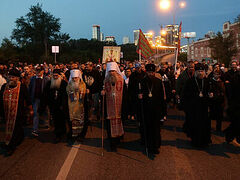
On the night of July 16 to 17, it is tradition for a solemn night Divine Liturgy to be celebrated in the square before the Church on the Blood, with many hierarchs serving and representatives of the Local Orthodox Churches present. After the liturgy, the Royal Cross Procession sets out for the Monastery of the Holy Royal Passion-Bearers at Ganina Yama.
A vast human river, with icons and banners, with singing and prayers, flowed through the sleeping city, past shopping centers and new buildings, past residential areas and industrial zones. Someone was pushing a baby stroller, another—a person in a wheelchair, here was an abbot with a prayer rope in his hands, two soldiers. Journalists from the central TV channels near me argued whether there were 70,000 believers walking or more.
There was a familiar professor from Ural University walking with his wife and friends. Athletes we had met in Verkhoturye. A businessman, in whose office I once saw the works of St. Basil the Great and a volume of Maximilian Voloshin with pages bookmarked. A composer and electronic musician who recorded an album with a symphony orchestra and performed with the musician Tricky.
Fathers, mothers, children with backpacks and fashionable sneakers. Elderly women in raincoats with folding stools. Many students. A sea of joyful, bright, inspired faces.
The sky wept, and a quiet summer rain began to fall. People wiped their wet foreheads and answered the sky with prayers. The prayers of thousands upon thousands of people closed the floodgates of heaven—the rain stopped, it became quiet, and only the words of the Jesus Prayer carried over the procession. Then it began to brighten, and the birds started singing in the trees.
 At the night Liturgy by the Church on the Blood. From left to right: the rector of the Church of St. Righteous Simeon of Verkhoturye in Obukhovo, the author, Hieromonk Theodosius, abbot of the Transfiguration Monastery in Kamensk-Uralsky. It is symbolic that the Royal Cross Procession begins at night, when everything is enveloped in darkness, and ends at dawn. It is as though you are walking the path of the cross of the last Russian Tsar and his family, appointed for them by the Lord. From darkness to light, from the triumph of evil that with inhuman hatred slaughtered the Tsar and his family—who were not even supposed to be remembered—to the living symbol of their victory: a corner of Holy Rus’ filled with flowers and gold, the Monastery of the Holy Royal Passion-Bearers.
Passing through the monastery gates, under the icon of the Mother of God, the people began to rejoice. Some, exhausted, fell right into the grass but continued rejoicing. They straightened their shoulders and rushed to help others, sharing water and food, embracing, kissing each other, and lifting up prayers to the Holy Royal Passion-Bearers.
Many participants of the Royal Cross Procession told me about the inexpressible feeling of joy when you become a partaker of the Paschal victory of good over evil, of love over hatred, of life over death! With Christ, the land of blood becomes a Paradisal garden, where there is no sorrow, nor sighing, nor death, where the Royal Passion-Bearers glorify the Risen Christ.
Through the prayers of the Holy Royal Passion-Bearers many miracles occur. The rector of the Church of Peter and Paul in Talitsa, Archpriest Igor Balabanov, told me that when the all-Russian Royal Cross Procession came to them, the icon of the Royal Passion-Bearers they carried began to stream myrrh right during the liturgy, witnessed by eight clergymen. The icon became covered, as if with dew, with fragrant oily drops that grew and ran down before their eyes.
In the morning, they woke up—and the apartment was filled with a wondrous fragrance. They looked: the icon of the Royal Passion-Bearers was entirely covered with droplets of myrrh.
And my colleague Svetlana Ladina’s icon of the Royal Passion-Bearers, brought by friends to the Royal Cross Procession, also streamed myrrh during the night. In the morning, they woke up—and the entire apartment was filled with an incredible, wondrous fragrance. They looked: the icon of the Royal Passion-Bearers was covered with myrrh droplets. A report about this miracle was made on the Soyuz channel—it is easy to find online.
Here at Ganina Yama, near the Tsar, the people of God gather. With icons, with flowers, with children in arms, and elders in wheelchairs. A sincere, intelligent, hardworking, kind, trusting, loving people. A people who love God and the Holy Tsar—the God-loving, believing Tsar, who gave his life for his people. Once they lived in different worlds, but they met at the foot of the Cross.
The love of Christ revealed to us the sacrificial feat of the last Russian Emperor and his family. This cannot be understood by a cynical, deceitful mind—it can only be understood by the heart.