On July 27, the Church commemorates St. Nicodemus the Hagiorite. Priest Pavel Serzhantov, a theologian, a philosopher, associate professor of the Sretensky Theological Academy, and a cleric of the Moscow Church of the Holy Trinity at Saltykov Bridge, has talked about the role of the eighteenth-century Greek monk in today’s spiritual education.
 St. Nicodemus the Hagiorite —I think this saint is known to few readers. It is known that St. Nicodemus the Hagiorite labored on Mt. Athos for thirty-four years and published around thirty spiritual books. Fr. Pavel, could you tell our readers about his life in brief?
—My field of study is asceticism and anthropology rather than Church history, so I won’t go into details of his biography. But I am interested in him from the perspective of his contribution to Orthodox asceticism, his personal experience and his works as a publisher and author. St. Nicodemus (†1809) received a religious upbringing in his family, was a well-educated and talented man, a faster, and man of prayer.
He is known in connection with the Philokalia. A great event was the publication in 1782 of the collection of texts entitled the Philokalia, and it came into being thanks to two editors: Metropolitan Macarius of Corinth (1731–1805) and St. Nicodemus the Hagiorite.
—By “Philokalia” we mean the love of beauty, of the sublime. Is it about the spiritual beauty that is revealed to Christians who follow the instructions of these collected texts?
—Philokalia is the love of the beautiful and good. It is also an anthology, a collection of texts. In the eighteenth century they loved to give long titles: the Philokalia of the Holy Sober-Minded, Selected from Our Holy and God-Bearing Fathers, in Which, Through Active and Contemplative Moral Philosophy, the Mind Is Purified, Enlightened and Perfected. The Greek Philokalia was translated into Church Slavonic by St. Paisius (Velichkovsky), and into Russian by St. Theophan the Recluse.
The idea of the Philokalia is inspiring: it provides valuable guideline in life, and allows us to see Patristic spirituality as a whole. The Holy Fathers are the immediate successors of the apostles. They provide us a reliable link with the apostles of Christ and with Christ Himself without any fantasies about the apostolic faith that the Protestants are prone to. In fact, Sts. Macarius of Corinth and Nicodemus the Hagiorite set an example—after the publication of the Philokalia many similar collected works were published, and this still continues today. Each selection of works had its own concept. It was in the original Greek Philokalia as well as in the version by St. Theophan the Recluse. If you look at St. Theophan’s letters, you can see how carefully he built the Russian Philokalia: first the penitential struggle with the passions, then Divine stillness (hesychia), and finally—the highest contemplative experience.
Sts. Nicodemus’ and Macarius’ work set a high standard for their followers. Thanks to them and their follower, St. Paisius (Velichkovsky), Patristic asceticism in Russia once again shone brightly and became prominent. I was a matter of time, and of course, God’s blessing. The publication of these collected texts was a turning point. The Philokalia is a book that you must read if you want to familiarize yourself with Orthodox asceticism and mystical theology. You can’t do without the Philokalia!

In addition to the Philokalia, St. Nicodemus the Hagiorite is associated with Unseen Warfare, a book that is mainly about the struggle with the passions, about basic things. Here St. Nicodemus again worked as an editor and compiler at the suggestion of St. Macarius. And then St. Theophan the Recluse translated the Greek Unseen Warfare into Russian, reworking it. Our great St. Theophan adopted much from St. Nicodemus, so these two saints are somewhat similar: strict ascetics, learned monks, and great enlighteners.
—I have heard priests recommend this book in their sermons.
—In April, the rector of one Moscow church and I met at our theological academy and discussed the reality of parish life with our students. We also talked about spiritual literature. He said that he advised his parishioners to use Unseen Warfare when it comes to fighting the passions. I asked him, “Do you refer to this book at confessions?” He replied, “Yes.” Perhaps his approach is not universal, and tastes differ. But Unseen Warfare by St. Nicodemus is still relevant to many Christians. In the early 1990s, I even saw an abridged version of Unseen Warfare among the books of Protestant Publishing House. It was surprising, since the Protestants have little interest in the Holy Fathers… Thus, St. Nicodemus is the Philokalia, Unseen Warfare, and other works.
For instance, thanks to St. Macarius, St. Nicodemus published the treatise, “Concerning Frequent Communion of the Holy Mysteries of Christ.” In different ages, people received Communion in different Churches more frequently or more seldom. 200 years ago, people took Communion relatively seldom. So Sts. Nicodemus and Macarius tried to influence their Orthodox readers to frequently partake of the Holy Mysteries of Christ.
St. Nicodemus is little known as an author here, but he was a prolific publisher and writer, and his books are too numerous to put on one shelf. He also wrote hymnographic texts, Bible commentaries, and A Manual of Confession… But most of the volumes published by him are still virtually unknown—not everything he wrote has been translated yet.
This man did a lot to ensure that the Hesychast tradition did not fall into complete oblivion and that monastics perceived it as a commanded practice. At the same time, there is a feeling that St. Nicodemus’ “targeted readership” were not only monastics, but also pious laypeople. St. Nicodemus was a tireless enlightener who revealed ascetic themes to people.
—Can we say that he had an impact on the spiritual life of his age and at the same time on subsequent periods—on the entire Orthodox world?
—He influenced the Greek world, and subsequently the Russian world, and then many other Local Churches. St. Paisius (Velichkovsky), who had his same spirit, became a prominent figure in two Churches at once. He belonged to the Russian Church, but also labored in the Moldavian environment. The Romanian Church sees St. Paisius as “its own”.

—Did they know each other through Mt. Athos?
—We can’t say that they were acquainted, but there is a spiritual bond between them. St. Paisius was also an ascetic, a learned monk and an enlightener. When the Philokalia in St. Paisius’ translation appeared, it was a blessing. It spread among the ascetics, and St. Seraphim of Sarov knew it well. Optina Monastery lived in the spirit of the Philokalia—it shone with its elders and was a powerful spiritual and enlightenment center on an imperial scale. The people of Optina translated, published, and wrote very much. They were all people of the same spirit: Sts. Nicodemus, Paisius, Theophan, and the Optina Elders.
—Why did the works of St. Nicodemus prove to be important precisely for Russia?
—It’s hard to say. I believe there was a mediator between St. Nicodemus and Russia in the person of St. Paisius (Velichkovsky), a learned ascetic who labored for spiritual revival. Both St. Nicodemus and St. Paisius served the cause of spiritual revival and gave a powerful impetus.
It was used by the figures who played a key role in the destinies of Optina Monastery and Glinsk Monastery. Optina was one of the strongest centers of Russian spiritual life in the nineteenth and early twentieth centuries. But Optina Monastery would hardly have become like this but for St. Paisius. In my view, a spiritual connection was at work here: St. Nicodemus—St. Paisius—the Optina Elders.
—Tell us about the role of St. Nicodemus the Hagiorite in the revival of the practice of the Jesus prayer. Can we say that he was the initiator of the return to the traditions of early monasticism?
—St. Nicodemus’ idea of the Jesus Prayer was not limited to the prayer rules that a monk must follow. He put emphasis on the fact that this prayer penetrates human nature to such an extent that it reaches the depths of the heart, and from the heart a Christian offers up imageless prayer to God—that is, a prayer cleansed of all fantasies on religious topics. Such prayer will not create any visual image of God with Whom you communicate. God is above all images—He is not a construct of our imagination. The prayer of the heart, the Jesus Prayer, is very different from the approach when, for example, 300 Jesus Prayers are prescribed for skipping Matins. Indeed, the Jesus prayer can help someone who could not get to Matins, but the practice of the Jesus prayer has given the Church much more. Performing deep repentance and waging total war with the passions, ascetics would cut off extraneous thoughts in the Jesus prayer day after day. And God blessed some of them by uniting the mind and the heart, vouchsafing them to taste a more sublime experience, which is like the threshold of the Heavenly Kingdom.
St. Nicodemus served to revive the Jesus prayer. Though it cannot be said that the Jesus prayer had been completely forgotten before him, but the prayer of the heart had largely lost its key positions. It had gained these positions from the fourth and fifth centuries in Egyptian monasticism, then in Sinai, in the Byzantine Empire, and in ancient Russia. And St. Nicodemus regenerated it.
—Do you think this saint, who is distant from us in both time and space, can help modern people who want to improve their spiritual life? Which of his books would you recommend reading? Concerning Frequent Communion?
—It is important for some to read this work; and for others—to look into Unseen Warfare; and for others it makes sense to take the Philokalia into their hands, proceeding from the fact that this is not a book that will swiftly bring you to the promised realm and not expecting extraordinary wonders or unforgettable experiences there at every step. It is a book of selected Holy Fathers thanks to which the mind is cleansed of sinful thoughts and enlightened if you live by it, and not theorize or dream of lofty things.
This book helps a confused Christian to see sin in himself and regulate his struggle with the passions. The Russian Philokalia is based precisely on such principles; the first two volumes are about spiritual warfare, and the subsequent ones are about a higher, hesychast life.
 Priest Pavel Serzhantov
—Fr. Pavel, how do you see St. Nicodemus? What was he like? Was he a creative or a humble man? How did he react to the attacks against him?
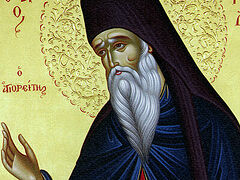
—I like an icon where St. Nicodemus stands against the background of shelves with spiritual books. He was a scholar, but at the same time a scribe which is instructed unto the Kingdom of Heaven (Mt. 13:52). He lived according to what was written in the books he published. His deeds did not contradict his words. He wrote from the heart, not just moralized. And that was the moralizing eighteenth century. But he was an ascetic who did not try to invent his own ascetic system, to re-invent the wheel... He humbly entered the ascetic tradition, thereby showing himself to be a creative person—in his decisions and implementations. It is very important. For me, the figure of St. Nicodemus is interesting from this perspective.
I would say that he was a man who had his own tasks, prompted by life. And this is how he fulfilled them: He turned to the Patristic tradition, saw the consensus of the Fathers, became imbued with the spirit of the Holy Fathers—and through this he fulfilled his tasks. He had a powerful resource—the Patristic synthesis. He succeeded in showing other people what these Fathers of different ages, times, and cultures agreed upon in bringing to light the main thing in Christian life. This ability to see the consensus of the Holy Fathers is very important.
St. Nicodemus had a good memory: with its help he could work in libraries and memorize what Sts. Basil the Great, Gregory the Theologian, John Chrysostom, Isaac the Syrian had written; and he could have become a dogmatist and played with quotations, using one or another saying according to the situation. Dogmatists usually love to argue—to blame others and justify themselves. St. Nicodemus was accused of this, but his reaction to the attacks was that of a doctrinaire.
I see something else in him: He was able to enter into the essence of the understanding and knowledge that the Fathers had, and express it for his contemporaries and for many subsequent generations. A long time has passed from the time of St. Nicodemus. In the twentieth century, Archpriest Georges Florovsky convincingly spoke on the subject of Patristic synthesis. Nowadays, once again, the consensus of the Fathers is being questioned by some, and some speak of “post-Patristic theology”… That is why figures like St. Nicodemus the Hagiorite are still relevant today for theologians and non-theologians alike. Hieromartyr Hilarion (Troitsky) was a proponent of the consensus of the Fathers like St. Nicodemus. Let’s mention his name too, because we are talking at Moscow Sretensky Monastery where his holy relics rest.
Orthodox Christians must certainly acquaint themselves with Patristic theology. Not just make a Patristic quotation book to use sayings in some disputes and academic articles, both to the point and beside the point. In the hands of such men as St. Nicodemus and Hieromartyr Hilarion, the consensus of the Fathers is vital spiritual food. They offer this spiritual food to people very skillfully, observing proportions. One dish, another, a third one—spiritual food gives us strength, infusing spiritual health into us. St. Nicodemus was humble; with his talents he could have written brilliantly and published his own writings, but instead he preferred to be an editor, publisher, and author of prefaces.
—Why do you think he was canonized only in the twentieth century?
—Canonization depends on many things. Some saints were canonized very quickly (St. Gregory Palamas); while St. Theophan the Recluse was canonized 100 years after his repose... Sometimes canonization takes place by obvious Divine providence, when saints miraculously reveal themselves. I don’t know about St. Nicodemus. I believe that if it happened in the mid-twentieth century, then it was time for us to turn our prayerful attention to him. His works were read in the nineteenth century too, but in the twentieth century, church people probably felt that he really helped. He became an inspiring example of living in Christ.