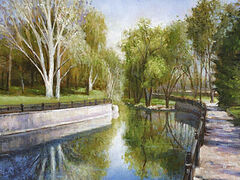
The Volga River
The Volga flows measuredly and soothingly. Its voice is special, “its own”, and recognizable. Yes, every river has its unique voice, just as every human being does. Although it can sound differently, with different intonations—sometimes menacingly and excitedly. Once in my youth I found myself on the bank of the Volga River at night during a thunderstorm. Behind me stones were falling from a high rocky part; in front of me was a dark space, the sky and the water; and from above streaks of lightning were dashing into the noisy river, which received these strikes, worrying and exclaiming...
And on a sunny July day like today, it talks softly and reassuringly, like a taleteller of olden times. Indeed, it is a storyteller—mesmerizing and lulling with stories from the past. You can’t count how many people and destinies have passed by it; and it remembers all and whispers about it if you sit very still and listen.
You sit on huge ochre-gray rocks on the bank in the village of Vasilyevo near the city of Kazan. The rocks are also ancient and mighty, with depressions, hollows and smooth surfaces alternating with sharp edges. Perhaps they lay like this when the Tver galley sailed along the Volga, on which Empress Catherine II made her famous “Volga Voyage” in 1767; and in 1918, when Vladimir Kappel’s army participated in the capture of Kazan...
Down here, where the sharp and thin blades of reeds sway, judging by pre-revolutionary photographs, there was a pier. Ships docked, and people disembarked here—a distant, bygone life…
 The Church of the Exaltation of the Holy Cross in Vasilyevo village
If you climb up from the bank carefully, leaning on the same rocks, the walls of the Church of the Exaltation of the Holy Cross in the village of Vasilyevo, where St. John of Kronstadt served the Liturgy on a July day in 1897, will show all white.
But I’m not climbing up yet: just sitting quietly, watching and listening.
 The Holy Trinity Convent of St. Makary of Yellow Lake, town of Makaryevo, the Nizhny Novgorod region
Before my eyes is boundless space, with endless ripples of water, and the opposite vibrant green bank, on which (of course!) is the silhouette of a convent as an inseparable part of the surroundings. This is the St. Makary Convent, founded in the first half of the fifteenth century. But current shining white buildings were constructed in the nineteenth century.
If you look a little further, you can see the island city of Sviyazhsk (in Tatarstan), and the semicircular (Byzantine!) dome of the Church of the “Joy of All Who Sorrow” Icon of the Mother of God.
A fisherman is lazily half dozing in a green inflatable boat bobbing on the small, shaky waves; a motor ship is sailing in the distance—a large three-decker—but because of the remoteness and the overall scale of the surroundings it seems tiny.
And the sky, lots of sky near the horizon line—it is almost transparent, white, and then bluer and bluer. Slightly below this blue are clouds with their fluffy gray gold... The river catches the shadows of the clouds, takes them in and begins to rock them.
 The Volga
The vastness of the sky and the water—upwards and deep; here history shrinks into a single point, and the past and the present unite. It’s Isaac Levitan’s immensity of nature, which appears to be bigger than the landscape; or rather, so much is included in the landscape that you cannot express it in any words, no matter how many volumes you may write. And no need to express it—just sit here, absorb it and be saturated with it. Listen to the whisper of the water, thinking about those about whom the great river tells you, without naming them. But we do know many names: Alexei Peshkov (the writer Maxim Gorky), the Boratynskys, the Tolstoys, the opera singer Fyodor Chaliapin, the artist Nikolai Feshin (he lived right here in Vasilyevo after the Revolution until he emigrated to the USA)... These are just the first names that come to mind, but the list goes on.
The Volga remembers my family, my husband’s kin, ourselves as young children, and our children when they were still babies...
And then you can climb up, go inside the church and pray for all of them: both the departed—the known and the nameless (nameless for us, but God knows and loves everyone)—and the living. The Volga attunes you to prayer. Maybe when we cease to exist physically, and the Volga continues to carry its waters, someone will sigh prayerfully for us as well?
The Volga does not let you go: no matter how far you may go, it will call you, promising to calm you and put everything right inside you. And you won’t be surprised when one of your children—like our child who was born at a Moscow maternity hospital and comes to his parents’ birthplace only occasionally—says: “In the future, I would like to live by the Volga.”