Claudiu Tarziu (born 1973) is an Orthodox journalist and writer, a popular politician, senator and, since 2024, a member of the European Parliament.
Closer to Heaven!
To speak about anchorites in the third millennium is at the very least bold. Who will believe that today there are people who have such a thirst for God’s Presence that they hide in the wilds of the mountains to live with Him alone? But they exist. Even in our days, the Neamț Mountains hide hesychast monks in their gorges, who are knocking on the gates of Paradise with their incessant prayers, asking for forgiveness and salvation of all of us.
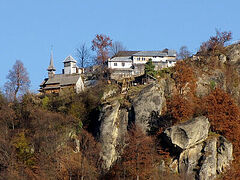
 Panaghia Rock in the Ceahlău Massif, the Neamț Mountains
An earthly creature
He is sitting on a roughly hewn bench, leaning on his staff like a shepherd. Habits of youth! He reminds me of the God from my childhood dreams. A sturdy, broad-shouldered peasant in a padded jacket with a snow-white beard and hair. He begins each phrase solemnly, in a slightly singsong voice, with a strong Moldovan accent that grates on your ear like a sleigh rushing over a thin crust of snow.
“When I came to these mountains, there were fifty hesychasts here. Whenever I met any of them, he called me by name—they were so spiritual! And there were twenty-seven nuns, including Mother Zenovia, a Bucharest minister’s daughter. She had papers from King Carol I of Romania that she was allowed to live in any forests. She had been an anchoress for sixty years.”
I wanted to ask him if any hermits still remained in the Neamț Mountains nowadays. After all, they said that they had become six feet taller from the bones of the hesychasts who rest in their caves and crevices. But the elder was silent. Loud songs of nature could be heard all around: the chirping of grasshoppers, the flapping of wings, and maybe even the cracking of bursting buds on trees.
“Once I came across a dugout in a cave. On the door was written: ‘An earthly creature lives here.’ It was the cell of Hierodeacon Cristofor, whom I later met. He carried a skull in a bag; it was yellow, as if made of wax, and thousands of fragrances emanated from it. It was the head of a saint who had struggled in the area. One night, that saint appeared to Hierodeacon Cristofor in a dream and told him to remember him as Hieroschemamonk Pavel. Hierodeacon Cristofor stayed with that skull at the monastery for three days, and then left, saying, ‘Don’t look for me, because I’ve prayed that no one would find me.’ I never saw him again. Nor could I find his cave again.”
There are hermits who pray to God that no one will find them, so that they may always be in communion with God in their minds and hearts. For St. John Climacus says: “The strength of a king is in a large army, and the strength of a hermit is in much prayer.”[1]
I gave a start, as if waking up. It’s as though ages have passed since I listened to Fr. Cleopa (Ilie). The great spiritual father of Moldova himself was a hermit in the Neamț Mountains for ten years. Meeting him on the porch of his cell at Sihastria Monastery prompted me to set off in search of anchorites in the wilds of Neamț. And now I was following in his footsteps…
 Panaghia Rock in the Ceahlău Massif, the Neamț Mountains. A pre-war postcard
“Please Don’t Knock. I’m Very Sick.”
Fr. Proclu (Nicau) from the village of Mitocul (Neamț County) became famous as an elder skilled in giving spiritual advice and consolation. He longed to hide from the world, but the world kept finding him like a faithful dog that you try to get rid of, finding its way home from 100 miles away.
After fifty years of ascetic labors in crevices of the rocks and in dugouts, in his old age the hermit moved to the outskirts of the village of Mitocul Balan, closer to people. And he made a compromise—three days a week, on Tuesdays, Thursdays and Saturdays, people could break his solitude and ask for several words for the benefit of the soul.
“It’s wonderful that it’s Thursday today! I hope he will accept me so that I can finally grasp what inspires people to become hermits and what the open-air hesychasterion teaches them,” I thought.
 Obelisk to the veterans of the Russo-Turkish War of 1877–1878, the village of Cracauani, 1904. The inscription on the obelisk reads in Romanian: “In memory of the brave men who fell in the War of Independence. 1877–1878.”
From a strip of asphalt with numerous cracks and gaps, ostentatiously designated as a “district road” connecting Piatra Neamt with Targul Neamt, I turned left, towards the village of Cracauani, onto a modest country road. Over seven miles of somersaults by car over stones, potholes, and carriage tracks that have scarred the ground forever seemed like 100 miles to me. Apparently, this road was specially laid out in order to make you switch from the everyday pace, when you see only the surface of things, to a slow “step” so that you can see their depth. This change is very appropriate before meeting with a great spiritual mentor.
Late in the evening, I reached the village of Mitocul at the very edge of a forest. Spring was late there. The sea of fir trees dropped thick snow “foam” onto the village.
Fr. Proclu’s cell, nestling on a hill, resembled a child’s toy. There was a narrow plain yard, framed by a wooden fence, through which a tree that had not yet turned green squeezed its branches. The gate was supported by two boards from the street. At the top was a notice written in block letters: “Please don’t knock. I’m very sick.”
There were several bags of goodies by the gate, apparently left by believers who couldn’t get to Fr. Proclu. I dared to knock anyway. I knocked once—silence. Then knocked again, but nothing could be heard except a cuckoo somewhere far away in the forest.
After the third attempt I heard a gate creak from somewhere higher up and saw another fence. A small old woman in black beckoned me to come over. Christ’s words came to my mind: Be of good cheer; I have overcome the world (Jn. 16:33). Full of hope, I hurried down the path. It was Fr. Proclu’s sister who took care of him. She categorically told me not to knock anymore, because the elder could no longer get out of bed and couldn’t breathe without a special device, which meant he would not be able to speak.
I begged:
“I just want to see him and ask for his blessing.”
The old woman was adamant. She waved at me, giving me to understand that I must go away. “If only I could see his face,” I thought. Maybe a suffering hesychast elder would have told me the story of his life better without words.
“Is my journey (in the footsteps of the hermits of the Neamț wilderness) over before it has even begun?” I got into my car and drove back along the same impassable road. An old man was tending four sheep by the side of the road. He slightly raised his faded hat with his finger and beckoned me to stop:
“You’ve been to the saint, but he hasn’t accepted you?” he started talking. “Don’t worry, fellow. He’s very sick and about to die.”[2]
“Do you know him?” I wondered.
“Everybody knows Father Proclu! People come to him in droves, as befits saints.”
“How do you know he’s a saint?”
The old man stared at me in amazement:
“Only saints can live in the desert on herbs and water, like forest animals, immersed in prayer for days on end. After all, if this country has not perished in the midst of so many troubles, it’s been only through the prayers and feats of the hesychasts.”
I was heading for Cracaoani, rocking from side to side, like in a carriage. The famous monasteries of Varatec, Sihla, Sihastria, Agapia and Secu were situated very close by. Hesychasts usually choose to live near monasteries, where they come from time to time to confess, receive Communion, and attend the Divine Liturgy. But I thought I should look higher up in the mountains.
Pipirig, a village of Transylvanian shepherds
 St. Nicholas Church in Pipirig, 1807. Photo: Mihai Oprescu
I drove past Varatec and Agapia on to Pipirig. This village was founded on the ancient lands of Neamț Monastery around 1700 by the families of Transylvanian shepherds who had run away from the village of Valea Bargaului when the Habsburgs began persecuting them. There is an ancient wooden church there, built in 1807 and dedicated to St. Nicholas.
Pipirig is best known as the village of the grandfather of the writer Ion Creanga, David (a churchwarden of the church), and also as the birthplace of Patriarch Nicodim (Munteanu) of Romania (1939–1948). I arrived so quickly that I didn’t have time to make a plan. The only option was to go from resident to resident until I found a hermit.
 The interior of St. Nicholas Church in Pipirig
I went into the church and venerated the icons. The wooden iconostasis, painted in 1841 by the priest and iconographer Vasile Rezmerita, rivets your attention to the holy icons. I read a few prayers, waiting for someone to show up. But no one was coming into the church.
A middle-aged man was tidying up a grave in the churchyard. I greeted him and wondered if he had heard of any hermit in the area. He answered “yes” indifferently. When I wondered if he could take me to him, he asked me why I needed that. I replied that I needed advice that only a hermit could give.
“Okay then. Leave the village, go into the forest and walk like this for a while…”
“But how can I find the ascetic?”
“He’ll find you himself if he wants to.”
I stared at him. He was very serious.
I drove out of the village onto a road that “slipped” into the forest like a snake into water. The forest behind me hid the tracks of my car. I didn’t know where the road led—there was no end to it in sight—but I’d been driving for quite a while. Maybe the man had played a joke on me? The cold air smelled of old trees and clean towels, like in my grandmother’s guestroom.
I got out of the car and went on foot, while trying to determine the north by moss on the trees. I reckoned that It would take me ten to fifteen minutes to climb up the mountain. As I was scrutinizing the forest, I was suddenly seized with such inexplicable joy that I wanted to utter a lingering victory cry, but I restrained myself. A sublime and solemn stillness reigned around, like in a cathedral.
Onufrie from a fir glade
I caught a glimpse of a shadow detaching itself from a slender row of beeches. The shadow took on the shape of a man. It was a monk, tall and skinny. He gazed straight into my eyes.
“Bless me, Father! I’ve been looking for you.”
He didn’t answer. He nodded his head and beckoned me to follow him. I had a lot of questions in my mind: How did it occur to me to ask for his blessing, since I didn’t even know whether he was a priest? And why was he waiting for me? How did he know I was coming? Meanwhile, the monk didn’t say a word.
His face seemed to be carved from stone, polished by the wind, with deep expressive wrinkles; his black beard with streaks of gray fell to a wide leather belt that was tight around his cassock, and his gray hair was gathered in a ponytail. He was about fifty. He was walking upright and climbing up the mountain without any effort.
The sky opened through a shaft of light in the trees. We reached some kind of narrow “roof of the world” above a rock fringed with firs. He stretched out his hand towards the village, visible in the distant depression:
“When I start missing the world, I come here.”
I nodded, rejoicing that he had spoken to me, but he hastened his steps again, heading heaven knows where. Every now and then he told me something: a quote or a parable about how people in the world get distracted easily without the fear of death. “What if he’s taking me to the world’s end?” I asked myself. I resolved to tell him what I wanted and what I am:
“I’m a reporter.”
He answered nothing, as if my words had been blown away. And we found ourselves in front of a cell, a kind of tiny wooden hut, which the monk immediately filled with his tall body. There were a trestle-bed (of course, too short), a table that could barely seat two people, a chair, and a stove with a pot covered with a lid on it. The walls were covered with icons.
“Kneel down. Let’s pray if you want to speak,” he commanded.
He covered me with an epitrachelion and prayed aloud in a beautiful and soothing voice. I felt a surge of concern, as before confession.
“Know that in the desert you are always tempted by the devil. The holy eremite fathers prayed with those they met, because the demon could not stand prayer and became invisible at once.”
He scooped nettle soup from the pot with a wooden spoon and poured it into two clay bowls. Next he took a small towel off a ball of polenta on the table, read Our Father and invited me. We sat down (me on the chair, and the priest on the trestle-bed), and we had a meal in silence. Once I had swallowed the last spoonful of the soup, he got up and read the thanksgiving prayer.
I tried to find out who he was, when he became a monk, how he became a hermit, how long he had been living in those mountains, whether he had ever lived as a hermit elsewhere, but my questions disappeared into the abyss between us without the slightest echo.
 View from the Ceahlău Massif, the Romanian Kogaionon. According to Strabo’s Geographica, Kogaionon is the sacred mountain of the Getae, located north of the Danube, most likely in Romania’s Ceahlău Massif. Photo: Justin Ikim
He told me about the truth of faith, the veneration of icons, the troubles that befall the world because of our malice—about anything but himself. He said that he viewed hesychasm as love that cannot be shared with anyone:
“If I have devoted myself to God, it means that my whole life should belong to Him alone: my whole life, not just half of it with the other half being devoted to everyday cares, thoughts, ambitions and human nature. Only those who are truly strong can live in a monastic community and in the world, wholly loving God and devoting their entire lives to Him. And that’s how I used to live, but now I’m not so strong anymore.”
He humbled himself so that I might not think that he was more perfect than monastery monks. Contrary to his rugged appearance, his speech was gentle and breathed great goodness.
It was time for me to leave. I asked for his blessing.
“Seek peace and you will be saved! Pray to God that He will make His will yours—that is, that you can endure any adversity, illness, suffering and hardship with the awareness that it is God’s will and that by His will you will be saved.”
He saw me to the doorstep of his cell and told me to walk back without any fear.
“Father, may I know your name?” I dared to ask him.
He frowned a little:
“What? You came to me without knowing who I am?” And then he smiled, “Onufrie.”
I was walking down the mountain with long and rapid strides. My ears were ringing. I had a strange feeling, as if I had stepped out of time and was now returning to it again. The further away from the cell I was, the louder birds were singing, as if an invisible hand were turning the volume control.
I was exhilarated over finding a true anchorite. And yet I felt some incompleteness. I was disappointed with having been unable to fish out a single confession from Fr. Onufrie about himself.