On August 14, 1894 was born the Belgorod Elder Archimandrite Seraphim (Tyapochkin), a confessor and man of prayer endowed by God with many spiritual gifts. Let us consider the main milestones of the life and labors of this ascetic of faith and piety.
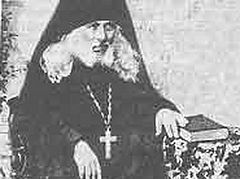
 Archimandrite Seraphim (Tyapochkin)
The future archimandrite was born into a noble family in Poland. He was named Dimitry in Baptism, in honor of St. Demetrios of Thessaloniki. The family had many children and was very faithful. One day, his father took him to church, and when he saw the icon of St. Seraphim of Sarov, he told his father: “I want to be like him, like this saint.” Much later, in his declining years, he asked for the monastic name of Seraphim in honor of his beloved saint. The Elder recalled his childhood as follows: “When it came time for my studies, my father took me with him to a service attended by students of the theological school. This service deeply touched my childhood soul, and I asked my father to send me to study at the theological school. My desire was fulfilled.”
 Young Dmitry, seated in the center, with his family
After graduating from the Warsaw Theological School, he was sent to the Chełm Theological Seminary, where he became especially close to the brother of St. Hilarion (Troitsky), Hieromonk Daniel. The young man loved to read the Gospel under his desk, for which his classmates nicknamed him “the monk.” His formation was greatly influenced by the seminary rector Archimandrite Seraphim (Ostroumov), who is numbered among the saints in the Synaxis of the New Martyrs and Confessors of Russia.
Dmitry studied diligently and after graduating from seminary in 1917, he was sent to the Moscow Theological Academy. There, the future Elder crossed paths with St. Hilarion, who was both inspector and an instructor at the academy at that time. He recalled about this period of study: “The Lord ordained that I wouldn’t be at the Academy for long. I enrolled in 1917, and in 1919 the Academy was closed. The time I spent within the walls of the Holy Trinity-St. Sergius Lavra has remained indelible for me for the rest of my life.”
When the school closed, Dmitry moved to the Ekaterinoslav Province, where he became a teacher and married a teacher named Antonina. In 1920, the young instructor was ordained to the diaconate and priesthood. “The priesthood was the dream of my youth,” he would later say.
Starting in 1921, Fr. Dmitry served in the village of Mikhailovka, Dnepropetrovsk Province. The villagers loved him for his prayerfulness, kindness, compassion for them, and his participation in their lives. In 1932, the terrible time of the Holodomor began. Two infants in his family died of starvation. The parishioners pitied their priest and brought a cow to his farm. The soviet authorities confiscated the cow and put the family on the lists of those to be dispossessed. Fr. Dmitry continued helping his fellow villagers however he could. His parishioners of those years recalled of him: “How many people Fr. Dimitry saved during the famine with alms... You don’t know, but I know... All the starving people were drawn to his home and church. And what could he give? Crumbs. He saved them with Communion and a word. And he himself was skin and bones in a cassock...” In 1933, his wife died of tuberculosis, leaving Fr. Dimitry with three daughters to care for.
The 1930s were a time of ruthless persecution of the Russian Orthodox Church, and Fr. Dmitry was no exception. He refused secular work, which many priests had taken up, unfailingly wore his cassock, and continued to serve despite threats from the authorities. His Holiness Patriarch Tikhon entrusted him with removing the antimens from closed churches. The priest was registered by the GPU authorities. They suggested that he leave his church, to which he replied: “To always serve is my pastoral duty, and times are hard for everyone now.”
Fr. Dmitry was arrested in 1941. The case was fabricated—he was charged with “anti-soviet agitation” like many of the New Martyrs and Confessors. The trial was conducted hastily due to the beginning of the German occupation. In prison, Fr. Dmitry met Hieromartyr Onuphry (Gagalyuk) and entreated his prayers. He was given ten years in a gulag in Kazakhstan.
In the camp, Fr. Dmitry continued to fulfill his priestly duty, not embittered by the severe sorrows and severity of the camp guards. Asked whether they beat him in the camp, he replied:
How am I any better than others? What happened to everyone happened to me. I’m glad that the Lord vouchsafed me to suffer with my people and to fully endure all the sorrows that have befallen the Orthodox more than once. All my life I’ve been grateful to God that I was part of the difficulties of those years… The grief and hardships that happen to us must be accepted as a mercy from God.
His fellow prisoners loved and respected him. As his release date approached, Fr. Dmitry was asked what he intended to do. He replied:
“I’m a priest. I intend to serve.”
“Well, if you want to serve, then stay in the camp.”
They added five years to his sentence, this time in the Krasnoyarsk Krai. Blessed are the meek: for they shall inherit the earth (Mt. 5:5). With meekness and gentleness, bowing his neck under the mighty hand of God (1 Pt. 5:6), Fr. Dimitry awaited his release. In exile, his faithful spiritual children supported him, sending him care packages.
In that period, Fr. Dmitry managed to serve the Liturgy one day after a fourteen-year break. Due to his exemplary behavior, he was allowed to move about without an escort and on Pascha he went to a church located on the camp territories. As his spiritual daughter Schemanun Ermogena recounted, the priest of that church had received a revelation in a dream about a special prisoner who would be in the narthex. Without hesitation, this priest approached Fr. Dmitry and invited him to concelebrate, to the indescribable joy of the prisoner.
In the morning, the camp authorities found out about it. The faithful who were at the service were compelled to renounce God, but in vain. The prisoners were sent further north. As the Elder himself later said about it: “They took us by water, then threw us ashore, where there was only sky, snow, and forest. Thank God that since childhood I’ve been used to little food. I’d eat a crumb with prayer and recover my strength, while others died like flies from malnutrition… I realized I was doomed to die, to be torn to pieces by wild animals… And then when I saw bears coming towards me, I raised two crosses—one large, the other one smaller. As I stood with these crosses, the bears came very close to me and stopped. They looked at me, looked all around, and left. So I was saved by these crosses.”
Fr. Dmitry was released from the camp in 1956. He returned to his family in Dnepropetrovsk exhausted and sick. His children were against his intention to continue serving as a priest, worried he’d be arrested again. But as a good and faithful servant (Mt. 25:21), he zealously desired to serve Christ according to His commandment: Thou shalt love the Lord thy God with all thy heart, and with all thy soul, and with all thy mind (Mt. 22:37).
 Fr. Dmitry after exile At first, Fr. Dmitry was briefly sent to serve in the city of Kuibyshev. There occurred something that struck fear into many—a young woman named Zoya became paralyzed while holding an icon of St. Nicholas. It was Fr. Dimitry who, after serving a moleben for the blessing of water and blessing the entire room where she stood, was able to take the icon from her hands. Other clerics had tried to do it before him but were unable. Zoya, however, continued to stand motionless. Fr. Dmitry said: “Now we must wait for a sign on the Great Day [that is, Pascha].” On Pascha, the guard at the house saw a dignified-looking old man who wanted to enter the house. The third time, they let him in and waited for him to come out. They heard him say: “Well, aren’t you tired of standing?” The old man still didn’t come out. In the end, they couldn’t find him in the house and realized it was St. Nicholas. After that, Zoya’s body began to come back to life. An investigation was launched. Once it was done, Fr. Dmitry was sent back to the village of Mikhailovka, where he had previously served. He kept the icon of St. Nicholas he had taken from her arms in the altar of his church.
Elder Seraphim’s ministry was fraught with sorrows. During the years of soviet rule, the people’s consciousness changed and the faith of many cooled off. Nevertheless, there remained pious people who were drawn to him, who brought their children to be baptized and believed in his prayers. Among the people, he was called “the monk.” His homilies could make people weep. Batiushka loved God and men and selflessly served his neighbors, despite the many illnesses he had contracted in the camps. The villagers firmly believed that Fr. Dmitry’s prayers would prevent flooding in the Dnepropetrovsk lands, and indeed, it’s known that by his prayers this danger passed. At the same time, the authorities were watching him.
In 1960, Fr. Dmitry was sent to the Kursk-Belgorod Diocese and appointed rector of St. Nicholas’ Church in the village of Rakitnoe. The Elder served there until his death. In the same year, he sent a petition to the local bishop, saying:
In 1933, I was widowed and left with three daughters. In the widowhood that befell me, I understood God’s providence. Monasticism became my cherished dream, as was pastorship in my youth. New trials in life strengthened me more and more in fulfilling my desire for monasticism. And now I not only desire, but thirst to go out at least at the eleventh hour to work in the monastic vineyard of Christ’s Church… If there’s no violation of obedience on my part, then I dare to ask to be tonsured with the holy name of St. Seraphim of Sarov, whom I’ve revered as my patron since childhood
His request was fulfilled and he was tonsured into monasticism with the name Seraphim.
Thus began Elder Seraphim’s grace-filled ministry in the Belgorod land. He was given a ruined church that had to be restored first. Prayer was offered at the parish from morning till evening, and gradually people were found who were ready to help. The church was painted by the famous iconographer Archimandrite Zinon (Teodor), who didn’t take a single penny for his work. They served by the light of the lampadas. Such an environment created a special prayerful mood in the souls of the faithful. One bishop of the Church later said about the Elder’s prayer: “He prayed with tears; he burned during prayer. He was a man of prayer, he lived by it, feeling a constant need for communion with the Lord. Those who had the joy of communicating with Batiushka could fully appreciate his high spiritual gift.”
The authorities hindered the renovation of the church and the construction of a prosphora kitchen. But with love and kindness, Fr. Seraphim turned the persecutors into friends and they even forgot why they came. Ye are the light of the world. A city that is set on an hill cannot be hid (Mt. 5:14), the Savior said of His disciples. Fr. Seraphim’s spiritual gifts couldn’t remain hidden from the faithful. People felt his love. And like bees to honey, believers from all over Russia began to flock to him to taste the sweetness of the Holy Spirit through his compassion and prayers. In addition to the gifts of love and prayer, God endowed him with the gifts of clairvoyance and healing. The Elder would humbly say: “I don’t heal—I pray. And if through prayer the sick are healed, the suffering are relieved, the sorrowing are comforted, it’s from the Lord.” According to the remembrances of those who knew the Elder personally, there was no first and second for him—everyone came first.
Many monks, bishops, rectors, and theological students came to see the Elder. Metropolitan Anthony (Bloom, of Sourozh) also sent him messages. Bishop Veniamin (Likhomanov) of Rybinsk remembered him thus:
There’s no doubt he was a holy man. He had such a special disposition. He prayed, he lived by prayer… Fr. Seraphim had a distinctive feature: He was filled with love. He always listens to you and comforts you, saying: “Let us pray. Everything will be alright.” I confessed to him: You’d say one word and he’d give you guidance and comfort… I saw in him an ascetic who endured much—a man of prayer, a holy man.
 Archimandrite Seraphim and Hieromonk Zinon, 1980
Another witness to the Elder’s prayers said:
One day, when I was a young man, I went into the altar while they were singing the Cherubim Hymn. I was standing quietly off to the side when I suddenly saw Fr. Seraphim in an extraordinary radiance and somewhat elevated in front of the altar table. It’s hard to describe; it’s impossible to convey. This grace-filled radiance came from Fr. Seraphim more than once, and it wasn’t just me who saw it.
Archimandrite Zinon, in turn, spoke of the Elder thus:
I saw that quiet holiness that, it seems to me, is the truest. I never once heard him condemn anyone or disparage anyone, although he saw all sorts of people and suffered much from them. He was visited by various people who sometimes didn’t want to look at each other after leaving his cell. But he treated everyone with the same love and was able to unite everyone—they became one in his presence. This is also one of the traits of holiness… And the most important thing I discovered (which Elder Silouan the Athonite also noticed): All the saints are like Christ. I imagine Christ to be just like that—meek, quiet, compassionate, sympathetic to everyone… He embodied the Gospel ideal with his life. It was a revelation for me: He bore the image of Christ within him. I can’t imagine Christ any other way… I’ve known many pious and honest clerics, but Fr. Seraphim is a saint. It’s a mystery. Like any mystery, it’s impossible to explain.
Elder Seraphim’s grandson, Archpriest Dmitry Tyapochkin, said of him: “My grandfather was like an unearthly luminary: He radiated to everyone as much light as the person coming to him could receive.”
His memories of his grandfather are also interesting:
After the rain, we always went to church very slowly. We had to avoid all the worms, bugs, and spiders. Grandpa walked ahead and carefully made sure that that no one stepped on them… I remember him sitting in a chair in the garden, apple trees and acacias in bloom, and the fragrance in the garden. I looked at him and he seemed to be sleeping. His face, all white, bore no signs of life. I looked down and saw his prayer rope moving in his hands. I was stunned. I touched his hand, and he opened his eyes and, as if nothing had happened, he said: “How good it is in the garden.” And he wept.
Another Russian elder, Archimandrite Kirill (Pavlov), recalled the Belgorod ascetic:
No empty words came from his mouth, no jokes were uttered, and there was no flattery in his words. All his words were filled with meaning. I didn’t notice even a hint of displeasure or irritability in his voice; he didn’t condemn anyone, never expressed any indignation. He was meek, modest, and humble. What struck me the most and what I remember was his genuine love, coming from the depths of his heart and the same for everyone. Everything became peaceful in Batiushka’s presence. Yes, this man was filled with God’s love.
St. Paisios the Athonite also knew of and revered Elder Seraphim.
In 1970, the Elder was elevated to the rank of archimandrite. By his example, he showed people how to love God, to strive for holiness and the acquisition of the Holy Spirit. In his sermons, Fr. Seraphim, like the Psalmist David, taught the people: “Praise Christ, all of you. Praise Him in your homes, praise Him in your families, praise him throughout your life.” He also said:
The search for the Kingdom of God and His righteousness should be the main goal of our earthly existence, that is, of our entire earthly life… The path of following Christ is the path of the Cross and self-sacrifice, and there is no other path. It wasn’t joy or gladness that the Divine Teacher bequeathed to His disciples, and through them to us, but the sorrows and woes of which life consists… Go to Him. He’ll comfort you, He’ll give you peace of soul… Seeking peace for our souls, we—already exhausted, having suffered and grown weary on life’s path—will go to Christ. He’ll warm us with His love, He’ll comfort us, He’ll forgive all our sins against Him, He’ll forget all the offenses we so often inflict upon Him, He’ll restore to us His favor, and in the bosom of infinite love, we’ll find rest for our souls.
The blessed end of the Belgorod Elder was approaching, which he knew about in advance. Before that, St. Seraphim of Sarov and St. Nicholas the Wonderworker appeared to him. On Bright Monday, April 19, 1982, the Elder peacefully departed to the Lord. His final earthly words were from the Cherubic Hymn: “To the Life-giving Trinity we sing the thrice-holy hymn…”
Despite the resistance of the authorities, Elder Seraphim was buried in the presence of a large gathering of people near the altar of the church in Rakitnoe, where he served. Materials are now being prepared for his glorification.
I’d like to end this essay about the grace-filled Russian Elder with a testimonial about him from the recently reposed Schema-Archimandrite Iliy (Nozdrin):
I’m grateful to the Lord that He granted me to communicate with wondrous elders, one of whom was Archimandrite Seraphim (Tyapochkin). Batiushka shook me to my depths with his love. There’s nothing higher than love, says the Apostle of Love John the Theologian—I saw this eternal love embodied in Elder Seraphim.
May the Lord grant rest to the soul of Archimandrite Seraphim in the mansions of the righteous!