Québec City, September 3, 2025
 cbc.ca screenshot
The Québec government announced Thursday it will introduce legislation this fall to ban prayer in public spaces, a move that has drawn sharp criticism from religious leaders and civil rights groups who warn it violates fundamental freedoms.
Secularism Minister Jean-François Roberge said the government would table a bill to address what he called the “proliferation of street prayer,” describing it as “a serious and sensitive issue.” The announcement follows statements from Premier François Legault, who expressed mounting frustration over public prayers in Montreal, the Guardian reports.
“To see people praying in the street, in public parks, this is not something we want in Québec,” Legault said in December. “When you want to pray, you go in a church or a mosque, not in a public place.”
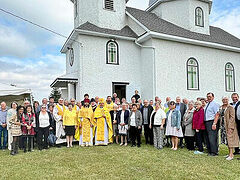
Fr. Gleb Melnyk of Sts. Peter and Paul Cathedral in Québec (Orthodox Church in America) expressed concern about the proposed legislation. “We see a little bit of discrimination with these actions. It’s very important not to infringe on the freedoms of people,” he said.
Fr. Gleb also noted that outdoor religious activities, such as the Paschal procession, have helped bring the community together and have been taking place for decades without a problem.
The proposed ban comes amid tensions over Muslim prayers taking place during pro-Palestinian demonstrations, including outside Montreal’s Notre-Dame Basilica. For more than half a year, the group Montreal4Palestine has organized Sunday protests that include public prayer, prompting both demonstrations and counterprotests.
The Canadian Civil Liberties Association said banning prayer in public spaces would infringe on freedom of religion, freedom of expression, freedom of peaceful assembly and freedom of association. “Suppressing peaceful religious expression, individually or communally, under the guise of secularism not only marginalizes faith-based communities but also undermines principles of inclusion, dignity and equality,” said Harini Sivalingam, director of the equality program at the organization.
Martin Laliberté, president of the Assembly of Québec Catholic Bishops, questioned whether a ban would affect Catholic rituals like the Way of the Cross procession on Good Friday, or if it would be illegal for someone to practice yoga in a park or to pray during a papal visit.
Roberge did not specify whether the government would invoke the notwithstanding clause, which would allow the bill to override certain sections of the Canadian Charter of Rights and Freedoms. Legault has previously indicated he was considering that possibility.
The announcement follows a detailed report by Québec’s independent committee studying how to strengthen secularism. The committee made 50 recommendations, including extending the religious symbols ban to daycare workers. However, the report did not call for a province-wide ban on public prayer, instead finding that municipalities already have the “necessary competences” to enforce rules surrounding street prayer.
The Parti Québécois leader Paul St-Pierre Plamondon, whose party leads in public polling, called public prayers an “appropriation of public space by religious fundamentalists” and pledged to hold an internal referendum to determine his party’s formal position.
The proposed legislation would expand Québec’s existing secularism efforts, which include Bill 21, passed in 2019, that bars judges, police officers, prison guards, and teachers from wearing religious symbols while at work.
Follow OrthoChristian on Twitter, Vkontakte, Telegram, WhatsApp, MeWe, and Gab!