And I heard a great voice
 Metropolitan Athanasios of Limassol
Last time we read chapter 15, which speaks of seven angels and seven plagues. Revelation describes mysterious events: angels with seven trumpets blow and various disasters occur all over the world. We’ve said that this isn’t meant literally: It won’t necessarily be that angels descend and then calamities happen. These are events that occur throughout time. Some things have already happened, some are happening, and some are yet to come. The seven trumpets are mainly spoken of in chapter 8, and now chapter 16 repeats about the seven angels who had seven plagues, which are called the last scourges on earth. These are severe calamities, difficult things, painful and wicked.
Thus, the Evangelist says: And I heard a great voice out of the temple saying to the seven angels, Go your ways, and pour out the vials of the wrath of God upon the earth (Rev. 16:1). The vials are some kind of vessels concealing these events. The Evangelist John the Theologian heard a loud voice out of the temple. Of course, this is the voice of God, because only God speaks from the temple. He told the angels: Go your ways, and pour out the vials of the wrath of God upon the earth. When the Church speaks of the wrath of God, it doesn’t mean that God is angry like us men, when we’re nervous, screaming, irritated, and want to be comforted in some way so it will pass. God doesn’t have passions—God is passionless. God is perfect peace and perfect love. God doesn’t have meekness—He is meekness itself. God doesn’t have love—He is love itself.
But why is it talking about the wrath of God here? Because we humans turn God’s blessings into difficulties. The further we move away from God, the closer we get to the enemy of our salvation, the devil. And the further we get from God, the further we move away from God’s providence for us. Then various troubles happen to us or around us, whether on a personal or societal level or throughout the whole world. It’s our departure from God that brings negative consequences, not God. God doesn’t get angry, doesn’t worry, doesn’t get irritated, but we speak by applying this to human feelings. That is, this wrath of God is the result of our apostasy. It’s we who walk away. Just as how a man who moves away from the light finds himself in darkness but when he approaches the light he begins to see. When he moves away from the fire, he freezes, because he’s far from the heat source. Similarly, a man moving away from God gradually surrenders to the power of the devil, who wants to harm us, of course. He doesn’t wish us well, doesn’t love us, doesn’t pity us. He doesn’t sympathize with us, saying: “Okay, that’s enough. I feel sorry for this man. I’ve already done so much to this man.” The devil wants to completely destroy us because he hates us.
God says to the angels: “Go and pour out the seven vials.” The prophet saw this. When it says he saw and heard, it means he saw and heard not with these eyes and these ears, because a blind man can see and a deaf man can hear. He saw it with his whole being. When the Church says that such and such a saint received a notification, it doesn’t mean what we usually mean when we say, for example: “I’ve received notification that Israel has attacked Lebanon.” We’ve heard such notifications. But in spiritual terminology, it signifies precisely what is contained within the word “πληροφορία”—“φέρω πλήρως” (I bear fullness, I have fullness within myself). A man learns perfectly, with his whole being, down to the last particle of his being—he sees and hears what God says to him. The whole man, his whole being hears: There’s nothing the man doesn’t know. His whole being receives notification and learns what God wants to teach him. The blind see visions of God and the deaf hear the word of God, since people possess sensory faculties that are stronger than the bodily organs, which can fall ill, which need glasses to see better, hearing aids to hear better, and so forth.
Thus, he heard and saw, he received full notification of these events from the Holy Spirit. And the first went, and poured out his vial upon the earth; and there fell a noisome and grievous sore upon the men which had the mark of the beast, and upon them which worshipped his image (Rev. 16:2). A terrible disease has come, a cruel and disgusting skin disease. Foul, festering sores have broken out on the men who have the mark of the beast and worship his image. Prior to this in Revelation, three beings were spoken of: First is the dragon, mentioned in chapter 10, rising up against the Church, and two beasts (which will be discussed further). One beast emerges from the sea, having ten horns and seven heads. The other emerges from the earth, compelling others to worship the image of the first beast and his servant.
 The Last Judgment and the Seven Deadly Sins, Jacob van Swanenburg
Revelation introduces these three beasts, which God will destroy and utterly annihilate. Terrible plagues and diseases have come upon those who had the mark of the beast. Remember, 13:17–18 said there’s a seal that contains the name of the beast or the number of his name. It will be placed on the right hand and the forehead of those who agree to accept the mark. We don’t know precisely what this seal is. Many have interpreted it in various ways, but we should be careful, because Revelation isn’t easy to interpret. We can’t simply say this means that, and that means that, and all these numbers mean this, and so on. Let us take care to be sealed with the seal of Holy Baptism and Chrismation in our Church. Those who will have the mark of the beast and worship his image will fall ill with a terrible disease, a malignant plague that will be very painful. When and how this will happen, we don’t know—will it occur gradually or will it suddenly hit us, revealing itself as a given reality in one instant? It will become clear as events unfold.
The first angel empties his vial and temptation comes. And the second angel poured out his vial upon the sea; and it became as the blood of a dead man: and every living soul died in the sea (Rev. 16:3). The sea becomes like the blood of a dead man, and everything that moves in the sea dies. Let’s recall that something similar happened to Pharaoh in the Old Testament, but on a smaller scale. Moses sent ten plagues to the Egyptian people to force them to let the people of God leave.
And the third angel poured out his vial upon the rivers and fountains of waters; and they became blood (Rev. 16:4). The water in the sea turned dead to show that there’s no more room for life in the sea. And then the third angel comes, empties his vial, and the rivers and fountains turn to blood. We’ve said that all these are images—we don’t know exactly how all this will come to pass. And in fact, we’re not really that interested in what it all means. What interests us is the fact that all this will happen and that we must remain faithful to God, remain whole and not be damaged when the time of the Christ’s coming arrives.
After the third angel poured out his vial, the Apostle John heard the angel of the waters say, Thou art righteous, O Lord, Which art, and wast, and shalt be, because Thou hast judged thus. For they have shed the blood of saints and prophets, and Thou hast given them blood to drink; for they are worthy. And I heard another out of the altar say, Even so, Lord God Almighty, true and righteous are Thy judgments (Rev. 16:5–7). God never acts unrighteously, and there is nothing having to do with injustice in the presence of God.
Let’s read further: And the fourth angel poured out his vial upon the sun; and power was given unto him to scorch men with fire. And men were scorched with great heat, and blasphemed the name of God, Which hath power over these plagues: and they repented not to give Him glory (Rev. 16:8–9). The fourth angel poured out his vial on the sun so it began to scorch people, and they began to blaspheme God for having such power, and they didn’t repent before God. Despite all these plagues that befell men, they didn’t turn to God. Had they come to their senses, then the plagues probably would have stopped.
And the fifth angel poured out his vial upon the seat of the beast; and his kingdom was full of darkness; and they gnawed their tongues for pain, And blasphemed the God of Heaven because of their pains and their sores, and repented not of their deeds (Rev. 16:10–11). The fifth angel pours out his vial upon the throne of the beast. We’ve already said there are three beings: the dragon, the beast, and the false prophet. The dragon is the devil; as for the false prophet—I won’t say who he is. I think you can see for yourself who he is—he who calls himself a prophet. I won’t speak about it, because my conversations are being listened to, and some follower of his will then start creating various stories. Later, if you want, I’ll tell you, but not now. You understand that someone calls himself a prophet, but he isn’t one, although he believes he’s a true prophet. After all, Scripture also calls him a false prophet who will appear in the last times. You see how false prophecy has spread today.
The fifth angel empties his vial onto the throne of the beast. The beast is a liar from the beginning, a deceiver, a heretic—he who teaches people and preaches heresy, leading the people of God away from the Church. He received the contents of the fifth vial and his kingdom was darkened. People chewed on their tongues and blasphemed God for their sufferings and sores but didn’t repent of their deeds. We must take note of this: Repentance is what we need—it’s repentance that changes our condition.
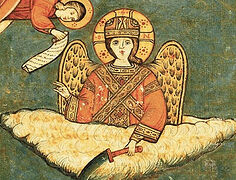
And the sixth angel poured out his vial upon the great river Euphrates; and the water thereof was dried up, that the way of the kings of the east might be prepared (Rev. 16:12). The sixth angel poured out his vial into the Euphrates and its water dried up so that the kings of the east might pass through and come to the place where there will be a huge battle—the last battle before the Second Coming. We can’t say for sure whether this is about the literal Euphrates River or whether it’s allegorical. We’ll see this as we go on.
 Angel at the River Euphrates. French manuscript, 14th C.
And I saw three unclean spirits like frogs come out of the mouth of the dragon, and out of the mouth of the beast, and out of the mouth of the false prophet. For they are the spirits of devils, working miracles, which go forth unto the kings of the earth and of the whole world, to gather them to the battle of that great day of God Almighty (Rev. 16:13–14). The three creatures are the dragon, the beast, and the false prophet. There were three unclean spirits in their mouths that were like frogs. A frog isn’t a bad animal, but people feel a certain revulsion when they see one—you wouldn’t just pick it up and put it in your mouth. But they had frogs in their mouths, demonic spirits working signs. They were working miracles. The devil will work miracles (pseudo-miracles, of course). He will amaze and dazzle people and lead them into delusion. And these demonic spirits will come from the mouths of the dragon, the beast, and the false prophet. They’ll be like disgusting frogs (unclean spirits) that will go out to the kings of the whole world to gather them for war on the great day of the Almighty God. They’ll bring the whole world to battle. Remember that it’s the devil who arranges wars, not God. The devil deceives people, darkens their minds so they no longer understand that war doesn’t benefit anyone in the world and that they themselves will die in the war. We see people fighting, one killing the other, using atomic weapons as if they would destroy only the enemy. No, they would kill all of us.
God says: Behold, I come as a thief. Blessed is he that watcheth, and keepeth his garments, lest he walk naked, and they see his shame (Rev. 16:15). God says here that blessed is the man who guards himself, his faith, his relationship with God and the Church so he doesn’t wind up naked, with others seeing his nakedness, causing him shame. A man of God is prudent and conscientious. He has discernment and preserves peace, no matter what happens. Of course, he empathizes with everything happening around him, but he doesn’t lose his peace because he feels the presence of God.
And he gathered them together into a place called Armageddon in Hebrew (Rev. 16:16). Satan gathers all the kings of the earth in one place, which in Hebrew is called Armageddon—a plateau in Palestine (it still exists) next to Mt. Carmel. There will be a huge battle there. Although we don’t know for sure—it won’t necessarily be on this exact spot. The final battle will take place—strong, huge in scope, and devastating; the last war before the coming of our Christ.
And the seventh angel poured out his vial into the air; and there came a great voice out of the temple of Heaven, from the throne, saying, It is done (Rev. 16:17). Everything that was supposed to happen has happened.
To be continued…