In the name of the Father, and of the Son, and of the Holy Spirit!
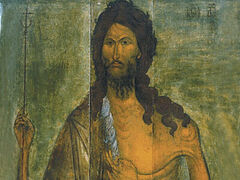
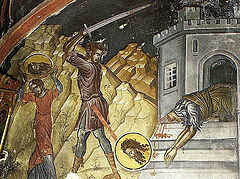
Dear brothers and sisters, today we celebrate the Beheading of the great and holy Prophet of God John the Baptist. And we call this day a little Holy Friday. On the great Holy Friday, the Lord was executed on Golgotha for the salvation of the human race. And on this day, being lawlessly beheaded, St. John the Baptist was born for eternity.
“On Holy Friday, people murdered God, crucified God,” St. Justin (Popovic) said. And today, the greatest of men, an earthly Angel and a Heavenly man, has departed to the other world. “For the Lord declared of him: Among them that are born of women there hath not risen a greater than John the Baptist (Mt. 11:11). In all Creation, there exists no greater praise.
“This is why today is a little Holy Friday. Consider: senseless people murder the greatest of the righteous. Is he getting in their way? Yes, he gets between the perverse King Herod Antipas and the dissolute Herodias. God’s Truth, God’s immutable Truth gets in the way of the lawless, gets in the way of poor sinners, gets in the way of everyone stupefied by the various passions.”[1]
St. Nikolai (Velimirovic) of Zica wrote: “Once Jerusalem and all Judea were astir with the news that a new prophet had appeared, like no one before him, and frightening. This man called out to the crowd around him, ‘Repent!’ The unrighteous in their fright said to the prophet, ‘Do you want us to give you gold? Just shut up, you’re wounding us, it’s like our consciences are gnawing at us.’—’I don’t need gold, you generation of vipers,’ the prophet answered. ‘I have what is more precious than gold.’
“The righteous also came to John and said, ‘Do you want us to give you gold for the lessons you have given us on how to be righteous?’ John replied, ‘I am living and speaking with you, brothers, for your own sakes, and not for the sake of your gold. I don’t need it.’ And so, rumors were spread about John that he knows no fear and spares no one. And John even reproached the iniquity of Herodias, Herod’s wife. She too sent him gold, but the prophet wrathfully rejected the adulteress’s dirty gold. John’s refusal brought Herodias to a state of demonic madness, and she was enflamed with the thirst for revenge... ‘Pleasures, and only pleasures!’ exclaimed Herodias. ‘Righteousness, and only righteousness!’ John would not stop saying. And so their collision was inevitable…”[2]
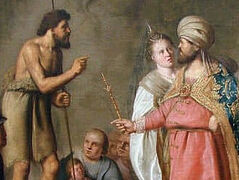
Shortly after the Baptism of Jesus Christ on the Jordan, John was imprisoned in the fortress of Machaerus for fearlessly denouncing King Herod Antipas for his adulterous cohabitation with his brother Philip’s wife, Herodias. While the preaching of the Gospel was gaining momentum, the holy Forerunner and Baptist of the Lord had been in prison for about a year. Herodias feared that the formidable denunciations of St. John would prompt Herod to send her back to her first husband. That is why she persistently demanded from Herod the death of the prophet-denunciator.
The great preacher of the Messiah and a true friend of the Bridegroom was finishing his ministry in the morning firmament of New Testament history. Christ, the Sun of Truth, was rising. A martyr’s death on earth and great gifts in Heaven awaited the Forerunner. Herodias openly began to live in the palace, having driven away Herod’s lawful wife (how it reminds us of our own times!).
The punishment of the Forerunner was also sought by the Jewish leadership, whose blatant injustice the prophet condemned without any fear or favor. The weak-willed Herod’s attitude towards the prisoner was ambivalent. Sometimes, in his irritation he wanted to execute the prophet, and sometimes, having calmed down, he heeded him and even did much according to his wise advice.
St. John did not change his beliefs even in confinement. And while everyone was cringing before the illegitimate couple, he continued to denounce the king and Herodias, who hated him for this. Herodias, the new Jezebel, was only waiting for a good opportunity to put the prophet to death. For a time, Herod did not dare to take John’s life, fearing people, and kept him in prison, hoping that they would soon forget the preacher they venerated. It was in the character of Herod: a cowardly and crafty fox.
And so a way out was found. There is a version that the feast itself, or at least everything that followed it, was jointly arranged in advance by the lawless couple in order to obtain the consent of the feasting nobles to St. John’s death Like a jury trial, they would give this consent the appearance of a judicial verdict and thereby justify themselves in the eyes of the people.
It was Herod’s birthday. Prominent people from Galilee were invited to the feast: military men, citizens, and the whole elite. At the same time, Herodias hosted a feast for the wives of Galilean nobles on her side of the palace, since the customs of the East not only did not allow women to sit at the same banquet table with men, but even to appear where they were feasting. In the East, women, and even more so maidens, had to hide themselves thoroughly from the eyes of men. And when they happened to be near—they even had to cover their faces.
The Jews did not have the tradition of celebrating birthdays, but Herod did not want to be inferior to the Roman rulers, who celebrated their birthdays with pomp. Herod combined the Eastern luxury of the holiday with the sophistication of the Romans: he invited musicians, singers, actors, and dancers, violating all the Jewish traditions. And in general, he mostly lived by the traditions of the pagan world.
According to the custom adopted from Rome, Herod, as the host of the feast, at the end of it was expected to arrange for the guests such a spectacle that would excite their sleeping nerves and lazily moving blood after drinking wine in abundance and having a sumptuous meal. Herodias took advantage of the moment and sent her daughter—in violation of all the customs and moral norms—who, half naked, performed an arousing seductive dance before them, which spurred the lustful delight of the intoxicated guests.
Forgetting maidenly modesty, all moral principles, decency, and public shame, Salome eclipsed all harlots in her dance. “It was a satanic disgrace,” noted St. John Chrysostom. And the intoxicated despot Herod promised everything she would ask of him, even half of the kingdom. Meanwhile, he knew that this was a lie, since he had just received only a fourth of the Kingdom of Israel from the Roman Emperor for his administration, not in ownership, and he did not have the right to dispose of it without the consent of the Romans.
But at the instigation of her mother, Salome immediately asked to be given the head of John the Baptist on a platter. “For what could be worse than this brutal fierceness? To ask a murder by way of a favor, a lawless murder, a murder in the midst of a banquet, a murder publicly, and without shame?” St. John Chrysostom wrote.[3] This kind of cruelty was a norm in the customs of the pagan world of that era.
Blessed Jerome bluntly said that the sadness on Herod’s face after hearing the request was feigned, and he seized the opportunity to get rid of John the Baptist. Herod’s fidelity to his oath was hypocritical and ostentatious, because the king would certainly not have sacrificed his own head even for the sake of keeping an oath. As they brought viands to that abominable feast, so they brought the head of St. John the Baptist on a platter and gave it to Salome, and she handed it to her mother.
The beheading of John the Prophet, Forerunner, and Baptist of the Lord took place in the winter—in early 29 A.D. He was thirty–two or thirty-three, which is the age of Christ. Being at that time not far from Lake Genezareth (Tiberias) and probably wishing to pray for John in solitude, our Lord Jesus Christ retreated from there alone by boat to a deserted place north-east of the bank near the town of Bethsaida. Six months later, the Lord would be crucified on Golgotha, and through His death on the Cross would free mankind from the power of sin, the devil and death.
St. Justin (Popovic) asked: “Resurrect him! Yet the Savior remains silent. Why, O Lord?” And he answers: “Because the Holy Forerunner must also become the first Apostle to Hades, to death’s kingdom. In that kingdom was to be found everyone: the righteous and the sinners, all of the people of the Old Testament, up to the coming of the Lord Jesus Christ. The Forerunner had to preach there as well to the souls of all human beings: ‘Lo, the One whom you have been awaiting, the Savior of the world, has come to earth. And lo, I go before Him to preach to you as well these greatest tidings. In a little while He will come down, and you will see Him.’”[4]
The Forerunner also appeared in hell as the first evangelist to preach the Gospel to everyone there. He also became the first New Testament martyr among all the holy martyrs, the first model and inspiration of all the holy New Testament martyrs from the holy Protomartyr Stephen up to the present day.
Today, we also sing of the first Christian confessor, the first confessor of God in this New Testament world. He spoke fearlessly to everyone’s face, confessed the truth of God and never renounced it. Thousands and thousands of glorious confessors of Christ in this world followed him—the holy Baptist.
That is why the Lord was silent and did not resurrect “the greatest among those born of women”; because he had to perform his feat as a martyr in hell, in the kingdom of death. And the Lord, Who descended into hell after His death on the Cross on Golgotha, brought out of the kingdom of death all those who had believed the Forerunner and believed in Him—the Lord Jesus Christ—that He is the True God both in Heaven and on earth.
“Almost 2,000 years have passed since the Beheading of John the Baptist, but it seems as if these twenty centuries have not existed. Peace and love in family and social life have become a very rare phenomenon. And in general, the life of modern people often looks as if they have set themselves the task of testing God’s longsuffering to the extreme, as it was before the Flood and the burning of Sodom,” says Priest Dimitry Mirolyubov.
The edifying meaning of this feast is very important to us people of the twenty-first century, too. As we know, the Lord and the Holy Church in the person of the Mother of God and the holy Myrrh-Bearing Women, glorified womankind, and we pray to them and imitate them; but at the same time it reminds us of possible falls, which, unfortunately, we can see in our days as well.
For example, this is what exhortation gives us on this feast in his sermon the famous Abbot of the Pskov-Caves Monastery—Archimandrite Alipy (Voronov; 1914–1975), a model of deep and ardent faith.
“Christian women, to be saved you should listen only to Orthodox priests, not to yourselves or strangers. If you don’t understand something, come and ask in the simplicity of your souls, and we will explain. Each monastery has its own rule, which must be obeyed. But some women, both visitors and locals, want to ‘introduce’ their own rules.
“The wicked Herodias still lives in the woman’s heart. This is satan who entices her to what is not given to her from God—to have the upper hand over her husband. This satanic domination of women over their husbands has caused many evil deeds on earth. The whole history of the world is full of this. ‘It is better to live with a viper, the most evil snake, than with a wicked wife,’ says a Russian proverb.
“The heads of our Christian community are priests who guide everybody, including women and children, to the Kingdom of God. They teach that we must walk towards the Heavenly Kingdom on the path of humility. But there are evil Herodiases among our Christian women who do not accept these teachings of the priests, but they themselves want to teach. But the priest is a servant of God, endowed with authority from above.
“I receive whole bundles of letters from such women who want to teach us priests. And they even threaten us: ‘If you don’t do what I want, I’ll complain to the higher authorities!’ At first I would read these letters, but now I recognize the handwriting, and knowing that there is nothing clever in them, I began to throw them into the fire without reading them. Unfortunately, Herodiases are still here.
“Those Christian women who understand their God-given role are good mothers, sisters, and wives. Blessed are those who accept this and do not strive for what God has not given them—to be the heads of their husbands. Let us, brothers and sisters, pray to the Mother of God and the Myrrh-Bearing Women, and emulate them, so that we all can learn from them how to live humbly according to the will of God.”
And let me conclude with the words of St. John Chrysostom: “Now you have heard about the evil deeds of wicked women, and about the virtues of good ones. Love the good ones, and do not imitate the wicked ones: be zealous together with the former, and turn away from the latter, so that by following in the footsteps of those (I mean the good ones) you may be counted among the host of saints in Christ Jesus our Lord, to Whom may there be glory and power forever and ever.”
Glory be to our God always, now and ever, and unto the ages of ages. Amen.