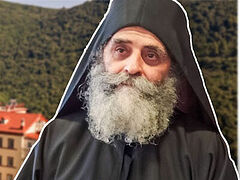
On August 24/September 6, the memory of St. Aristokly the Wonderworker of Mt. Athos is prayerfully commemorated.
 The future elder (Alexei Alexeievich Amvrosiev in the world) was born in 1846 into a religious peasant family from Orenburg. His father died young. When the boy was ten, he became seriously ill and lost the use of his legs. He was bedridden for two years. Doctors couldn’t help him. His pious mother, rising for prayer, tearfully entreated St. Nicholas the Wonderworker to heal Alexei, promising the saint to dedicate her son to God when he grew up. She also gave a vow to become a nun herself in the event of the boy’s recovery. On the winter feast of St. Nicholas, Alexei was healed. When he reached seventeen, his mother took the monastic habit. Alexei got married, but he was widowed early. With his mother’s blessing, he left for the Holy Mountain in 1876.
On Mt. Athos, he entered the Russian St. Panteleimon’s Monastery, entrusting himself to the spiritual guidance of Schema-Archimandrite Makary (Sushkin) and Elder Ieronim (Solomentsov). In the second half of the nineteenth century, when the future elder arrived at the monastery, a spiritual revival and flourishing of Russian monasticism was taking place there. A few years later, having gone through the novitiate, he was tonsured into the mantia with the name Aristokly, in honor of the Cypriot Hieromartyr Aristokles of Salamis.
In December 1884, he was ordained to the diaconate then the priesthood. Two years later, Hieromonk Aristokly accepted the great schema with the same name. He spent several years working in the monastery’s iconography workshop, climbing the ladder of virtues under the guidance of his elders.
In 1887, Hieroschemamonk Aristokly was sent to Moscow with an olive branch from the place of the beheading of Great Martyr Panteleimon. He was appointed to a new obedience at the Athonite dependency of St. Panteleimon’s Monastery on Yakimanka Street in Moscow. Despite his young age, Fr. Aristokly came to the Russian land from Mt. Athos as an experienced spiritual father who had acquired many gifts from God. He headed the dependency for several years, simultaneously serving as rector of the Chapel of the Great Martyr and Healer Panteleimon on Nikolskaya Street. Molebens to the Mother of God and St. Panteleimon were held there. Many people flocked there. Fr. Aristokly received the suffering every day, being endowed with the gifts of healing and clairvoyance. With the blessing of St. Philaret (Drozdov), he traveled to the homes of the infirm, taking relics and wonderworking icons from the dependency with him. In these homes, he would serve molebens, after which healings would occur. The faithful generously donated to Fr. Aristokly, which he in turn gave to help the poor.
 Chapel of St. Panteleimon at the Vladimir Gate, 1924. pastvu.com
In 1888, the dependency started publishing the journal, “Soul-Profiting Companion.” It told about the life of Russian Athonites and printed letters from elders and soul-profiting instructions. Thanks to this journal, Russian monasticism on Mt. Athos was enriched with new novices, and donations started coming in to St. Panteleimon’s. For example, in 1894, a 14.5-ton bell was donated from Moscow to the monastery.
Besides the Athonite dependency, the Elder often served in Moscow monasteries and churches. For his service to the Church, he was awarded a pectoral cross in 1893. However, in 1896, due to a false denunciation, he went back to St. Panteleimon’s Monastery. There he bore the obedience of economos and confessor for the brotherhood. In 1896, he visited Moscow for the coronation of Tsar-Martyr Nicholas II.
In 1909, the spiritual council of St. Panteleimon’s Monastery again appointed Fr. Aristokly as abbot of the Athos dependency. That year, at the age of seventy, the Elder returned to Moscow. Once again, thousands of people from all walks of life reached out to this God-pleaser, seeking his spiritual guidance for the salvation of their souls. For nine years, right up to his repose, Hieroschemamonk Aristokly served at the Athos dependency. During this time, new buildings were built there, serving godly purposes, and a library of spiritual literature. In one building, he constructed a house church in honor of the She Who Is Quick to Hear Icon of the Mother of God, which he especially venerated. The church was consecrated in 1918 by Patriarch St. Tikhon of Moscow and All Russia. His Holiness highly venerated Elder Aristokly for his spiritual gifts.
The Elder was in constant correspondence with his beloved St. Panteleimon’s Monastery, sending meticulous reports on what was happening in the dependency. As a good and sacrificial pastor, Fr. Aristokly acquired a large number of spiritual children from the Russian flock, admonishing and instructing them for salvation. He told one of them: “Ah, my beloved child, if you only knew how much I want to save you! I would endure everything for you—may the Lord save you! If only I could bring you to Him! If only you would be saved—I have no greater concern than to bring you to the Lord, and there’s no more serious matter on earth than the salvation of the soul.” The Elder received hundreds of people daily, despite his own serious leg ailment and unhealed wounds.
The famous Moscow Bishops Tryphon (Turkestanov) and Arseny (Zhadanovsky) would go see him for spiritual guidance. Elder Aristokly prophesied the abbacy in the Holy Land of Nun Barbara (Tsvetkova), a spiritual daughter of Bishop Arseny. He told her: “Your desire for monasticism will be fulfilled, only far from here… There, in the Holy Land, there will be much to do.” Leaving Russia seemed unthinkable for the Tsvetkov family—their father was in prison. But later, everything happened according to the Elder’s prophecy. He foretold both the 1917 revolution and the Second World War. He told one of his spiritual daughters: “Many Russians will think the Germans will rid Russia of the Bolshevik power, but it’s not so. The Germans will indeed enter Russia and do many things, but they’ll leave, because it won’t be the time for salvation yet. That will come later, later…”
During the revolutionary period, through the Elder’s prayers, many were saved from starvation, prison, and execution. The Elder exorcised demons. There’s a well-known case of the healing of his spiritual daughter who was on her sickbed. He told her: “Well, my beloved child, it’s time for me to go. Don’t despair but pray and give thanks to the Lord. I’m going to go, and when I leave, go to the window and wave to me, and I’ll wave to you.” The woman objected that she couldn’t get up. But the Elder said: “Don’t worry. Just wave to me.” And indeed, she was able to get up and wave to him from the window, despite the serious illness she had had.
He also healed a boy who was born blind, but not without the prayerful labors of his mother. This is how the woman described the healing: “Early in the morning, I was reading to the akathist to the She Who Is Quick to Hear Icon of the Mother of God, as always, then I started reading the akathist to the Great Martyr Panteleimon when suddenly I heard: ‘Mama, mama, come quick!’ I ran to my son, and what did I see? My son was sitting on the bed, his eyes open, and he looked at me and said: ‘Mama, I see you! I can see you, mama!’ In our time, the Elder’s prayers brought about another healing, of an infant whose eyes also hadn’t opened.
Elder Aristokly foretold to General Brusilov what would happen to him later: “When they want to cut you, don’t give in and it will pass.” The general was wounded, but he refused to have surgery. The Elder told him: “Read the akathist to Sts. Boris and Gleb and you’ll recover.” After praying to them, the general fell asleep and woke up healthy. Later, the Elder told the general that Russia would remain strong and terrible to its enemies, but the intelligentsia would have to suffer. And so it happened.
Such spiritual instructions from Hieroschemamonk Aristokly have come down to us, among others: “We must try with all our might to do good, at least a bit;” “We must say ‘glory to God’ for all things. We’re not worthy to receive what the Lord sends us;” “If you don’t have love, all your deeds will come to nothing;” “You don’t have to exhaust yourself to the point of becoming too weak for spiritual deeds. Everything in proportion.” “Those who work on a feast day will never prosper;” “Unceasingly call upon the Theotokos. Whether you’re going to work or whatever you’re doing, say: ‘I place all my trust in thee, Mother of God. Preserve me under thy protection.’ Or say: ‘Theotokos and Virgin, despite not me a sinner need thy help and intercession.’ Or otherwise, however you can, but call upon her.”
 The Elder’s spiritual daughter Nun Evfimia recalls:
Batiushka always rejoiced when he saw his spiritual children’s zeal towards one another or towards others. He had extraordinary gratitude for the slightest kindness from another. He loved children remarkably. And he was always, always surrounded by children. They were so devoted to him that they absolutely didn’t want to leave their Batiushka… Sometimes the Elder would walk from his cell through the courtyard, and the people would be waiting for him. He would bless them all and they’d give him a small box of food for doves and Batiushka would scatter it for them with prayer and bless them. This happened every morning, and the doves would perch wherever, waiting for him. Then the Elder would enter through the back door, and the children would already be waiting for him along with the adults, while only adults were let in through the front entrance. First, he would receive everyone with their children, and then he would go to the large room, completely filled with icons like a chapel, for a general blessing. Batiushka was exhausted by the crowds…
Elder Aristokly reposed in the Lord on August 24/September 6, 1918. His end was blessed, before the She Who Is Quick to Hear Icon of the Mother of God. His funeral was served by Archbishop Joasaph (Kallistov), Bishop Tryphon (Turkestanov), and Bishop Arseny (Zhadanovsky), with a large gathering of people. When they carried him to his place of burial, doves formed a cross in the sky and thus accompanied the funeral procession. Before the Elder’s canonization, his grave was located at the Danilovsky cemetery. The faithful would go there to venerate him.
In 2004, his relics were found to be incorrupt. That November, they were transferred in a procession from Danilov Monastery to the Church of the Great Martyr Nikita at the Athonite dependency in Moscow, and there they remain to this day. Healings through the Elder’s prayers occur to this day.
Venerable Fr. Aristokly, pray to God for us!