This article is dedicated to Righteous John Domovsky, an ascetic of faith and piety from Rostov-on-Don, a confessor of Orthodoxy, a fighter against the Renovationist schism, and a pastor of Christian souls who lost their spiritual support during the civil war and persecution of the Church. The ministry to which God called him presented him with difficult choices, especially at the end of his life: to become a monk, retire, or remain in the midst of human sorrows, ecclesiastical unrest, and the conflagration of war. In those days, many solved these problems by emigrating or fighting with the authorities, while others were isolated and retreated into reclusion. Righteous John, “holding on to eternal life,” firmly confessed his faith, fulfilled the law of Christ’s love, and chose the path along which the Lord led him to the Heavenly Kingdom.
On July 24, 2025, by decision of the Holy Synod, Archpriest John Alexeevich Domovsky was canonized as a righteous saint for local veneration in the Don Metropolia. The Synod determined to commemorate the Righteous John, Presbyter of Rostov on February 24/March 9 on the day of his repose, and August 27/September 9, on the day of the reburial of his remains in 2020.
***
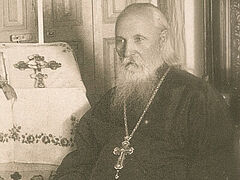
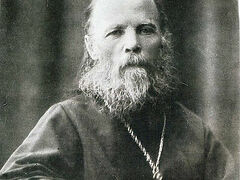
 Righteous John of Rostov On May 27, 1908, he bought a house for his family, a ten minutes’ walk from the St. Alexander Nevsky Church. It was there that a strong Christian community began to form around the pastor. Fr. John was loved and respected for his accessibility and for celebrating the services with such reverence. People were particularly attracted by his humility, love for everyone, and the peace he brought to the community.
Parishioners later recalled about him: “Fr. John immediately won over his flock. Many experienced a kind pastoral attitude from him. You could feel firm guidance in life under his rectorship, which strongly united the clergy and brought splendor to the church.”
In 1910, he was awarded the Order of St. Anna, 2nd Degree, and in 1914, the Order of St. Vladimir, 4th Degree, for his charitable work.
In July 1914, World War I began, which marked a new stage of labor for the Rostov ascetic. After the manifesto of Emperor Nicholas II, the Don authorities began to mobilize. Many workers, peasants, and Cossacks were conscripted to the front. A river of inconsolable relatives, wives, and mothers flowed to the Don elder for prayerful protection. Fr. John prayed for the Russian army and actively participated in collecting humanitarian aid for military hospitals.
The story of Fr. John’s pastoral and spiritual labors is closely connected with the finding of the icon of the Mother of God that he and all residents of Rostov after him called “Unexpected Joy,” although it was in fact a copy of the Kazan Icon of the Most Holy Theotokos, of simple craftsmanship, on a small board. Fr. John served molebens before the icon, and healings of the possessed and sick soon began to take place both during and after the prayers. This is how the name “Unexpected Joy” arose—because these miracles were unexpected not only for the flock, but for Fr. John himself.
Over the years, his health deteriorated and he developed a disease of the legs. On October 7, 1915, he voluntarily retired from active service but remained as honorary rector of the St. Alexander Nevsky Church (which no longer exists today).
Continuing to serve in the church, where crowds of believers often awaited his appearance, Fr. John dedicated most of his time to prayer with people at home, in his prayer room-cell. His room (or as they called it, his “oratory”) was the holy of holies of the house:
“There was amazing silence and peace there; many lampadas were burning; the air was always clear and filled with the smell of incense.”
This house in Nakhichevan became a kind of “monastery in the world,” where spiritual work was constantly going on. According to witnesses, people would go see Fr. John every day. He served molebens, heard confessions, gave spiritual and life advice, and comforted the people in the hardships of the civil war.
Here’s how Batiushka’s ministry was remembered by his contemporaries:
People would come to him from far away, from other cities, for advice, for prayer, for healing from illnesses. People gathered at his house early in the morning. The whole street was filled with wagons, carriages, and carts. People sat on the curb waiting to be received. They came to him from far away, seeking healing.
During the difficult years of the civil war, Fr. John’s labors intensified and the words of the Optina Elders came true about how he would become an intercessor and spiritual support for people who were troubled and confused, so that unbelief wouldn’t befall them.
Starting in February 1918, the government in Don changed six times. Towns and villages were subjected to constant raids and destruction from both opposing sides. That month, two clerics were killed in Rostov-on-Don: New Martyr Konstantin Veretsky from the All Saints Church, and Fr. John Talantov from the St. Nicholas Church. More than fifty villages were burned and dozens of churches were damaged and looted. This was a period of extreme severity towards the local population and clergy, and terror began. It was precisely during this time of troubles that more and more people went to see Fr. John for comfort and prayer.
He lived in Nakhichevan-on-Don (which became a district of Rostov-on-Don in 1928) to the end of his days, constantly receiving people in need of pastoral care and assistance. Visitors were greatly impressed by the many icons in his room-cell. All the walls were covered with them from floor to ceiling. Two images stood out among them: the Kazan Icon of the Mother of God (a copy of the Unexpected Joy Icon) and the Aksai Icon of the Mother of God, before which Fr. John constantly prayed to the Most Holy Lady. A small, cozy garden was laid out in the courtyard of the house, where Batiushka loved to spend time sitting on one of the benches, reading Scripture or praying the Jesus Prayer. He often received visitors there as well.
In the 1920s, Fr. John was no longer simply a pastor for scores of faithful, but an inspirer of resistance to the Renovationist schism in the Don land. During these difficult years of external and internal turmoil, he was a “rule of faith” for the clergy and people, the embodiment of fidelity to Patriarch Tikhon and the canonical Church. When most of the churches of Rostov-on-Don had been desecrated and handed over to the Renovationists, the Orthodox would gather on Sundays and feast days at Fr. John’s cell, celebrating Divine services accompanied by a choir that Batiushka had lovingly assembled. He was the spiritual father of Archbishop Zachary (Lobov) of Voronezh (who later suffered for his faith and was glorified as a hieromartyr at the Jubilee Council of Bishops in 2000). When he was Bishop of Aksai, Vladyka Zachary established correspondence with priests and parish communities that were sympathetic to the canonical Church authorities. Vladyka Zachary’s letter to his spiritual father, Fr. John, was imbued with a special spirit of love and devotion:
With filial devotion, I fervently greet you my dear spiritual father with the feast of the Nativity of Christ… I can’t tell you about my joy and spiritual comfort in liturgical prayers. I can only exclaim: Compassionate and merciful is the Lord (Ps. 102:8). I don’t know how long the Lord will extend His mercy to me, a sinner. It is with a feeling of deep compunction that I recall our pleasant meetings that I hold dear… I always pray for you and I tearfully entreat your holy prayers. Your sinful pilgrim, Bishop Zachary. December 18/31, 1923.
In 1927, the authorities completely handed over the St. Alexander Nevsky Church to the Renovationists. Fr. John no longer went there from that point on. He took the wonderworking icon from the church and instructed that after his death, his remains shouldn’t be carried past the cathedral, which was followed. He called the Orthodox not to go to churches occupied by the Renovationists and not to receive Renovationist priests into their homes.
Fr. John’s ministry was under close scrutiny from the authorities. The Joint State Political Directorate had been monitoring his community since at least 1923. One day, his house was searched. This event and the conversation with the investigator were reflected in the memoirs of St. John’s contemporaries:
When he was alone with the investigator, Fr. John said: “I’m not leaving here, but you need to get home now.” The investigator smirked, but he went home anyway, where he found his wife doing laundry in the kitchen while lunch was cooking on a stove on the balcony. The balcony door was open and his son was sleeping nearby in a cradle. The wind blew the door curtain toward the stove, it caught fire, and when the investigator entered the room, the burning curtain was already approaching the cradle. Had he been one minute later, a fire would have been inevitable. Returning to his office, the investigator said: “Go home, Father. No one will bother you anymore.”
The case against members of Fr. John’s community was opened later, after his death, in July 1930. This case involved, among others, Hieromonk Zachary (Mazhuga), the future Metropolitan Zinovy of Tetritsqaro.
The earthly life of Archpriest John Domovsky, ascetic of piety of the Don land, came to an end on March 9, 1930. He knew about his repose in advance. He told his family: “I will die during Great Lent. Since I won’t make it to Great Lent, I’ll break the fast now,” and ate an egg. Before his death, he foretold that he would be buried twice. Many Orthodox people from Rostov-on-Don and other cities gathered for the ascetic’s burial. The funeral was served by Archbishop Seraphim (Silichev) of Rostov and Taganrog. They carried Fr. John in their arms from his house to the Sophia-Wisdom of God Church (now destroyed)—one of the three churches that didn’t belong to the Renovationists. The Don ascetic’s first burial was at the walls of the church.
When the church was destroyed and the Sophia Cemetery closed, Fr. John’s precious remains were transferred to the Armenian cemetery by the efforts of his daughter Barbara and his spiritual children, the Sakhadzhiev family. During the reburial, the coffin lid cracked, and Fr. John’s incorrupt hands and feet could be seen, but they didn’t dare open the coffin completely.
There are recollections of Fr. John included in the book of Metropolitan Benjamin (Fedchenkov), A Bishop’s Notes. Vladyka Benjamin wrote it shortly before he left the Rostov Diocese in 1955. A chapter entitled, “Rostov Saint,” is dedicated to Fr. John, where his biography and stories of his miracles, both during his lifetime and after his repose, are given in some detail. There are numerous other testimonies of miracles worked through prayers to Fr. John.
After his repose, people came to him constantly at his grave. The Rostov-on-Don clergy served panikhidas quite regularly. Many revered Fr. John and entreated his prayerful intercession.
The document “Information on Particularly Venerated Places, Miraculous Icons, and Religious Fanatics in Deaneries and Individual Parishes of the Rostov Diocese” from the archives of the Operative Commissioner for Religious Affairs in the Rostov Province, records the veneration of Fr. John. The document contains the following entry:
In the Proletarsky District of Rostov-on-Don, at the former Armenian cemetery, there is the grave of the deceased... priest John Domovsky, who is highly venerated by the faithful as a “saint.” Year-round care is maintained at this grave, an oil lamp burns, and during the summer months many believing women gather near this grave.
It’s also noted that the clergy of Rostov-on-Don regularly serve panikhidas. The same document mentions:
On December 6, 1955, Metropolitan Benjamin (Fedchenkov), while serving at the Church of St. Alexander, announced to the people from the ambo that John Domovsky was a saint, and his grave was a source of miracles and all manner of healings.
 The glorification of Righteous John of Rostov It also states that Metropolitan Benjamin instructed people to collect materials for the canonization of the new God-pleaser John Domovsky.
Despite the Church persecutors’ constant monitoring of Fr. John’s resting place, the faithful didn’t stop visiting his grave, where a lampada constantly burned. The clergy continually served panikhidas. From the 2000s onward, his veneration intensified, with panikhidas being celebrated regularly by parish priests from Rostov-on-Don. Many testimonies were collected regarding cases of healing at the ascetic’s grave.
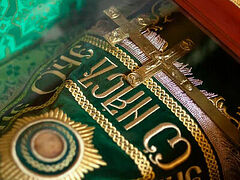
On September 9, 2021, the honorable remains of Fr. John were translated to church grounds, and they now rest in the Church of St. Alexander in Rostov-on-Don. It’s important to note that this church was originally the cemetery chapel of the Sophia Church where Fr. John was originally buried. The chapel was rebuilt into a church in 1942, consecrated in honor of the lost St. Alexander Nevsky Church in Nakhichevan-on-Don, where Fr. John served as rector.
At the Armenian cemetery, where Fr. John had been reinterred in 1934, Bishop Artemy of Taganrog, vicar of the Rostov Diocese, served a litiya after the uncovering of the ascetic’s relics. At the dependency of the Church of Tsarina Alexandra, amid the general singing of “Christ is Risen,” the coffin with the righteous one’s venerable remains was met by the head of the Don Metropolia, Metropolitan Merkury of Rostov and Novocherkassk. Addressing those gathered, Vladyka noted:
It’s no coincidence that we are singing the troparion of Christ’s Pascha, because before his repose, Fr. John prophesied that he wouldn’t celebrate an earthly Pascha, but the Heavenly Pascha. Therefore, when they uncovered his precious remains, they found an egg in his hands—a symbol of Paschal joy. This joy lies in the unity of man with God.
After the translation of Fr. John’s holy relics to the church, panikhidas began to be celebrated regularly at his tomb by the clergy of Rostov-on-Don, with the blessing of Metropolitan Merkury.
 St. John’s relics
On July 24, 2025, by decision of the Holy Synod, Archpriest John Alexeyevich Domovsky was canonized among the righteous for local veneration in the Don Metropolia.
On September 6, his holy relics were translated to the Cathedral of the Nativity of the Most Holy Theotokos in Rostov-on-Don. The next day, his glorification was celebrated with a large gathering of faithful. The service was led by Metropolitan Merkury, concelebrated by the bishops and clergy of the Don Metropolia.
The veneration of the Rostov-on-Don elder has spread beyond the borders of the Don land, and now, when the Lord has glorified His ascetic among the ranks of the righteous, help through his prayers is not long in coming. Righteous John, as in life, opens his arms to everyone who asks, praying for his flock before God’s throne.
Holy Righteous John, pray to God for us!