On September 13, the Russian Orthodox Church Outside of Russia (ROCOR) celebrated the third anniversary of the election of Metropolitan Nicholas (Olhovsky) as its First Hierarch. On September 18, the Church will commemorate three years since his enthronement. We talked with Vladyka about the challenges that the Church is currently facing and how church life is progressing and developing.

—Dear Vladyka, we are approaching the third anniversary of your election as First Hierarch. How would you characterize this time for the church?
—September 13 will mark the anniversary of my election as the First Hierarch of the Russian Orthodox Church Outside of Russia. Time goes by quickly, I must say. There is much to think about, but truly, I can say that I am grateful to God for His many mercies, understandings, and blessings upon the Church and the world.
There are problems around us. We can see this, we can feel it, and we are concerned. But a person of faith—a person who is active in the church, a person who believes—will find the strength to continue to pray, to endure, and to be grateful to God for all things.
—So, the Church is living and developing, correct?
—Speaking for the Russian Church Abroad, glory be to God, yes, there are joys and daily struggles, but there is a sense of life. Orthodoxy throughout the world is surviving and, in various ways, spreading the light of Christ.
—How is the ROCOR growing now?
—We have our dioceses throughout the world. In 2020, we were quietly commemorating and, where possible due to the pandemic situation, celebrating the centennial of ROCOR. At that time, as you may remember, there were many restrictions. Simply put, the world seemed to be closing in on us. But, where possible, we prayed and talked about this milestone. By the fall and winter of 2020, there were opportunities to gather and commemorate the centennial of ROCOR in a more public setting.
I can speak more specifically for America and the Eastern American Diocese because I am also the ruling hierarch here. We have new parishes developing throughout our diocese, from north to south. There is a mission in Maine dedicated to St. Innocent of Moscow. I blessed its establishment. We have churches being built in Virginia, and, God willing, we are in the process of building and strengthening a new cathedral in Florida dedicated to the Lord’s Resurrection. This cathedral will have a chapel dedicated to St. John of Shanghai and San Francisco, and another chapel dedicated to St. Luke of Crimea.
God willing, after Pascha next year, we will conduct a full consecration of the Church of the Holy Myrrh-bearers located in Virginia. There is already a beautiful church there.
These are just a few examples within our diocese of how I see the Church growing both spiritually and physically.
This past May, before the feast of the Ascension, we consecrated our church in Methuen, Massachusetts dedicated to St. Xenia of St. Petersburg. This parish has many active families, and there is a complete liturgical life. After the church’s consecration, parish life continues to grow vividly.
I can also note that, within our diocese—and throughout the Church—we have various church functions and events. First and foremost is the cycle of divine services. This is important to me, to our Synod, and to the bishops. And I think it is important to the faithful. Performing divine services as often as possible—Vigils on Saturdays and Liturgies on Sundays, along with all feast days—is life in the Church and a life in Christ, which we strive to fulfill ideally. This can be challenging at the parish level, but we try.
Many of our parishes have parish schools. The classes can be held on Saturday or Sunday afternoons, providing youth with the opportunity to learn about the Orthodox faith, gain insight into Russian cultural heritage, and understand what it means to be a good Orthodox Christian, which is especially important today. There are also classical academies throughout the diocese. Paideia Classical Academy in Coconut Creek, Florida, and St. George Classical Academy in Boxford, Massachusetts, are two examples.
Our youth conferences take place in December, on or around the feast of St. Herman of Alaska and St. Spyridon. The youth gather at a parish that hosts the conference in our diocese on the East Coast. There is one conference held on the West Coast and one in the Midwest. For 2–3, or maybe even 5, days, the youth hear edifying lectures from the clergy, can ask questions, receive answers, and, of course, participate in the divine services and receive the Holy Sacraments. The Nativity Fast is observed.
We have an enriched music program within our Church. Our school of liturgical music, known as the Synodal School of Liturgical Music in memory of Metropolitan Laurus, holds its annual session at the Novo-Diveevo Monastery in Spring Valley, New York for two weeks in July. The same school holds similar a session for our parishes in Western Europe. This is an intense music program that helps young choir directors, or even those who are just assisting at the parish, to learn more about the structure of divine services, how to chant, and how to read in church at the parish level, especially where a small parish may not be able to fulfill the full cycle of services. The structure of the vigil, the liturgy, and the rubrics for the feast days are examined. The students learn to conduct, which helps the clergy serve, the faithful pray, and allows everyone to appreciate the beauty of Sunday or the significance of the feast day.
Within our diocese and throughout ROCOR—in Germany, France, Australia, and South America—we also have our scout camps for youth, which usually hold sessions during the summer. Additionally, during the first two weeks of August, St. Seraphim's camp takes place in the beautiful forests of Blakeslee, Pennsylvania. There is a wonderful campground that we have been able to use for many years, where Orthodox youth gather to connect with one another and realize that they have Orthodox friends—like-minded individuals who are navigating today’s world with its many temptations and challenges. The clergy travel from their parishes to be with the youth, hold Law of God classes, engage in healthy discussions, and address topics that are essential for the youth to understand so they can be strong in the Orthodox faith. The divine scriptures are read and explained. There is also time for sports and other outdoor activities. The apex is the hierarchal Liturgy served on the one Sunday during the camp’s session.
I also want to note that our diocese has another youth camp called Новый Иордан (New Jordan). It is smaller in size than the other camps but is growing. The Holy Myrrh-bearers parish from Brooklyn, New York, under the rectorship of Father Paul Ivanov, organizes this camp in upstate New York, about 45 minutes from Jordanville. Youth aged 5 to 18, and even up to 20, gather for two weeks, with our priests, like those at the other camps, leading group discussions about the history of the Church, Holy Russia, and the struggle of the New Martyrs. We need to keep these things close to our hearts and understand who we are, where we came from, and where we want to be in the future — to be lost, or to be good people in the Church, glorifying God and receiving His many blessings.
I, or one of my brother bishops, visit the camps for a few days.
I mentioned only a few camps. There are others at the parish level in Massachusetts, Maine, Georgia, Washington, D.C., and Florida. I support and encourage all of this, and I can only pray that our schools and youth camps continue to grow even more.
Holy Trinity Seminary in Jordanville, New York, and the Pastoral School of the Diocese of Mid-America continue to train our young men to become clergy in the Church. There is a four-year bachelor’s program and a master’s of divinity program in Jordanville. The seminary, located within the walls of the monastery, provides a unique environment that helps students develop spiritually and intellectually. During their course of study or after graduation, the seminarians are ordained to begin their ministries.
—It is not a secret that one of the most serious issues the ROCOR faces now is the situation with its mission in the Holy Land. How does the mission survive in these challenging times, and how does the ROCOR help it overcome all the difficulties?
—I was able to visit Jerusalem in August 2023 for the Feast of the Transfiguration and the Dormition. I have been to Jerusalem before, but that was my first visit as the First Hierarch of the Russian Church Abroad. I was able to visit the Holy Land again this year, in May and June, and to be at our convent on the Mount of Olives, celebrating the feast of the Ascension, which is the feast day of the convent. I spent time in the Old City while also visiting Gethsemane, our convents, and the monastic clergy.
Both times, Patriarch Theophilos III of Jerusalem warmly welcomed me. He has a very good relationship with our Russian Ecclesiastical Mission, our abbesses and nuns. We are grateful for his prayers and offer our prayers to God for his health.
I often say that our clergy in Jerusalem and our nuns are on the front lines because there is much commotion in the Middle East right now. There can be problems on the Mount of Olives when protests or riots arise on the streets outside the monastery walls, and the police have to come through. Sirens sound, gas bombs are thrown, and a sense of unrest unfolds. The nuns and pilgrims often walk to visit the holy sites, the Old City, and the Lord’s Tomb. We pray that they are protected and safe. I am concerned for them. The head of our Ecclesiastical Mission, Archimandrite Roman (Krassovsky), and our priests are diligent in their service and conduct divine services daily. Our nuns are truly fulfilling monastic obedience in many ways—not only praying for their own salvation but also praying for the many faithful across the globe and defending holy sites often simply by their presence.
Unfortunately, it is currently difficult to visit Jerusalem and other cities in the area due to various flight restrictions. We repeatedly hear that now is not the right time to travel there because it is not safe. This is sad, and we have had to postpone or cancel the pilgrimages to the Holy Land. I am in communication with our clergy and nuns there. Our Fund for Assistance collects donations in the form of monetary aid. The aid is sent to the Russian Ecclesiastical Mission, to our convents, and to the school in Bethany.
—Another issue is Ukraine. We are all human beings. We have our thoughts, emotions, and political views, and they may contradict one another. How is the ROCOR navigating through all these storms, and how is it possible to maintain unity among the flock?
—As always, we are praying for peace. This is not simply said. We have special prayers during the Divine Liturgy. We are asking God to be merciful, to forgive us our transgressions, to grant us understanding, to help us be humble and patient, to encourage us to be forgiving, and to truly ask that God bless the Orthodox people to be united, not divided.
We can take from the Gospel the Lord’s Resurrection and His first words to the Apostles when He came through the closed doors: Peace be unto you. Jesus Himself stood in the midst of them and said unto them, Peace be unto you.
From the first moments of Christ’s Resurrection, He wishes peace to the Apostles and to all of us, which He gives us. We often forget this, and mankind itself disrupts this peace.
In the Gospel of St. John, the Lord says: Peace I leave with you; My peace I give unto you: not as the world giveth, give I unto you. Let not your heart be troubled, neither let it be afraid.
We believe in God and pray that He will grant us this peace. All things are possible. But we need to find peace within ourselves first, because we often have many problems. Yet, we can strive to find peace with God, ask for forgiveness, try to be better, and then this peace can spread around us.
In the world, you shall have tribulation; but be of good cheer, for I have overcome the world.
The Lord gives us peace. Christ has conquered the world. And if we are with Him, we can conquer all the problems and temptations that surround us.
First and foremost is the prayer for peace. We can discuss many things and debate current events for days, but if we do not understand that without God we will be completely lost, then I am afraid there will be even more problems. This understanding and dedication to prayer will lead us to the peace we need.
—I know that the ROCOR provides humanitarian aid to the canonical Church in Ukraine. Will you continue this support?
—Absolutely. There is prayerful, moral, and humanitarian support. I believe that our Fund for Assistance has sent nearly $1 million in aid to the parishes and monasteries of the canonical Church and to those in need over the past three years. I know that some people send financial help through other means. Of course, this is on our minds, and we are doing our best to help and speak the truth about the canonical Church in Ukraine. This and our support for the canonical church will not change.
—Back to North America. I believe one of the most significant successes in recent years has been the improvement of the relationship with the Orthodox Church in America (OCA), the second-largest Orthodox denomination in the country. How do you envision the future of this relationship?
It will continue on this path of brotherly love, understanding, and prayerful support.
On Memorial Day in May 2023, the annual pilgrimage weekend took place at St. Tikhon’s Monastery in Pennsylvania. I was very happy to receive an invitation from His Beatitude Metropolitan Tikhon, the Primate of the OCA, to join them. The Iveron Hawaiian Icon of the Mother of God was present, along with other hierarchs, fellow clergy from the Synod and the Eastern American Diocese, and of course, the clergy from the OCA. It was a wonderful day of prayer and remembrance for the fallen Orthodox soldiers. May this continue.
I have received Metropolitan Tikhon at the Synod on more than one occasion, and I look forward to inviting him again, of course, to the Synod and to pray in our Synodal Cathedral dedicated to the Mother of God.
—Do you plan to work on joint projects, events, or services with the OCA in the near future?
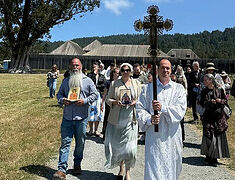
—I am glad you asked that question. The first weekend of October, we will celebrate the 100th anniversary of the pilgrimages of Orthodox believers to Fort Ross, organized by the Russian Church and always accompanied by the Divine Liturgy at Holy Trinity Church on the fort’s grounds. Metropolitan Tikhon of the OCA will be there, along with other hierarchs from California and other visitors. Metropolitan Maximilian of Irkutsk was invited to be part of this wonderful celebration commemorating the beginning, you could say, of Orthodoxy on America's mainland. To think that 100 years ago the holy words were intoned: “Blessed is the Kingdom of the Father, and of the Son, and of the Holy Spirit”, and that this continues across America in various parishes—this is a great joy and, of course, must be remembered and liturgically celebrated.
—How does the ROCOR maintain relations with other Orthodox Churches in America?
—We have prayerful relations and, when possible, friendly visits. We have a growing relationship with the Antiochian Diocese. Metropolitan Saba (Esber), the head of the Antiochian Archdiocese of New York and All North America, has been at our Synod in New York. I have visited him in his Archdiocese in Englewood, New Jersey. He has been invited to join us this December to celebrate our Synodal feast day and the memory of the Kursk Root Icon of the Mother of God.
We have always maintained good relations and understandings with the Serbian Orthodox Church in America, Serbia, and throughout the world. I am in contact with Bishop Irinej, the Serbian hierarch of Eastern America. This past February, Metropolitan Longin of the Serbian Orthodox Church in Chicago and Bishop Kliment of the Bulgarian Orthodox Church visited me in the Synod as we celebrated the memory of St. Nicholas of Japan.
Last year, in June, members of our Synod and priests visited Serbia with the Holy Kursk Icon at the invitation of Serbian Patriarch Porfirije. We celebrated the Feast of the Ascension in Belgrade. It was wonderful to visit Serbia and thank the Serbian clergy and faithful for providing a home to the bishops, the faithful, and the Kursk Icon following the revolution in the homeland. In essence, we celebrated the centennial of the ROCOR. Our history is one of many hardships. Overcoming struggles gives us a sense of spirit and joy in the Lord. The revolution in Russia caused many Russians to suffer. Many had to escape. Our Church life continued, nevertheless, and continues today.
—You already mentioned the importance of youth ministry in the Church. How does the Church work to attract the attention of young people? How is it possible in our not-so-easy times?
—I see this firsthand. Our children and youth are all good. If anything, we—the clergy, the parents, and all adults—have to be better examples of what it means to be kind, faithful, and pure. We can do this. The youth should know that they have someone to look up to, someone to talk to, and someone who will encourage them to lead a life of the gospel.
I urge parents to continue being good Orthodox mothers and fathers, to remind their children to thank God for everything, to attend divine services on time and stay until the end, to pray at home, to pray before meals, to communicate their concerns, and to have open discussions, because each family is a small church within the home. It lies on the parents to be an example of an Orthodox marriage. These are troubled times; some might say apocalyptic. But when has it ever been easy? With God, all things are possible.
And of course, we want to continue our youth programs at the diocesan and parish levels, focusing on Orthodoxy.
The Prince Vladimir Youth Association operates under the auspices of the Synod of Bishops. From their website, we read, “The objectives of our organization lay in the values established by Prince Vladimir the unifier of peoples to integrate youth through national identity, culture, language, philanthropy and importance of community service.”.
We can show the youth our love and support and remind them to remain within the bosom of the Church.
—I know that one of the most significant projects for the ROCOR is the renovation of the historic Synod Building in Manhattan. What is happening there?
—We have our building, our Synod of Bishops, on the Upper East Side in Manhattan. It was gifted to Metropolitan Anastasy (Gribanovsky) by Sergey Yakovlivich Semenenko in 1957. Since then, we have established our cathedral here, along with a chapel dedicated to St. Sergius of Radonezh, our meeting hall, offices, and residences. Aside from the daily services, various events take place. In many ways, this is the heart of ROCOR.
The building itself is over 100 years old. Plumbing and heating issues exist; the elevators are very old, the windows need to be replaced, and the entire brickwork outside must be repointed and cleaned. This is not a simple cleaning job or an easy repair. The renovation project was initiated to truly preserve our synod, this holy place, while also rebuilding from within. The glorification of New Martyrs took place here in 1981. Various episcopal consecrations, clergy ordinations, funerals, and church services have been held over the years.
The campaign started in August of last year. Since then, our supporters have helped raise just over $1 million, and it is all accounted for. The biggest project we have completed so far is replacing the entire heating system in the subbasement, along with most of the plumbing and drainage pipes.
Yes, there are still leaks that we are trying to examine and correct. Some plumbing, heating, and electrical issues persist, but there is evidence that improvement has been made. All the repairs are completed in accordance with the proper codes.
This is a 10-year plan. We now have two videos that are viewable. People can see and understand what is happening. Hopefully, the latest updates will be available to watch by mid-fall, showcasing the progress and highlighting the issues we have with some of our doors, as well as the exterior of the building. Sometimes, I get discouraged.
Nevertheless, we continue. The building is here. The spirit is strong. We are alive, and many are attending the divine services. We are happy to welcome our clergy and faithful as guests. Our church life will continue with God’s blessing.
—When do you plan to complete this project, and how much money do you need?
—In total, $15 million. This is quite a substantial amount. This is for everything, from top to bottom, inside and out. I understand the concerns, but we must continue. Fundraisers exist to gather donations to support our mission in Jerusalem, assist our faithful in Haiti, and aid those in need in Ukraine. Small parishes in my diocese need assistance with building additions or repairing damage. All of this is getting attention. However, we cannot forget about our heart, our center, and spiritual home — the Synod of Bishops. God will provide. It will take time, but I have faith that God will provide.
—Is it fair to say that the Synod renovation will not disrupt your humanitarian and other projects?
—The humanitarian aid and other projects will continue.
—You are a First Hierarch who travels a lot, and you are on the move almost all the time. What visits were the most memorable for you, and why?
—I would have to say, first and foremost, that the visit to the Holy Land and Jerusalem—the places where Christ was born, preached, performed miracles, was crucified, rose on the third day, and ascended into Heaven—was profound. In many ways, as we understand, the holy fathers say that one who goes to Jerusalem is fulfilling his own Gospel, the fifth Gospel.
I have wonderful memories of the pilgrimage with my brother bishops to Serbia last year in June with the Kursk Icon. Patriarch Porfirii and the clergy of the Serbian Orthodox Church were very welcoming, and we had wonderful celebrations in Belgrade, Sremski Karlovci, and various monasteries commemorating our first Hierarch, Metropolitan Antonii (Khrapovitsky).
I am grateful to have visited various parishes in our Eastern American diocese. I am thankful for having visited South America and Bishop John in Argentina, where I celebrated the cathedral feast day on St. Thomas Sunday in 2023.
The previous summer, for most of July, I visited the Australian and New Zealand dioceses. After a short visit to New Zealand, the feast of the saints. The patronal feast day of Peter and Paul at the Sydney cathedral marked the beginning of my time in Australia. Quite memorable is my almost daily interaction with Archbishop George, the ruling hierarch. Visits to the parishes in Croydon, Cabramatta, Melbourne, Geelong, and Dandenong—just to name a few—left a warm impression. Abbess Maria at the Our Lady of Kazan Convent in Kentlyn also received me and my assistants.
I have a personal connection to San Francisco and the Cathedral of Joy of All Who Sorrow, where my episcopal consecration took place on June 29, 2014. Since then, St. John of Shanghai and San Francisco has become a particularly special saint to me. Last year, we celebrated the 30th anniversary of St. John’s glorification. My heart is with the Synod in New York, but a piece of it is in San Francisco.
Last year, it was a great joy to lead the service of consecration for the church in Santa Rosa, CA, dedicated to Sts. Peter and Paul. This year, on August 1, I had the opportunity to visit the St. Seraphim Parish in Monterey, California, which was celebrating its 75th anniversary.
On November 8, 2024, Archbishop Peter (Loukianoff) reposed in the Lord. I traveled to Chicago to lead the clergy and faithful in prayer during the Divine Liturgy and funeral services.
When possible, I make the effort to visit Holy Trinity Monastery in Jordanville.
So, these visits to the parishes, whether they are within my diocese on the Eastern American seaboard, in California, Jerusalem, or Europe, they are all very special, because I can feel the prayer and see the faithful. I try my best to pray for my flock. I ask God to be merciful and keep all of us on the path of salvation.
—Continuing with the theme of travel, can believers hope that the main shrine of the ROCOR, the Kursk Root Icon of the Mother of God, will visit Russia in the foreseeable future? And what countries and places will it visit soon?
—In the past three months, the icon has been visiting the German diocese. Metropolitan Mark and Bishop Job were visiting monasteries and parishes there.
After visiting London and the Western European diocese this fall, the holy icon will return to New York. From January to February, it will remain in the Synod in New York.
—Are you in discussions with dioceses in Russia about the icon’s visit to them next year?
—We will pray that the Lord directs our steps.
—I ended many interviews with your predecessor, Metropolitan Hilarion, with a question that I would like to use to conclude our conversation now as well. Many people are waiting for the glorification of Brother Joseph Muñoz-Cortes, Father Seraphim (Rose), and other righteous individuals. How are things progressing in this direction?
—There is a Synod meeting scheduled for this December in New York. There is a possibility that we will have the Council of Bishops gather next year after Pascha. All of our ruling bishops and vicar bishops will participate. The agenda will be forthcoming.
—Where will this council take place?
Most likely in Germany. We have had meetings there before. Also, the German diocese will be celebrating its centennial—from 1926 to 2026. This is an important anniversary to mark, so, in light of that, I propose that we hold our Council in Germany next year.
In conclusion, I would like to say the following. Last year, I reread the book by St. John of Kronstadt, My Life in Christ, and this year I am rereading the works of the Optina elders. I recently read something that St. Barsanuphius of Optina said about prayer. I was very touched by what he had to say and would like to conclude our conversation with this.
“We cannot demand prayerful rapture from God. We are required to work in prayer. Joy is sent from God when it pleases Him and is beneficial to us. Therefore, let us pray to Him and rely on His holy will in all things.”
This is my wish for all of us. I think this is the answer to all questions.