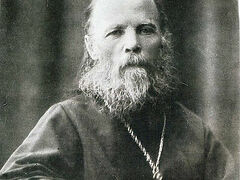
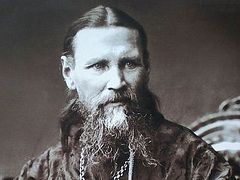
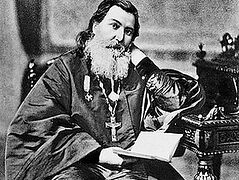
On September 14 (new style), 1836, Archpriest Valentin Amfiteatrov, a Moscow wonderworker and intercessor and ascetic of piety, was born. Let us turn to his life.
 The future priest Valentin Amfiteatrov came from a pious priestly family. His father, Archpriest Nikola, was the nephew of the famous Church figure of the first half of the nineteenth century Metropolitan Philaret (Amfiteatrov). The family lived in poverty. Fr. Valentin would later say of his childhood: “I studied by the light of a tallow candle stub and often lacked even the most basic necessities.” His upbringing was overseen by his pious mother, whom he deeply revered. At eleven years old, he entered the Orel Theological Seminary and later transferred to the Kiev Seminary.
In 1854, the young man entered the Moscow Theological Academy, eventually graduating with a PhD in theology. After that, he was appointed a teacher of general history, Russian history, and Greek in the Kaluga Theological Seminary.
In 1860, the young teacher married a priest’s daughter named Elizabeth. Their marriage was a happy one. The couple had four children. He later said of his family: “I’ll tell you sincerely that my family life gives me so much pleasure that all the bitterness of life disappears in it.”
After his ordination, Fr. Valentin was sent to serve first in the Holy Annunciation Church in Kaluga, then to the Holy Trinity Cathedral in Likhvin. He received a priestly award for his diligent service. In 1871, he and his family moved to Moscow and Fr. Valentin was appointed rector of the Sts. Constantine and Helen Church near the Kremlin’s Spassky Gate.
The last decades of the nineteenth century in the Russian lands were accompanied by spiritual decline, which eventually led to the Red Terror. Fr. Valentin was a “burning lamp” for the faithful of Moscow, refusing to allow faith in Christ to completely cool off in the souls of men. One of his contemporaries said of his ministry:
Fr. Valentin proved that a zealous priest can attract worshipers even to abandoned churches with no parish community. Even on weekdays his church could be filled to overflowing… With his artistically precise language and caressing voice, he spoke to the people who crowded around him, offering advice from a heart and mind that had just been illuminated at the Lord’s Table.
He ministered in this church for eleven years, serving the Divine Liturgy daily. At first, he served practically alone, but the faithful gradually began to learn about the God-loving priest. The church was filled with people and a large spiritual community was formed.
Fr. Valentin’s spiritual daughter, the Martyr Anna Zertsalova, wrote:
Batiushka comforted everyone, calmed everyone, and supported everyone! He would instruct one person, help another with money, find employment for another, provide shelter and refuge, heal this one, correct that one, enlighten another. From morning till night, he labored tirelessly, knowing neither peace nor rest, whether in church or at home... Sometimes he would stand and hear confessions for seventeen hours, remaining in church from morning till night, spiritually healing lost sinful hearts.
Fr. Valentin didn’t receive people to Confession immediately, but tested them for a long time. His church had an Unexpected Joy icon. He would serve molebens and akathists before it, and the suffering would receive healing.
Mother Anna herself suffered for her devoted love for her spiritual father. After his death, she started publishing materials about him, for which she was tortured by the Soviet authorities at the Butovo training ground.
She recalled:
His reverent serving and compunctionate reading of akathists aroused such a feeling in the faithful that it was impossible not to shed tears when looking at this crowd of people standing before the wonderworking icon and calling upon the Queen of Heaven with faith and hope. And the countenance of Our Lady simply shone, simply gleamed! She gazed meekly upon all, invisibly illuminating them with Divine grace, while the pastor stood and prayed.
Fr. Valentin offered a homily full of spiritual wisdom at practically every divine service he celebrated. Later, his pastoral words were published in several volumes. He taught his flock true repentance, Christian virtues, and love and reverence for God. He instructed them:
It’s not with our bellies, with food that we save our souls. The Lord needs our fervent heart, not external fasting and hypocritical church attendance—this is all sanctimony and delusion… May you have love and mercy, not outward, empty piety.
Fr. Valentin considered Confession and Communion of the Holy Mysteries of Christ to be the center of the spiritual life. He taught:
He who wants to have peace, grace, and joy within himself, and that peace, friendship, and love would reign among his loved ones, should repent; that is, change completely, and most importantly, he should seek solace in our Lord and Savior, Who is always ready to help the penitent.
In particular, Fr. Valentin told one of his spiritual daughters about the Eucharist:
We must be prepared for Communion every day, as for death. This gift is very great, incomparable to any other in the whole world… Worthy reception of the Holy Mysteries unites man with God forever. Such a man carries the grace of God within himself. He’s as close to the Lord as a green branch is to the fruit-bearing tree it’s growing on.
For Communion, we have to reflect: How do I love the Lord?... When you approach the Holy Gifts, say to the Lord: “You are everything to me. I have nothing and no one besides You.” We have to pray: “Forgive us our debts…” What does it mean to desire Communion? It’s the same as thirsting for drink—you can’t drink all at once, but little by little, otherwise it will cause harm. So too with Communion. If you thirst for it, you need discernment. Think: Do I love the Lord? If you wouldn’t trade Him for anything—not for money, not for your father, not for anyone—then you love Him. If you wish ill will upon no one, then you may receive Communion.
How do we attract Christ? By faith, love, purity, going to church, communing… The Lord must be received with humility, meekness, and joy. What does it mean to commune? No one can understand it. From Communion, we receive healing of bodily and spiritual illnesses. How should we prepare? The main thing is humility—to approach like the thief, like the woman with the issue of blood, like St. Mary of Egypt. The Lord must be received with humility, meekness, and joy. The Lord said: But to this man will I look, even to him that is poor and of a contrite spirit, and trembleth at my word (Is. 66:2)… After Communion, we should rejoice—there’s no need for any contrition.
Fr. Valentin was pleased that his flock communed frequently, saying: “I really love those who commune often—they’re my friends.”
 In 1880, Fr. Valentin’s wife reposed. Two years later, he was appointed rector in the Moscow Kremlin Cathedral of the Archangel Michael. “The community that had formed around him lost the atmosphere of a cozy little church. Martyr Anna wrote: “The flock had to part with its beloved church, which it had grown so accustomed to. Everyone moved to the cathedral.”
Being appointed to a new position took its toll on Fr. Valentin’s health, as he took the changes very hard. We read from his spiritual daughter:
He wept bitterly, bidding farewell to the wonderworking Unexpected Joy Icon of the Queen of Heaven, who for so many years was the divine defense and protection of its faithful minister. A new, different life began in the cathedral. The negligence and inattentiveness of the cathedral clergy to their duties was so deeply ingrained that it took great effort to raise everything to an appropriate level… The monotonous services, devoid of fervent faith and inspiration, and the negligence of the clergy all contributed to the cathedral being not a temple of prayer and compunction, but merely a place for tourists to visit, coming just to see the relics and icons and historical tombs there, and not at all for prayer.
However, with Fr. Valentin’s rectorship, the Archangel Cathedral was transformed. Mother Anna continues:
And so the shepherd, having entered this forgotten, abandoned cathedral, with the burning flame of his unquenchable lamp of faith, lit countless candles everywhere and illuminated the entire cathedral, revealing the precious wonderworking icons and saints’ relics resting in the cathedral, which had previously been shrouded in gloom. The cobwebs hanging around quickly disappeared, dust and mold were wiped away, the paintings were renewed, the litter was carefully swept out, the veils and shrouds were decorated, and beautiful wreaths were hung. The cathedral appeared in such beauty, in such splendor that everyone was struck by such a rapid, wonderful change.
Gradually, other gifts that Fr. Valentin had received from God began to manifest. One person who knew him left these recollections:
Over time, it was noticed with complete certainty that Fr. Valentin possessed the gifts of prophecy and clairvoyance. It was extraordinarily easy for him to understand the state of those who turned to him, who often had difficulty even expressing themselves; and to their bewilderment, he would frequently answer questions they hadn’t even posed yet. Due to his natural sensitivity, Fr. Valentin tried to make this as unnoticeable as possible, but all who came into contact with him were convinced that nothing could remain hidden from him and his penetrating insight.
And within the walls of the Archangel Cathedral, the flow of believers who needed Fr. Valentin’s pastoral care never stopped. People came to him with every possible need. He helped many people financially. We read from Mother Anna:
Humble, angelic servant of Christ… Our dear, unforgettable shepherd! Every moment of your blessed life was radiant, wonderful, beneficial; everything within you shone with love, mercy, goodness, spiritual greatness and power! Like a mighty eagle, you soared above your numerous flock, directing all toward goodness and salvation. As soon as you noticed that someone was weakening or straying, you would immediately bring them to their senses and direct them onto the righteous path of Christian goodness.
 Archangel Cathedral
The Lord visited Fr. Valentin with a serious trial—he went blind. The good shepherd could no longer serve in church, being forced into reclusion in his house on the banks of the Moscow River. “To be deprived of the divine services, to be deprived of standing before the altar of God, to be content with a quiet, monotonous life at home with high gifts of public ministry—only the angelic patience of the great righteous one could endure this,” we read from his faithful spiritual daughter. So the needy and his numerous spiritual children started flocking to his house. He continued confessing, teaching, rebuking, caressing, and comforting suffering souls. “Don’t weep, my child,” the loving priest would say to those who came to him. The future St. Nikon of Optina also visited Fr. Valentin, receiving his blessing for monasticism.
Fr. Valentin endured the ordeal humbly. His spiritual son said about this: “Having meekly accepted the trials that befell him, Batiushka lost neither his clarity of spirit nor his inherent good-natured cheerfulness.” Despite his rather sad situation, he continued to instruct others:
Always thank God… For everything, for everything… Don’t grieve beyond measure in the midst of misfortune... When you’re unwell, always remember that the Lord is with you. Don’t complain about illnesses—everyone has his own cross. For some it’s illness, for some orphanhood, or poverty, and however one labors, that’s how he attains the Kingdom of Heaven... In times of sorrow, we should more often repeat: The Lord is my light and my Savior, whom shall I fear?
Fr. Valentin instructed one servant of God as follows:
You need to pray to God to send you an angel to protect you, that the Holy Spirit would descend like an eagle and embrace His little fledgling. You must enter into yourself, remember the future life, and not worry about what you’ll eat. You have to enter into yourself—look at yourself and think about how you behave. Talk less at the table, don’t be offended by anyone, endure everything for the sake of the Lord, don’t listen to harmful conversation, force yourself to remain silent, or else flee so as not to hear tempting things.
St. John of Kronstadt also knew about Fr. Valentin. He would tell believers who came from Moscow: “You have Fr. Valentin in Moscow—go to him.”
In the last years of his life, Fr. Valentin was very ill. He dictated his spiritual instructions to his daughters for future books, though most of these manuscripts were lost in a fire at his house. He died in 1908 on the feast of the Prophet Elias. Before a large gathering of people and clergy, Archpriest Valentin Amfiteatrov, that lamp of faith, was buried at Vagankovo Cemetery next to his wife. Not long before his repose he told his spiritual children:
When I die, go to my grave and tell me everything you need, and I’ll hear you. And before you even manage to leave, I’ll fulfill everything and give it to you. If someone even a mile away from my grave turns to me, I’ll respond to him.
His grave became a place of pilgrimage. To this day, many people flock to Vagankovo Cemetery on the days commemorating Fr. Valentin.

Let’s conclude this brief essay on the life of the Moscow ascetic with his good instructions:
In your deeds, show benevolence and readiness to serve others. Be like the ancient Christians—they were friendly and had unfeigned love toward all, held all things in common, prayed with one accord. Our wedding garment must be made white: with faith, hope, and love... The Crucified Christ stretches out His most pure hands to us. He’s ready to receive us, as the father received the prodigal son who returned to him from a far country. Let us restore, brothers and sisters, our best desires to walk with Christ, to be Christ’s, and henceforth no longer distance ourselves from Him...
May the Lord grant repose to the soul of Archpriest Valentin in the dwellings of the righteous!