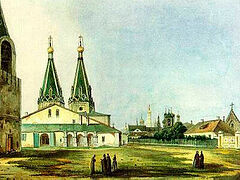
The only monastery in Moscow dedicated to the Feast of the Miracle of St. Michael the Archangel at Chonae,1 and one of the most famous ecclesiastical monuments destroyed by the Bolsheviks, was located before the Revolution in the Kremlin, on Ivanovskaya Square. Today, in its place are the paved area before the Dormition Belfry and a government building near the Senate. In earlier times, this grand Moscow monastery was even known as the “Great Lavra.”
It was founded in 1358 by St. Alexiy, Metropolitan of Moscow, in gratitude for the help and miraculous healing of Taydula, the wife of Tatar Khan Jani Beg—during the dark era of the Tatar-Mongol Yoke in Rus’. Some scholars, however, maintain that Taydula was not Jani Beg’s wife, but rather his mother, and the beloved wife of the famous Khan Uzbek, the organizer of the Golden Horde. (This view was also held by the great Moscow historian Ivan Zabelin.)
Taydula had long suffered from a severe eye condition, and when she went completely blind, she gave orders to summon the Metropolitan of Moscow—about whom stories had reached the Horde as a Russian priest whose prayers were never denied by God.
The road to the Horde was always perilous for Russians—no one knew how, or with what outcome, they might return, or whether they would return at all. Before departing, St. Alexiy served a moleben with the blessing of water in the Dormition Cathedral of the Kremlin, before the tomb of St. Peter, Metropolitan of Moscow, who during his life had honored Moscow as the spiritual capital of Russia. During the service, a candle miraculously lit itself—this was taken as a good omen. The saint broke the candle into pieces, distributed them to the people, and took some of it with him, along with the holy water, on his journey to the Horde.
He departed on August 18, 1358—a month before the Feast of the Miracle of St. Michael the Archangel.

According to tradition, while waiting for the hierarch, Taydula had a dream—she saw him approaching her in majestic liturgical vestments, accompanied by priests in the same garments. Upon waking, she gave orders to have vestments made identical to those she had seen in her vision. Later, this vestment, gifted by Taydula to the saint, was kept at the reliquary of the hierarch in the Chudov Monastery.
Scholars calculate that the journey to the Horde in those days took about a month, meaning the hierarch would have arrived in mid-September. He lit the miraculous candle with a prayer, sprinkled the afflicted woman with holy water—and Taydula’s sight was restored.
The joy was boundless on both sides, once divided by enmity. Khan Jani Beg reduced the tribute levied on the Russians, and Taydula gifted the saint a plot of land in the Kremlin, which had belonged to the khan and had previously served as the Horde’s Embassy Court—the place where tribute from Rus’ was collected. According to another version, the land had been the khan’s stables. Either way, this was the only territory transferred to Moscow, and the khan’s residence was moved to Bolvanovka in the Zamoskvorechye district.
Historian Ivan Zabelin believed that St. Alexiy, seizing the opportunity, personally requested this land from the khan and designated it for the construction of a monastery for men, with a cathedral dedicated to the Miracle of St. Michael the Archangel.
Even the very act of dedicating the thanksgiving church to this feast is deeply symbolic. More than that, many historians believe that Taydula’s healing took place—or very likely took place—on the September feast day of the Miracle of St. Michael the Archangel. After all, that would have coincided roughly with the saint’s arrival in the Horde.
If, indeed, by Divine Providence, the miraculous healing occurred on that very feast day, it would have been an unimaginable miracle, a sign from God granted to Rus’. And even if it happened on a different day, the very dedication of the monastery’s thanksgiving temple to this feast speaks to how great Moscow’s joy was over this miracle—and how deep was her Orthodox spiritual wisdom.
The Miracle of Archangel Michael at Chonae
In ancient times, near the city of Hierapolis in Phrygia (Asia Minor), there existed a miraculous spring. The daughter of a pagan from nearby Laodicea suffered from muteness. One night, her father saw in a dream St. Michael the Archangel, who revealed that his child would be healed if she drank water from the spring.
The father believed the vision, brought his daughter to the spring, and after drinking from it, the girl was miraculously healed and began to speak. The joyful family, with the healed daughter, received Christian baptism, and the father built a church in honor of St. Michael the Archangel next to the spring.
Following this, many locals—most of them pagans—began to come to the holy spring. Many embraced the Christian faith with heartfelt joy. In the newly founded church, there served a pious priest named Archippus, who fervently preached Christ and never left the temple.
But this Christian victory stirred the hatred of the pagan inhabitants, who devised a cunning plan to destroy the church and its priest. They connected two mountain rivers through a dug canal, sending a powerful stream directly toward the church. Archippus fervently prayed for deliverance—and then came the miracle: St. Michael the Archangel appeared in glory, and with his staff, struck the mountain, opening a great chasm into which the water flowed, bypassing the church.
The Christians gave long and grateful prayers to God and their heavenly protector. From that time forward, the place was called “Chonae”, meaning “opening,” “cleft,” or, according to another interpretation, “immersion.”
This miracle came to be understood as the protection of the Orthodox Christian church from pagan forces.
For Orthodox Rus’, still suffering under the yoke of unbelievers, this feast came to symbolize both deliverance for the faith in Christ and spiritual victory. And so, in Moscow, the great Chudov Monastery was established.
The Founding and Growth of Chudov Monastery
In 1358, a wooden cathedral church was established; in May 1365, the first stone church was built in its place.
The monastery’s founder, St. Alexiy, took care to provide for it materially, enriching the Kremlin monastery with precious vessels, villages, and fishing grounds. One such village was the famed Cherkizovo, which the saint purchased from his Tatar servant Ilya Azakov and granted to the monastery. Cherkizovo remained under monastic control until the secularization [by Empress Catherine the Great] of 1764.
The Hamovniki district, too, was once part of Chudov’s holdings, and it was there that the famous Church of St. Nicholas was built in the seventeenth century for the royal weavers producing white linen. Before 1626, the area had been called “Chudovka”, named after the monastery, and it was where the metropolitan’s stables were located.
Chudov Monastery was one of Moscow’s richest monasteries, receiving gifts and donations from grand princes, tsars, and boyars for commemorative prayers.
The Repose and Canonization of St. Alexiy
St. Alexiy reposed in the Lord in 1378. Sensing the approach of death, he began to read the prayer for the departing soul and died before finishing it. In humility, he had requested not to be buried inside the church, as was customary, but rather near it—and so he was buried in the Annunciation Chapel of the Chudov cathedral.
Zabelin believed that Grand Prince Dmitry Donskoy did not fully honor the saint’s final request, yet still, his relics were laid within the chapel.
In 1431, the saint’s incorrupt relics were discovered when the roof of the aging church collapsed during the Divine Liturgy. By God’s mercy, no one was harmed, but the church had to be rebuilt. During the work, St. Alexiy’s tomb was uncovered. His relics were enshrined in the Annunciation Chapel of the cathedral. Near his reliquary stood his episcopal staff, and beside it was kept the vestment gifted by Taydula.
Then, in 1483, Grand Prince Ivan III ordered the construction of a new church within the monastery with two altars—one in honor of the Annunciation, and the other in honor of St. Alexiy. It was there that his holy relics were reverently transferred. The Annunciation Chapel in the old cathedral was then abolished.
That period was marked by momentous events in the history of the Chudov Monastery.
In 1441, the monastery became the place of confinement for Isidore, Metropolitan of Moscow—a Greek by origin, who had signed the infamous Union of Florence with Roman Catholicism in 1439. As is well known, Orthodox theologians later viewed the conclusion of that union as a profound spiritual cause of the fall of the Byzantine Empire in 1453.
Having signed the union on behalf of the Russian Orthodox Church, Isidore returned to Moscow carrying the Latin cross before him, and during a service in the Dormition Cathedral, he commemorated Pope Eugene during the litany. This outraged the Grand Prince of Moscow, Vasily II, who called Isidore a “Latin deceiver” and imprisoned the traitor in Chudov Monastery.
Shortly thereafter, Isidore escaped to Rome, where he died in 1462. The prince refused even to pursue “that false shepherd.”
He was the last foreigner to hold the office of Metropolitan of Moscow—after him, the Russian hierarch St. Jonah was immediately appointed.
Rebuilding and Renewal of the Chudov Cathedral
In 1504, during the grand wave of construction in the Kremlin, the cathedral church of Chudov Monastery was completely rebuilt. It is possible that the same Italian architects who worked on the Kremlin participated in its construction—architectural features suggest that its builder may have been Aleviz Novy, the architect of the Archangel Cathedral.
On the feast day of the monastery’s patron in 1504, the newly constructed cathedral was solemnly consecrated, and over the years, it would undergo further restorations.
Grand Princess Elena Glinskaya had a silver reliquary made for the relics of St. Alexiy, and together with her five-year-old son Ivan (the future Ivan the Terrible), along with the metropolitan and bishops, she tearfully prayed to the saint on his feast day in February.
Her husband, the late Grand Prince Vasily III, had fervently prayed at the tombs of St. Alexiy in Chudov Monastery and St. Peter in the Dormition Cathedral, imploring God to grant him a long-awaited heir—since during his twenty-year marriage to his first wife, Solomonia Saburova, he had remained childless.
When, from his second marriage to Elena Glinskaya, the sovereign finally had a firstborn son—the future Tsar Ivan IV—the prince, as the chronicles say, “fulfilled with joyful soul the vows of his heart.”
He ordered the construction of two reliquaries: a golden one for St. Peter, and a silver one for St. Alexiy. However, both were completed two years after his death, in 1535.
The Fire of 1547 and Political Turmoil
In the great fire of 1547, the entire Chudov Monastery burned down, with the exception of the reliquary containing the relics of St. Alexiy.
Half a year later, in January 1548, a significant event occurred: Fr. Feodor Barmin, a priest of the Kremlin’s Annunciation Cathedral and spiritual father to Tsar Ivan the Terrible, was tonsured a monk in Chudov Monastery, seeking repentance for his role in the uprising against the Glinsky family.
It was he who, after the fire of 1547 (which occurred shortly after the coronation of the first Russian tsar), spread the rumor among the people that the disaster was caused by the Tsar’s relative, Anna Glinskaya—that she had used sorcery and called down the fire upon Moscow.
The boyars supported the rumor, and the tsar ordered an investigation. But a violent mob, in its fury, murdered Prince Yuri Glinsky inside the Dormition Cathedral itself.
It was, unmistakably, a political matter.
Since the time of Ivan the Terrible, a tradition was established to baptize royal newborns in the Chudov Monastery, beside the reliquary of St. Alexiy. Here, Tsarevich Ivan was baptized in 1554, and in 1557, Tsarevich Fyodor, in the presence of the tsar himself.
It was in Chudov that Tsar Alexei Mikhailovich was baptized, with the sacrament performed by Patriarch Philaret, who was baptizing his own grandson. In turn, Philaret later baptized his son, Peter I, in Chudov in 1672—although by then, the “Most Serene” Tsar (Alexei) had begun to alter the tradition somewhat, baptizing his elder children from his marriage to Miloslavskaya in the Dormition Cathedral. Still, Peter was baptized at Chudov. Notably, a century and a half later, in 1818, another great reformer, Alexander II the Liberator—who abolished serfdom—was baptized in the Chudov Monastery.
During the baptism, his grandmother, Empress Maria Feodorovna, brought the infant close to the hand of St. Alexiy, seeking his blessing. The heir was in fact born adjacent to the Chudov Monastery, in the Kremlin’s Nicholas Palace, which was later demolished by the Bolsheviks. That palace had been built on the site of the former Metropolitan’s house (or possibly remodeled from it). Therefore, an old historian reverently stated that the heir was born “within Chudov Monastery itself”, highlighting this as a pious and significant fact.
Strikingly, that historian wrote those lines in 1820, never imagining the glorious role that heir would later play in Russian history.
Thanks to its location and status, Chudov Monastery was closely connected to the Russian tsars—not only through baptism and their presence at feast-day liturgies, but in many other ways.
The Time of Troubles
In the Time of Troubles, in 1610, Vasily Shuisky was tonsured a monk in Chudov by force, and later transferred to the Joseph-Volokolamsk Monastery. Two years later, he was retrieved by Hetman Żółkiewski, who removed his monastic garb and dressed him in fine robes, so as to present to the Polish king not a captured monk, but a captured Russian tsar. He later died in Poland. His wife, Tsarina Maria, was also tonsured a nun and sent to the St. John the Baptist Convent in Moscow.
Even earlier, in 1602, Deacon Grigory Otrepyev fled from Chudov to Lithuania. With him begins one of the most infamous chapters in the history of Chudov: the saga of Russia’s first False Dmitry. Otrepyev remains a subject of scholarly debate. It is believed he was the son of Galician nobleman Bogdan Otrepyev, who was allegedly killed in a drunken brawl in Moscow’s German Quarter (which already existed by that time). The future pretender, then named Yuri, entered the household of the Romanovs, relatives of Ivan the Terrible. When the Romanovs fell from favor, Yuri took monastic vows under the name Grigory (though historian Malinovsky calls him Hieromonk Herman) and, with help from patrons, entered the prestigious Chudov Monastery.
From there, he fled abroad, declared himself Tsarevich Dmitry, and returned to Moscow with a large Polish army backing his political claim. But the people rejected him—after only ten months, an uprising broke out in Moscow, for many had begun to doubt his legitimacy. When his corpse was thrown onto Lobnoye Mesto,2 a copper coin was placed in his hand, as if in payment for his theatrical performance.
At the same time, Patriarch Ignatius, who had crowned the False Dmitry, was deposed and imprisoned in Chudov Monastery.
Chudov’s history was also tightly woven with the fates of Orthodox Church hierarchs.
In 1612, Patriarch Hermogenes, imprisoned in the monastery, performed his great labor of martyrdom. From captivity, he sent out letters across Russia, calling the people to defend their homeland. He became the spiritual inspiration of the national militia:
“I do not forbid Lyapunov to fight for Moscow. I bless the warriors to die for the faith and to defend the Fatherland,” he told the Polish invaders, who demanded he bless Polish prince Władysław for the Russian throne.
While still free, Hermogenes had demanded the baptism of Marina Mnishek, opposed the idea of crowning her son, and supported Mikhail Romanov. But when he refused to bless Władysław for the throne, he was arrested by the Poles and martyred by starvation. That refusal, and his blessing for the resistance, ignited the uprising in Moscow.
His holy relics were translated to the Dormition Cathedral under Tsar Alexei Mikhailovich, but he was canonized only in 1913. That same year, a magnificent tomb was built in the cathedral, and in the lower church of the Chudov Cathedral, where the saint had died, a chapel was consecrated in his name.
It was also in Chudov Monastery that Patriarch Nikon was stripped of his patriarchal dignity. The Eastern Patriarchs, Paisius of Alexandria and Macarius of Antioch, removed from him his staff, panagia, and patriarchal klobuk. Nikon remarked bitterly: “Take your pearls for yourselves.”
Later, two archimandrites of Chudov, Joachim and Adrian, became patriarchs of Russia—Adrian being the last patriarch of Peter the Great’s era.
After Peter abolished the patriarchate, he appointed the Chudov hierodeacon Timofey to “oversee” liturgical practices in Moscow.
When the Moscow diocese was restored in 1737, the episcopal see was reestablished in Chudov Monastery.
In 1626, Chudov Monastery burned down. Tsar Mikhail Feodorovich commissioned a great bell in memory of his father and had it hung in the monastery’s belfry. Then, in the year 1680, plans were laid to rebuild the Church of St. Alexiy, according to Tsar Feodor Alexeyevich’s designs. The consecration took place in May 1686 (Old Style) on the Feast of the Translation of St. Alexiy’s Relics. On the eve of the consecration, young Tsars Peter and Ivan (Peter at that time ruled jointly with his brother by demand of the rebellious Streltsy) personally lifted the relics of St. Alexiy and placed them in the new church, accompanied by the ringing of the Ivan the Great Bell Tower. This new, two-altar church was distinctive in that it was divided into male and female sections, with separate entrances. The Church of St. Alexiy was for men, and the Annunciation Altar was for women.
Within the St. Alexiy Church, there was a remarkable icon of St. Alexiy, painted on the very board from his coffin—and later wounded by the knife of a mad Calvinist heretic.
At that same time, a new church was established in the monastery in honor of St. Andrew the First-Called. It was founded in praise of the Apostle, and in commemoration of the “pacification” of the terrible Streltsy uprising that shook Moscow in 1682.
The capital was then in turmoil, and one day, Patriarch Joachim carried out from the Dormition Cathedral a precious relic—the right hand of St. Andrew. He placed it on an analogion in the open square, served a moleben (supplicatory service) there on the spot, and called upon the Streltsy to “cease the unrest,” promising them forgiveness for their rebellion.
To the joy of the tsar and the patriarch—and indeed of the Streltsy themselves—peace was restored, and universal gratitude to the holy Apostle took root. In commemoration of this miraculous reconciliation, the Church of St. Andrew was founded within the Kremlin monastery—a dedication rare in Moscow. In 1737, it was reconsecrated as the Church of the Exaltation of the Cross and repurposed as the monastery’s infirmary chapel. In the nineteenth century, however, it was once again restored under its original dedication to St. Andrew.
For centuries, Chudov Monastery was a true stronghold of Russian enlightenment.
Maximus the Greek once lived within its walls, and liturgical books were revised here during the Nikonian reforms. It was in Chudov that Patriarch Philaret established the so-called “Patriarchal School”, a Greek-Latin college that became the forerunner of the Slavic-Greek-Latin Academy.
Among its teachers were Arsenios the Greek and Epiphanius Slavinetsky, a graduate of the renowned Kiev Moghila Academy, who worked in Chudov on the correction of liturgical texts.
In 1658, Epiphanius translated for the Tsar and Patriarch a “Doctor’s Book”—a new and still rare medical manual, as medicine was only just entering the courtly life of Moscow. For his work, he was awarded a salary of 10 rubles.
By tradition, noble boys were sent to Chudov Monastery “away from corrupting company,” to be educated and raised. Upon reaching the age of sixteen, they would return to secular life. The foreigner Klenck, who visited the monastery at the end of the seventeenth century, remarked that Chudov was more like a aristocratic boarding school than a monastery.
The Russian educator Karyon Istomin also lived here. Originally from Little Russia (Malorossiya), he had first labored in the Zaikonospassky Monastery in Kitai-Gorod. In 1692, he published his famous primer (bukvar’), which he presented to Tsarina Natalia Kirillovna for the education of her grandson, Tsarevich Alexei, the elder son of Peter I.
Earlier, he had written for the young Peter a whole encyclopedia in verse. Historians often call Istomin a precursor of Trediakovsky—he composed poetic odes to Princess Sophia, and later to the marriage of Peter and Eudoxia Lopukhina.
Both Karyon Istomin and Epiphanius Slavinetsky were buried within the walls of Chudov Monastery.
Also interred here was the holy fool Timofey Arkhipov, who had worked as an iconographer before embracing his ascetic path. Until his death, he lived in the Kremlin near Tsarina Praskovia Feodorovna. When Princess Anna Ioannovna—daughter of Tsar Ivan Alekseyevich and niece of Peter I—would visit, Timofey would always greet her with the cry: “Don, Don, Don—Tsar Ivan Vasilievich!”
This was later seen as a prophetic utterance, foreshadowing the harsh rule of Anna Ioannovna, comparing it to that of Ivan the Terrible.
Among the Naryshkin family, a holy relic was preserved for generations—the beard of the fool-for-Christ. When it was lost, that senior branch of the Naryshkins died out, leaving no descendants.
The monastery was also the burial place of many noble Muscovite families: the Trubetskoys, Streshnevs, Kurakins, and Khovanskys.
The tomb of Prince Sergei Khovansky, who died in 1768, was considered by pre-revolutionary historians to be the last known burial on the grounds of ancient Chudov Monastery.
On his tombstone was inscribed a wise epitaph, beautifully capturing the spirit of Orthodox Russian burial tradition:
Whoso readeth this tablet, take heed—
How brief our life on earth indeed.
Thus signs are placed upon the grave,
That memory may be eternal and brave.
In 1905, another burial took place in the Chudov Monastery: Grand Duke Sergei Alexandrovich, Governor-General of Moscow, who had been assassinated by the Socialist-Revolutionary Ivan Kalyayev near the monastery within the Kremlin, was laid to rest here.
His tomb was built in a newly constructed chapel, dedicated in his name to St. Sergius of Radonezh. The design was carried out under the direction of architect R.I. Klein.
(In 1995, the grand duke’s remains were transferred to Novospassky Monastery, but they were actually discovered by chance back in 1985 during construction work in the Kremlin—and at that time, they were simply reburied on the spot.)
“At the Place of the Wonder”
In earlier times, the Kremlin monastery was affectionately referred to in old Muscovite fashion as “At the Wonder” (u Chuda).
In the second half of the eighteenth century, the architect Matvey Kazakov constructed for it a beautiful “Gothic” porch with turrets.
The monastery was famous throughout Moscow for its prosphora (altar bread). Muscovites would knock on the window and pass their coins through the open sash to purchase them. Inside the monastery’s Annunciation Church, a special alcove was built into the wall where they sold “miracle-worker’s honey.”
The monastery preserved many treasures, including:
-
A Gospel translated from Greek by St. Alexiy, along with his last will and testament;
-
The “Potemkin mitre”, adorned with diamonds and gifted by Prince Potemkin to Metropolitan Platon;
-
A mitre and staff bestowed by Emperor Paul I.
On 30 July 1767, in the Granovitaya (Faceted) Chamber of the Kremlin, the famous Legislative Commission—convened by Empress Catherine II to draft a new legal code for Russia—held its inaugural session. The solemn moleben for the occasion was celebrated in the Chudov Monastery.
This event marked perhaps the first time in Russian history that “deputy immunity” was introduced: Members of the Commission were permanently protected from the death penalty and property confiscation, while any offense against a deputy would incur double punishment.
The Commission functioned in Moscow for only six months, producing little result. It was then moved to St. Petersburg, and a year later dissolved due to the war with Turkey.
The year 1812 brought devastation to the Chudov Monastery, comparable in consequence only to the year 1917.
During the Napoleonic occupation, Marshal Davout’s sleeping quarters were set up in the altar of the monastery’s cathedral. Documents from the Spiritual Consistory and the Governing Senate were thrown by the enemy into cesspits.
The monastery was restored in 1814, and later the noted Moscow architect M.D. Bykovsky undertook a renovation of the cathedral, installing a bronze iconostasis with beautiful silver Royal Doors.
In 1826, Emperor Nicholas I celebrated in Chudov his first military victory over Persia. The trophies—keys to fortresses and “Shah’s banners”—were placed in the monastery for eternal preservation.
It was also here that the emperor gave thanks for the suppression of the Decembrist revolt, ordering a thanksgiving service in the monastery for deliverance from the rebellion, which had “threatened disaster to the entire Russian state,” and to proclaim eternal memory for the soldiers who fell on December 14, 1825, “for the Fatherland and the Tsar.”

During the Great Reforms of Emperor Alexander II, a state-sanctioned committee was established at the Chudov Monastery for the collection and safekeeping of public donations to fund a thanksgiving church dedicated to St. Alexander Nevsky, in honor of the liberation of the Russian serfs.
Strangely, this great temple—second in stature only to the Cathedral of Christ the Savior—was never completed in Moscow. Only in 1904 was the site of the foundation consecrated, located on Mius Square, and its construction was dedicated to the fiftieth anniversary of the emancipation of the serfs.
Construction began only in 1913, but was interrupted by World War I.
The unfinished structure, never consecrated, was later dismantled by the Bolsheviks, who used the bricks to build a residential building on the site.

The year 1917 brought about the destruction of the Chudov Monastery.
In that bloody November, the monastery was shelled—yet the icon of the Mother of God remained untouched.
For a short time thereafter, a few monks continued to live within the Kremlin monastery—in uneasy proximity to the Bolshevik government, which had moved from Petrograd to Moscow in 1918. But the new Kremlin residents were not pleased with this monastic neighborhood, and already by 1919, the monastery was closed.
In its buildings was established a cooperative named “Kommunist”, and in the crypt of the Church of St. Alexiy, they opened a “reading hut” (izba-chitalnya).
Soon, the monastery’s treasures were seized, and the site was handed over to the Kremlin Medical and Sanitary Directorate (Letchsanuprov), where the best physicians observed the highest-ranking patients of the Soviet leadership.
In December 1929, the Chudov Monastery was completely demolished, in order to clear the privileged space for the planned construction of the Presidium of the Supreme Soviet, designed by Ivan Rerberg.
The relics of St. Alexiy were transferred to the Archangel Cathedral. Then, in 1947, Patriarch Alexy I requested that they be moved to the Yelokhovsky Cathedral of the Theophany—where they remain to this day.
Icons from the monastery were sent to the Armory Chamber and the Tretyakov Gallery.
Today, nothing in the Kremlin bears witness to the Chudov Monastery—except the story itself.