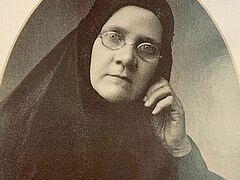
Valentina Ilyinichna Puzik at work in her native institute
Those who will be saved in times
of universal apostasy will be above us.
St. Anthony the Great
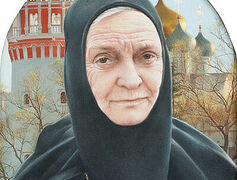
For most of her life, Schema-nun Ignatia (secular name Valentina Ilyinichna Puzik), a renowned Soviet scientist, doctor of medical sciences, spiritual writer, and hymnographer, labored as a monastic. She combined the qualities of a scientist and an ascetic of faith—she was a world-famous professor, and an Orthodox schemanun.
Valentina Ilyinichna was born on January 19 (February 1), 1903 in Moscow. Her father, Ilya Yakovlevich, was a peasant from Grodno province in Belorussia. Having completed his military service, he remained in Moscow, working as a junior clerk in the management office of the Kiev-Voronezh railway. He died of tuberculosis in 1915. Her mother Ekaterina Sevastyanovna (nee Abakumtseva) followed in her daughter Valentina’s footsteps. In the 1930s, she was tonsured a riassophor nun with the name Makaria, in honor of St. Macarius the Great. Her daughter Valentina was born on his commemoration day. She was later tonsured into the small schema, taking the name Avramia in honor of St. Avramry of Chukhloma. Her son Nikolai, Valentina’s brother, would later become a famous artist.
Since childhood, Valentina displayed outstanding mental abilities and great diligence. After losing her father to tuberculosis at the age of twelve, she decided to dedicate her life to the battle against this disease, which claimed the lives of so many thousands of Russians. In 1920, Valentina graduated from the Nikolayevsky Commercial School for girls on Novaya Basmannaya Street and entered the Natural Sciences department of the Physics and Mathematics Faculty of the First Moscow State University. In 1923, when the university opened a biology department, she continued her studies there.
After graduating from university in 1926, Valentina Ilyinichna began her scientific work in the field of pathomorphology of tuberculosis under the guidance of Vladimir Germanovich Shtefko, a famous phthisiologist.1 She became his closest student. Their mutual study, the monograph “Pathology and Clinical Findings of Tuberculosis” published in 1934, became a major work. Her first work, “The process of tuberculosis in patients of various physique,”, written during her student years, brought the young researcher international fame. In 1940, Valentina Ilyinichna defended her doctoral dissertation. Between 1945 and 1974, she headed the Laboratory of Tuberculosis Pathomorphology at the State Tuberculosis Institute (later the Central Research Institute of Tuberculosis of the USSR Academy of Sciences), a position she held for twenty-nine years. The Patriotic War didn’t stop the scientist from doing her work either; she continued her research on the pathogenesis of tuberculosis.
In 1947, Valentina Ilyinichna Puzik was awarded the title of professor. During her long life, she published two hundred and fifty scientific articles and seven monographs; many of them are recognized as major theoretical works. She became the founder of her own school of phthisiatrician pathologists, and her students worked throughout the former Soviet Union, saving the lives of many thousands of tuberculosis patients. She raised more than one generation of researchers; her students defended twenty-two doctoral and forty-seven master’s theses. Over the decades, her books were published only to later become the hands-on desk reference books for doctors in corresponding professions: “Developmental morphology of the human cardiovascular system” (1948), “Developmental morphology of the endocrine glands in humans” (1951), “Problems of tuberculosis immunomorphology,”, and others. Valentina Ilyinichna spoke several European languages, the knowledge of which proved useful when she became a participant in international conferences and symposia.
She received awards for her scientific work: the Order of the Red Banner of Labor, nine medals, and the title of Honorable Worker of Medicine. As early as the 1930s, her research activities gained recognition among foreign colleagues. The party leadership turned a blind eye to the fact that Valentina Ilyinichna went to church. She never advertised her faith, yet she also maintained her habit of attending church. Her colleagues at work had no idea she had been a nun in secret. Mother Ignatia admitted:
“I don’t know how the Lord saved me from camp. Maybe I wasn’t arrested because I always worked and they needed my work. I was allowed to work and teach young people, and I did have a lot of youth around me."
Nun Ignatia never became a member of the Academy of Sciences, although she very well may have claimed the title of academician based on her scientific merits. In this regard, her superiors alluded to her non-partisanship and religious involvement.
Valentina Ilyinichna recalled that she was seventeen when her soul was touched with the Grace of the Holy Spirit for the first time. It happened when she was feeding the hungry. At the time, in 1921, Moscow was deluged with refugees from the Volga region. Famished, they were sitting and lying on the sidewalks of the Three Stations Square, begging for a piece of bread. Not far from the Square, on Novaya Basmannaya Street, was the Sts. Peter and Paul Church, where parishioners organized a feeding station for refugees. Every morning, Valya would bring a bucket of soup cooked by her mother to the church, and each time she’d linger there to pray. This was how her faith grew stronger.
 Archimandrite Agathon (Lebedev) While she was still studying at the university, a major event happened that predestined the young girl’s future life. In February 1924, on the eve of her Name Day, Valentina came to prepare for Communion at the Vysokopetrovsky Monastery and had confession with Archimandrite Agathon (Lebedev; tonsured Ignatiy in Great Schema),2 a former resident of the Smolensk Zosima Hermitage. Her spiritual growth began at this confession—she became a parishioner of the Vysokopetrovsky Monastery and the spiritual daughter of Archimandrite Agathon. Her first meeting with the elder was described in her book, Eldership in the Time of Persecution.
Archimandrite Agathon was a very attentive confessor, and by the mid-1920s, an intimate circle of spiritual children had formed around him, its many members gravitating towards monasticism. Within the walls of the Vysokopetrovsky Monastery, many young men and women began to take monastic vows in secret. There, under the guidance of Zosima Hermitage elders, they grasped the foundations of spiritual life while continuing their secular work or studies, and this was to become a part of their monastic obedience. They worked at secular jobs "with all responsibility and with all love." Thus, according to Valentina Ilyinichna herself, the Vysokopetrovsky Monastery became "a hermitage in the capital city." The community formed by Archimandrite Agathon had as its aim the preservation of the ascetic tradition of Orthodox monasticism.
In 1928, at age twenty-five, Valentina Puzik received the secret tonsure as a riassophore nun with the name Barsanuphia, in honor of St. Barsanuphius of Kazan. Her spiritual father tonsured her in an apartment, the gathering place of Fr. Agathon's spiritual flock (as the Vysokopetrovsky Monastery had been closed by then). It was located in the attic reachable only by a narrow staircase. Matushka recalled how her spiritual mentor liked to say:
"A wide staircase in the entrance hall is the world, but then there is a narrow walkway to the attic—the monastic path.”
Valentina's tonsure took place during the persecution of the Church, when the Orthodox had to worship in secret, so the decision to connect her life with God at that time should be viewed as a feat on her part and of her fellow believers.
"Batiushka was strict with us," recalled Mother Ignatia, “so he only tonsured us in the the riassaphore. He said that one shouldn’t give the mantia (full tonsure) to those living in the world—they will make too much of it and fall into sin."
At the beginning of 1939, after the death of her spiritual father, she was tonsured into the lesser schema (receiving mantia) with the name Ignatia in honor of Hieromartyr Ignatius the God-Bearer and in memory of her spiritual father Schema-Archimandrite Ignatiy (Lebedev), who died in a camp for disabled inmates during the fourth year of his imprisonment, on the day of the Beheading of St. John the Baptist. The tonsure was performed by Archimandrite Zosima (Nilov), one of the elders of the Zosima Hermitage. Over the next seventy-six years, Mother Ignatia bore the weight and loftiness of monastic vows. Mother Ignatia combined extensive secular activity with monastic feats; she performed her cell prayer rule and often attended church, whenever it was possible—as this was what Fr. Ignatiy had taught her to do.
“Batiushka taught us to love Orthodox divine services above everything else, and he exposed us to the joys of worship," matushka used to say. "I read services daily, and if I don't, it feels as if my day had been laid to spiritual waste.”
She became one of the few women hymnographers in the history of the Church
In the mid-1940s, apart from her scientific work, she engaged herself in church creative writing, which, by her own admission, originated in her habit of daily written confession of inner thoughts. She wrote her first book 1945, The Biography of Schema Archimandrite Ignatiy (Lebedev). In 1952, she wrote a book about the monastic community he had founded. Her theological works were published in the Journal of the Moscow Patriarchate, and such magazines as Trinity Word and Alpha and Omega. Nun Ignatia served the Church by writing spiritual works about monastic life, on action of the Providence of God in the modern world and in the life of modern man, and on the history of the Church. She signed her works, “Nun Ignatia (Petrovskaya).” Her work as hymnographer holds a special place.3 She became one of the few female hymnographers in the history of the Church. Some of the services she created were included in the liturgical cycle of the Russian Orthodox Church. Among them are services to St. Ignatius (Brianchaninov), Patriarch Job, the Right-Believing Prince Dimitry Donskoy, Venerable Herman Zosima Hermitage, services to the Synaxis of Belorussian, Smolensk and Kazan saints, to the Valaam Icon of the Mother of God, and others. The digest, The Theological Works, published a series of her articles on the history of Orthodox hymnography (Sts. Andrew of Crete, John of Damascus, Joseph the Hymnographer, Theodore the Studite, and others). A large part of her writings have not been published yet.
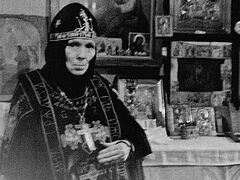
 Schemanun Ignatia (Puzik) Having retired from her professional career in 1984, the seventy-year-old nun devoted herself entirely to monastic service. Matushka Ignatia served for a long time as a Sunday school teacher in the Church of St. Pimen the Great in Novye Vorotniki (not far from the Novoslobodskaya metro station).
On April 24, 2003, Great Thursday, in the church of St. Sergius of Radonezh of the Vysokopetrovsky Monastery, Nun Ignatia was tonsured in the great schema, keeping her previous monastic name. However, this time around, her heavenly patron was to become the newly glorified Monk-Martyr Ignatiy (Lebedev), formerly her spiritual father, whose mantia matushka Ignatia had kept until her death. She was tonsured in the Great Schema by Igumen Peter (Pigol), at that time the abbot of the Vysokopetrovsky Monastery.
Schemanun Ignatia died on August 29, 2004 aged one hundred and two. She was buried at the Vagankovsky cemetery in Moscow. Every year, the priests of the Church of the Renewal of the Church of Christ’s Resurrection at the Vagankovsky cemetery serve a pannikhida in memory of Schemanun Ignatia.
The uniqueness of matushka Ignatia’s personality lies in the fact that she was able to align scientific activity and monastic service in her life, under the conditions of an atheistic regime. Matushka Ignatia belongs to the generation of twentieth century monastics who served the Lord outside the walls of monasteries: their rooms in communal apartments were their monastic cells, and they came together to pray in those few parish churches that had miraculously survived the persecutions.
To the last day of her life, matushka Ignatia retained a clear mind and a sense of humor. Contemporaries remembered her as a petite elderly woman with glowing and kind eyes. She kept a wide circle of acquaintances even in her advanced years. Both the scientists, her former colleagues at the institute, and young Sunday school students visited her. She was able to find a kind word for anyone who came to see her. People like Nun Ignatia are commonly referred to as “people of integrity." Zoya Sergeevna Zemskova, matushka Ignatia’s student and colleague at the institute, recalled about her:
"She often used to say, ‘Don't think bad of anyone. Judge no one.’ She taught us to love and accept everyone."
Memory eternal to Schemanun Ignatia!
 Schema-nun Ignatia (Puzik)
References:
Beglov A.L. Ignatia (Puzik). Orthodox Encyclopedia.V. 21. M.,2009.
Jubilee of Professor Valentina Ilyinichna Puzik—the centenary of her birth. M., 2003.
Nun Ignatia. Church hymnographers. M.: The Trinity-St.Sergius Lavra metochion. 2005.
Azin A., Zemskova Z. Puzik Valentina Ilyinichna—centenary of her birth. Life and Science. M., 2004.
Jubilee of Professor Valentina Ilyinichna Puzik—centenary anniversary of her birth.//Problems of tuberculosis. M., 2003, #3.