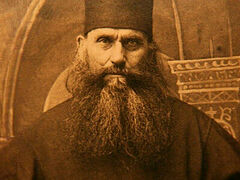
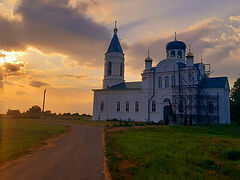
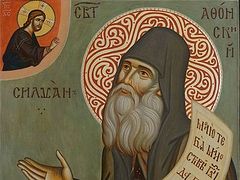
On September 24, the Orthodox Church commemorates a great saint—St. Silouan the Athonite.
Semyon Antonov (that was his secular name, before taking monastic vows) was born in 1866. At the young age of nineteen, he wanted to go to the Kiev-Caves Lavra, but Semyon’s father said, “You’d better serve in the army, and then we’ll see.” The future St. Silouan of Mt. Athos did not spend his youth quite virtuously and piously; he loved to play the accordion, hang out in groups, and drink. One day he punched a man in the chest, as he had been showing off his strength in front of some girls. And since Semyon was physically very strong, the guy fell and could not come around for several hours. Of course, St. Silouan repented of this for a long time afterwards.
Once at Pascha, after a festive dinner, he asked his mother to make him an omelet with fifty eggs and ate it right away. He was a very robust young man and worked hard. And he was known as the life and soul of any party.
In 1892, after the army (he served in St. Petersburg), Semyon went to Holy Mount Athos and became a novice there. He confessed all his sins to his father-confessor, and the Lord forgave him everything through the priest. Semyon rejoiced and undertook his struggle with sins, starting to live a real spiritual life. When he was still a young novice, he worked at the mill, carrying sacks of flour. It was a hard and exhausting labor. He did not sleep lying down, but only sitting, or in a chair without a back. He prayed very much, but, as the future saint himself believed, the Lord did not hear him. And when the young novice had already sapped all his strength and told God in a fit of temper that He was inexorable, the Lord appeared to him at that very instant. Seeing Him with His own eyes, Semyon felt a special joy and received a special grace. He never forgot this joy, always prayed and asked everyone else to pray for him as for a sinner.
Let me give you two quotes from St. Silouan the Athonite:
“The Lord is waiting for us in Heaven. Let’s pray and thank the Lord. He is merciful. He loves us sinners very much and is waiting for us together with the saints. We must humble ourselves for the sake of the Lord; and let us love our enemies, as the Lord has commanded us. Let us endure sorrows for God’s sake, but there (in eternity), once the soul sees the Lord and forgets all sorrows from His love, we cannot even remember our own son there—our Lord is so Pleasant and Meek. I am writing these lines to you tearfully. Schemamonk Silouan, a sinner.”
“Although I write to you a lot on account of your sorrows, loving you, I also have many sorrows of my own. I am to blame for them myself, because I have not learned the humility of Christ, and without it the grace of the Holy Spirit leaves us and the soul grieves for grace. By the grace of Christ, the soul feels at peace in pain. Your sorrows are great, but they are temporary. After death, if the Lord vouchsafes a person to contemplate Him, then he cannot remember His relatives from His love. This is what our Lord is. As I am writing, my spirit rejoices in God’s mercy and Glory. O Lord, vouchsafe us to behold Thee in the glory of Thy ineffable beauty. Glory to the Father, and to the Son, and to the Holy Spirit, that the Lord loves us sinners so much. He died for us on the Cross and gave the Holy Spirit to the Apostles, but we lose Him. But the Lord has also given us repentance, and the Lord rejoices at every repentant sinner, as the Holy Scriptures say.”
Having received a special grace and been vouchsafed to see God once, afterwards St. Silouan felt a longing for the Creator and strove in every possible way to please Him and regain the grace that the Lord had abundantly bestowed upon him in his youth when he worked as a novice at the mill of St. Panteleimon’s Monastery on Mt. Athos.
 St. Panteleimon’s Monastery on Mt. Athos. Photo by A. Forster
St. Silouan the Athonite struggled as a monk for forty-six years and then received the schema. Some of the brethren did not know about his special gifts, and after his repose, when his disciple, Archimandrite Sophrony (Sakharov) wrote the book entitled, Elder Silouan, pilgrims would come and say: “Show us the skull of Silouan the Athonite.” But it was in the ossuary with the other skulls, and the abbots were thinking of burying it so that no one would find it. Some viewed St. Silouan as a holy man, while others regarded him as just one of the brethren. And so as to avoid unnecessary veneration, the abbots would order the monks to hide his skull. But the pious brethren hid it in their cells, and so it was preserved. His skull is now at St. Panteleimon’s Monastery of Mt. Athos and available for veneration.
Some ascetics receive grace piecemeal, as the Apostle John the Theologian wrote: Grace for grace (Jn. 1:16). That is, we do not receive grace abundantly at once, but we acquire it little by little according to the extent of spirituality and perfection that we are in now and that we need. Some receive grace in the middle of their path, and some, like St. Silouan the Athonite (and there are few of them), obtained it at the beginning. And then they yearn for it, remembering that grace, joy, and peace, and strive to live with God.
So, in our spiritual life, when we pray, go to confession, and take Communion, we sometimes feel joy, and sometimes it seems to us that the Lord does not hear us. When we come to confession, we say: “We pray, but He does not hear us. We don’t want to come to church, we don’t want to pray, we don’t want anything.” We had a small experience of the grace of God and communion with Him. Now the Lord is testing us, but we complain right away: “We are weak! We don’t want to! We don’t feel that You hear us!” Maybe, on the contrary, during this period we should show our patience, zeal, devotion and faithfulness to God, try to continue walking with Him, and pray. He always hears us. Another thing is that we don’t hear Him, we don’t see Him in words and deeds.
Sometimes, through our loved ones, through some life circumstances, sometimes through the Holy Scriptures, through prayer, through the priests, He shows us His will and prompts us, but we simply do not hear it. We who are periodically focused on passions and sins do not always see the virtues of our neighbors, but more often we see their shortcomings and judge them. And here is an example from St. Silouan the Athonite: After he had tasted of the grace of God, he was faithful to Christ for the rest of his life. Likewise, after living in Paradise and sinning, Adam suffered throughout his life that he had lost this joy of Heavenly bliss and joy of being with God.
And when it seems to us that everything around us is bad, our lives are filled with sorrows and sadness, and the Lord does not see and help us—perhpas, to the contrary, He is close to us and waiting for our faithfulness, patience and humility, and wants us to become like Him.

Out of His boundless love He created man, although there was no need for Him to do it. When He saw that people were sinful, that they had fallen and were unable to attain salvation on their own, the Lord agreed and became incarnate. He became incarnate, lived here on earth, among people, voluntarily accepted a martyr’s death. He was crucified, rose from the dead, and bestowed on us the grace of the Holy Spirit, which works in the holy sacraments in the Church. And now He waits for us to be with Him in everlasting bliss. It is our own choice—either we live with God, or we live in sins.